
 By
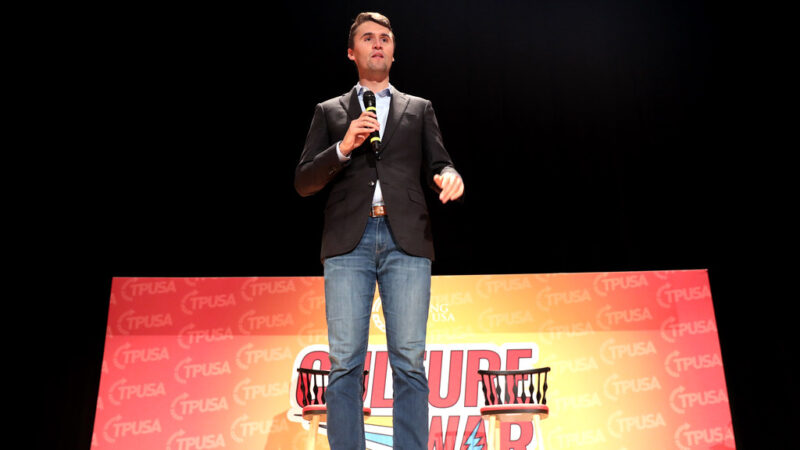
By The cold-blooded murder of Charlie Kirk on a university campus in Utah sparked a range of emotions. A 31-year-old father of two, whose life had been abruptly terminated by an assassin’s gunshot, was a devoted supporter of Donald Trump; some even say he had a significant role in Trump’s successful election campaign last year.
Until now, many writers and public figures across the Western world have expressed concern that this was yet another instance of political violence and anticipated that there would be other incidents in the future.
Nevertheless, the violence was condemned by prominent Democratic politicians, such as Joe Biden and Gavin Newsom; the MAGA world’s initial response was to assign responsibility to their political adversaries. Elon Musk denounced the left as “the party of murder.” Florida Republican Congresswoman Anna Paulina Luna shouted down Democrats on the US House floor: “Y’all caused this. You fucking own this.”
However, the most concerning statement arose from the Oval Office, where President Trump explicitly stated that the “radical left” was to blame. The American President declared, “For years, those on the radical left have compared wonderful Americans like Charlie to Nazis and the world’s worst mass murderers and criminals. This kind of rhetoric is directly responsible for the terrorism that we’re seeing in our country today, and it must stop right now.”
Political Violence Is More Legitimized on the Left
As the Hungarian online magazine Válasz Online noted, political violence is present on both sides of the political spectrum.
The far-left has created a cultural environment in which such actions are not only tolerable but also frequently explicitly celebrated.
The bearded young man who stood a few meters away from the dying victim, smiling and celebrating, at the Utah campus a few seconds after Kirk was shot, is the most emblematic figure of this phenomenon.
On various social media platforms, anonymous and named accounts belonging to far-left users published posts that expressed their satisfaction with Kirk’s death, referring to him as a reactionary and defending his execution.
The answer from the alt-right commentators to posting names of those who are celebrating Kirk’s death. A website called “Expose Charlie’s Murderers” invited users to submit links to people celebrating his murder. Three days after the shooting, the site had accumulated 30,000 submissions.
Unfortunately, acceptance of political violence is not limited to an immeasurably small group of dregs on the internet; polling shows a notable minority of Americans view it as acceptable.
In the past two years, there have been more instances of political violence from the left to the right than the other way around, a contrast to the situation two decades ago.
According to researchers, the internet has created “permission structures,” which are environments that were previously only present in marginal, extremist subcultures but now extend to a much broader segment of society. This has fostered an environment conducive to political violence.
Ten percent of American adults believe that physical violence should be employed to prevent Trump from regaining power, as indicated by the “Understanding Political Violence Survey” conducted by the University of Chicago.
In contrast, only 6.9 percent of respondents believed that the former president should be assisted in regaining power, even if it required the use of violence. In other words, the social support for violence against Trump was significantly greater than that for violence in his support.
In April, an additional survey revealed that over half of respondents who identified as left-of-center believed that it was somewhat acceptable to assassinate President Trump. Forty-eight percent of the same group expressed the same sentiment regarding Elon Musk, and nearly sixty percent concurred that it was somewhat acceptable to destroy Tesla car dealerships.
In contrast, a November 2017 YouGov poll found that only 8 percent of Democrats and Republicans said violence was “at least a little bit justified” when asked if it was justified to advance political objectives.
The most recent poll conducted by YouGov following Kirk’s murder revealed that 11 percent of respondents believed that violence can occasionally be justified in order to accomplish political objectives, while 72 percent believed that violence is never justified.
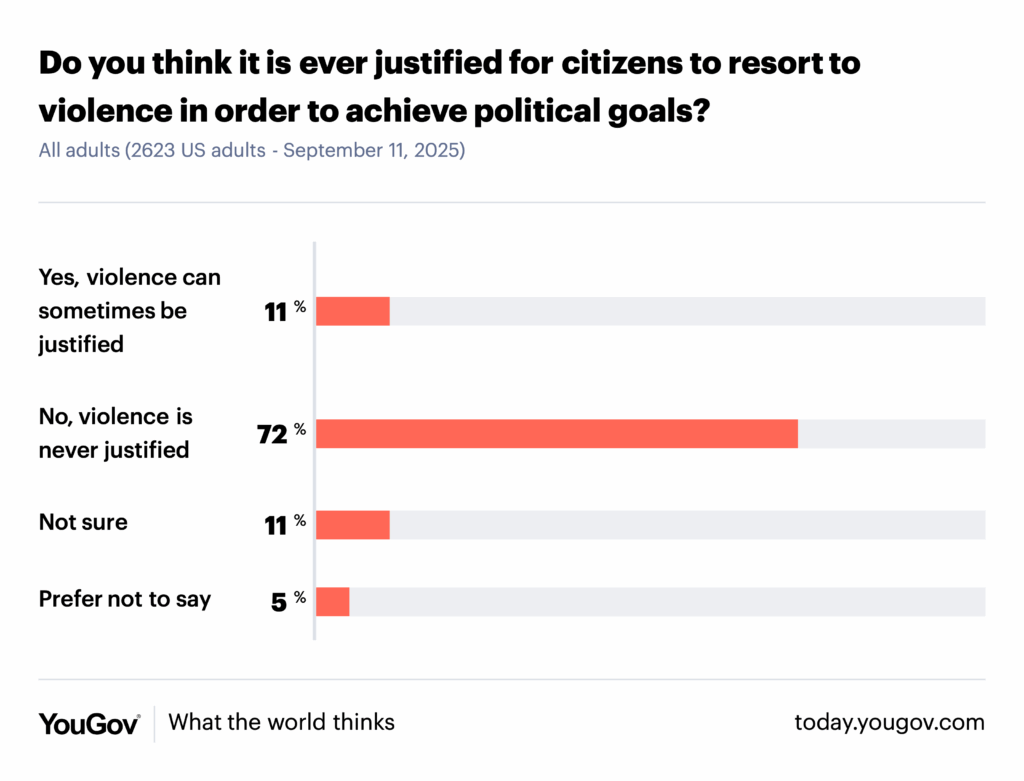
Source: today.yougov.com
Internet and Social Media Fueling Hatred
Since around the turn of the millennium, research has shown that political division in America is growing and is much greater than it was in the 20th century. The mass shootings at a synagogue in Pittsburgh in 2018 and a supermarket in Buffalo in 2022 were carried out by gunmen who expressed extreme right-wing views online.
On January 6, 2021, supporters of then-President Donald Trump rioted at the US Capitol and threatened to hang then-Vice President Mike Pence in an historic act of political violence incited and organized on social media platforms like Twitter (now X) and Facebook.
Just to mention the recent events, in July 2024, Donald Trump was nearly killed in the middle of a campaign rally by a lone gunman perched on a nearby rooftop. Then, a year ago, another attempt on Trump’s life at his Florida golf club.
“Violence targeting figures like Donald Trump or Elon Musk has gone beyond normalization—it’s being sanctified as resistance by parts of the political left,” noted Max Horder, researcher of the Network Contagion Research Institute (NCRI) in a Newsweek interview.
Luigi Mangioni Mangione, who is charged with shooting and killing UnitedHealthcare CEO Brian Thompson in a targeted attack last December, remains something of an enigma if we look at his political views, which are contradictory if not incoherent. He was the highly educated scion of a well-off Baltimore family who had no obvious problems with the capitalist system of which he benefited. Mangione wrote about his chronic back injury, but UnitedHealth never insured him. Now he became a sort of folk hero. For instance, a left-wing activist movement is embracing him and co-opting his image as a vigilante fighting against the perceived wrongs of the American healthcare system.
Kirk’s alleged shooter, Tyler James Robinson, is a 22-year-old from a small town in Utah near the Arizona border. We still don’t know much about Robinson’s motives. Still, the early analysis of the bullet that killed Charlie Kirk had an inscribed message, which suggests the perpetrator is someone who was deeply immersed in niche online meme and gaming cultures, where irony is often used to obscure ideological leanings. As the suspect was steeped in online culture, so was Charlie Kirk, whose rise to fame was also largely bolstered by being extremely online.
A New Civil War Emerging?
The ‘political tribes’ have long since become entrenched, and even within the Democratic and Republican parties, moderates who are seeking compromise and consensus have become insignificant. Trump has played a huge role in this on the Republican side. His affinity for menacing rhetoric doubtless has contributed to a coarsening of American political communication.
During the 2024 presidential campaign, Trump often referred to various phenomena like the “stolen election”, the “enemy within,” and made troubling comments like that he wants to be a dictator for a day.
Although he later denied or degraded his comments, he unnecessarily angered his followers and provoked his opposition. Violent rhetoric leads to direct violence, and social media posts glorifying these attacks threaten to normalize them. This kind of rhetoric helps violent people justify their actions.
On the other hand, Democrats—including the mainstream media, not just radicals—have long described Trump as a mortal threat to American democracy. There is a widespread belief among Democrats that Trump’s goal is to overthrow American democracy.
With tribes also comes tribal hatred. It is thought-provoking that one of last year’s biggest box office hits was Civil War, set in a dystopian America ravaged by civil war. The story depicts a war between the Western Alliance, led by Texas and California, rebelling against an authoritarian president serving his third term, and the central government. Reviews of the film also highlighted how the tension of the election year and the hysterical public mood are paving the way for political violence.
As Robert Pape, professor of political science at the University of Chicago, said, there are actual causes of what’s driving this violence. For the last three years, we have seen political assassination attempts on both the right and the left.
Pape also assessed Trump’s decision to deploy National Guard troops and US military forces to various American cities, which needlessly escalated tensions. On the other hand, he also condemned the strident language with which some of Trump’s opponents call for resistance. Like when Gavin Newsom, Governor of California, chose to say the US president “declared a war” on culture and knowledge, and “that is the time for all of us to stand up”.
Kristi Noem, the homeland security secretary, responded by arguing that the federal government was going to “liberate the city from the socialists and the burdensome leadership” of Mr. Newsom and Mayor Karen Bass of Los Angeles.
The professor urged bipartisan, forceful, and repeated condemnations of the violence, not “just a press release”. According to him, leaders from both parties must treat this as seriously as they do their campaigns.
“America’s political leaders need to cross their political divides and make joint statements (and ideally joint appearances) that denounce all political violence, welcome all peaceful protest. (…) Mr. Newsom and Mr. Trump, for instance, ought to make such a joint statement.”
The US was born in violence, fought a civil war less than a century after its founding, and in living memory seemed to be on the brink of another one – with a spate of assassinations in the 1960s that took the lives of Martin Luther King, Malcolm X, and John and Bobby Kennedy. That should provide some consolation, the knowledge that the country has been through this before and survived.