
 By
By What were Canada–US relations like before Donald Trump’s second presidency? How did the tariff war impact the personal ties between the two nations? How does the EU-Canada Security and Defence Partnership affect Canada’s role in the global defence landscape?
These are the main topics that we covered in an exclusive interview with Roger Hilton, a media presenter and research fellow at the Bratislava-based GLOBSEC think tank. Roger was born in Montreal, Canada. He is a 2016 graduate of the Diplomatic Academy of Vienna and holds a foreign policy certificate from the Moscow State Institute of International Relations (MGIMO). At GLOBSEC*, his research focuses on transatlantic and European defence with an emphasis on climate security, as well as the nexus between new technologies and conflict.
As someone born and raised in Canada who now lives in Europe, what are your thoughts on the foundations of US-Canadian relations?
I think it would be an understatement to say that the bilateral relations between the US and Canada are really going through arguably the largest transformation dynamic it’s ever had. We should mark this point of relations like the pre-Trump and post-Trump eras.
How do you distinguish these two eras?
Even with the first Trump administration, there were some tariffs on steel and some of the very important economic sectors, but it wasn’t this massive sort of, you would say, almost attack on the Canadian economy. This kind of bullying from Trump’s side was started before he even took office for his second term, remember? And when he had won the election, he was ultimately referring to the Canadian Prime Minister at the time, Justin Trudeau, as a governor of the 51st state. So, there’s this very distinct category now in the 21st century about sort of the relations pre-Trump and post-Trump, what it’s going to look like afterwards.

Roger Hilton
So, what did the relationship in the pre-Trump period look like?
I think if you look at the 20th century, it was built on some core strategic pillars, with a lot of it basically revolving after the Second World War. Then you had NATO, and NORAD (North American Aerospace Defense Command). These organisations are the best example of the most intimate bilateral defense relationship that any country has had with the US during the Cold War.
Any missiles that were going to come from the Soviet Union against the US would presumably come over the Arctic. Therefore, Canada played a huge role in the US defense. And there was the border security. So, the strategic and defense pillars were really a major part of the two countries’ cooperation.
In the post-Cold War era, Washington and Canada worked together on a lot of projects: for example, Canadian troops went to fight in Afghanistan.
Canada joined the NATO initiative to scale up the alliance’s presence in the Baltics. Last year, the NATO Multinational Brigade Latvia was stood up, with Canada as the lead nation, and Ottawa will send up to 2,200 troops by 2026.
One of the core issues, since the time of Ronald Reagan and Brian Mulroney (Canadian prime minister in the ’80s), is economic cooperation.
Before Trump, there had been a constant push, particularly among Republicans, to reduce barriers, integrate the economy, and limit tariffs and other trade obstacles. If you look at Detroit in Michigan and Windsor in Ontario, that area is sort of the heart of the auto sector.
I mentioned security and trade, and the third very strong pillar is innovation, working together, for instance, in the space industry, which is an emerging technology.
Tariffs and Their Impact
Could you give me an example of how the tariffs affected personal relations between the two nations?
Travel to the United States has decreased sharply. Earlier, Canadians from Eastern Canada went to Florida for vacation, and people from Western Canada went to Arizona and California. All of that is now on pause. Air Canada is diversifying its travel routes because people no longer want to visit the US. There are new options for Mexico and other places to visit.
Canadians are also boycotting American products. Jack Daniel’s whiskey has seen a sharp decline in sales, and Canadians aren’t buying it. They’re willing to pay more for non-American products.
I think you would agree, even though Hungary was behind the Iron Curtain, everybody still knew American pop culture “products”, like Levis Jeans and Michael Jackson. And no matter what, American culture has the most impact on Canada. We share the same language. People can visit Hollywood and go to New York. Culturally, as much as sports-wise, I think we share a lot. In the major sports leagues like the NHL, you have a lot of Canadians playing hockey in the US.
Finally, there are the people-to-people relations. Again, before Trump, when 9/11 happened, the US closed its airspace. There were all these stories about American flights having to land in random places in Canada. There’s one in particular, called Gander, a very small town in Newfoundland, where they landed. The people of this small town opened up their houses and offered their couches, which really exemplified people-to-people relations.
We were the luckiest country to live next to America, we had great economic opportunities, and we had continental security. These are all questionable right now.
Don’t forget that you share the world’s longest undefended border with the US.
Indeed, it’s not militarized in any way. Our shared border is much more secure compared to the US-Mexico border in terms of drug trafficking and human smuggling. That’s good.
How do you describe the relationship between the current Prime Minister, Mark Carney and Donald Trump?
Mark Carney, who had been perceived as an anti-Trump candidate, successfully won an electoral victory despite the poor polling performance of the Liberal Party.
There is an indication that Trump, while having a strained relationship with former Prime Minister Trudeau, harbors some respect for Carney, –who is a successful businessman, and the Central Bank governor in both Canada and the United Kingdom. – particularly values his financial expertise.
Many considered Carney an anti-Trump candidate —is that right?
Yes, he campaigned as the anti-Trump candidate, and even more so than Trudeau, as he was very blunt about what he said America wanted. He said the US wants to destroy Canada and to make us weak so that they can take over. So I mean, he painted a very terrifying picture. And then after he won, he doubled down on it.
During Carney’s interactions with Trump, there have been discussions about tariffs impacting trade relations, with the Canada-US-Mexico agreement preserving a majority of tariff-free trade. However, specific sectors, like automotive, have faced significant challenges.
Overall, the political climate reflects a complex dynamic influenced by business backgrounds and economic interests between America and Canada, especially concerning trade policies. So it at least seems that Carnegie has been able to have a working relationship with Trump.
Canada and the EU Relations: Good, but not that Important
Let’s move on to the EU-Canada relationship. The latest EU-Canada summit in June resulted in defense and economic collaboration. Analysts see Canada leaning more into partnerships with the EU to reduce dependence on the US.
Canada and the EU had always had good relations, but it was never such a big deal; whenever there was a Canada-EU summit, it didn’t get a lot of attention. It happened every two years; it is a more formal gathering. I think Europe has even had to recognize that Canada is a like-minded country, an ally with historical ties. However, Ottawa is not that powerhouse that the EU needs because it has the same population as Spain or Poland, more or less.
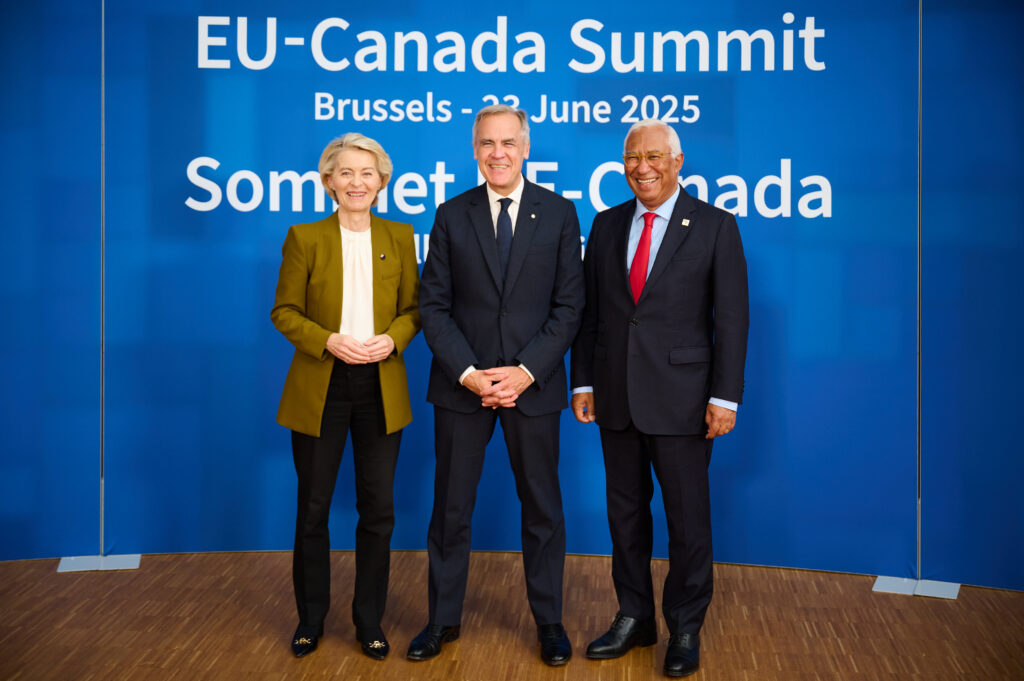
Ursula von der Leyen, Mark Carney and António Costa at the 20th EU-Canada summit. Photo: EC-Audiovisual Service/Dati Bendo
How does the new Security and Defence Pact with the EU affect Canada’s security industry?
When it comes to the security side, like energy, commodity security, and access to rare earths, I think Canada and Europe need each other a lot more than they recognize in this moment.
When Olaf Scholz was the Chancellor of Germany, he visited Canada. He had negotiated about the access to Canadian energy and to rare earth minerals.
On the defense side, Canada is now with the new NATO standards, and having to build up the capabilities, Canada is going to be one of the biggest customers over the next five to 10 years, maybe longer.
If Canada – which, for the most part, was buying UK and American military products – starts to buy all of the submarines from Europe, there’s a huge opportunity for the German and for the French industry.
So, I think, for the foreseeable future, the cooperation will materialise in innovation and the security field, such as drone technology. For instance, Canada is currently trying to scale up some of Ukraine’s drone technology industrially. So, I think a lot of the collaboration will be put into the security and defense armaments innovation.
I think Canada is looking to have technology transfer from its new defense relationship with South Korea or Europe. It’s controversial, but it’s important. When you’re reliant on one partner, it exposes you, as seen with Germany’s involvement in Nord Stream 2.
Where else can Europe and Canada cooperate?
I think Canada wants to be able to really defend itself, particularly in the Arctic. This is one area of the essential strategic cooperation with Finland, Sweden, and Norway. When the foreign and industry ministers from these Nordic states were in Canada, they signed a lot of bilateral agreements on security and intelligence trading.
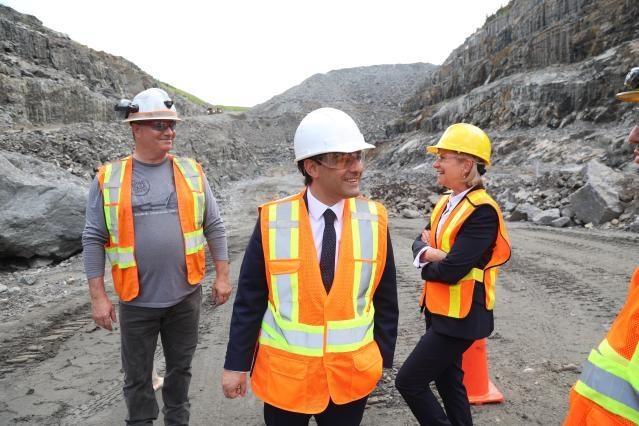
European Commission Executive Vice-President (EVP) Stéphane Séjourné, in charge of Industry Strategy tours Northern Graphite at Lac des Isles, Quebec. Photo: Dave Chan/
EC – Audiovisual Service
I think Canada realizes it’s not a game-changer, but there is an opportunity for them to ramp it up. And as you know, it is starved for access to rare minerals, and Canada has them. So there’s a natural geometry to increasing trade at that level.
The disinformation and hybrid tactics from Russia are problems that both Canada and the EU bloc are trying to address.
And of course, we are all tied together in Ukraine.
Both Canada and the EU support Kyiv materially and financially. They’re helping Ukrainian refugees with humanitarian aid, diplomatic support at the UN, and other venues.
Finally, tell me, why and how does Canada help Ukraine?
The Ukrainian Canadians put a lot of pressure on the Carney government; this is the domestic part. And if we look at Ottawa’s foreign security policy, it just makes sense to help Ukraine.
Canada gives both financial and military aid to Kyiv and trains Ukrainian soldiers in the UK. Canadians believe it would be far more expensive if this war were to spread to Europe. That’s why Canada really needs to be more involved, rather than writing a check.
*The opinions expressed are the interviewee’s personal views and not those of their employer or the institution they are affiliated with.