 By
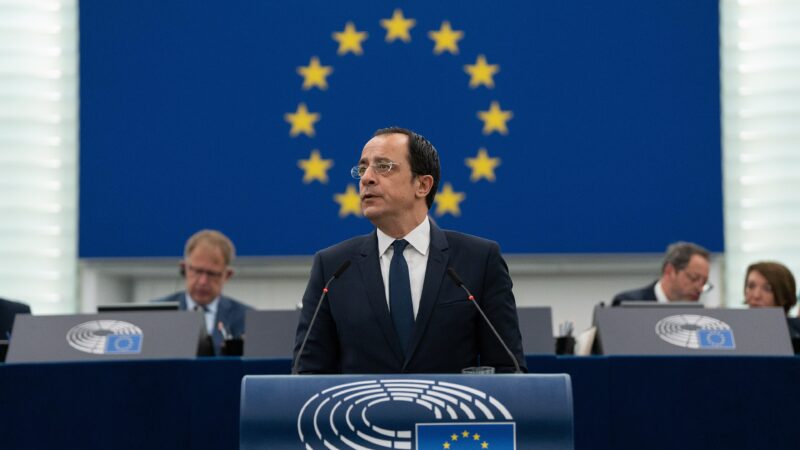
By Under the motto ‘An Autonomous Union – Open to the World,’ Cyprus took over the rotating presidency of the Council of the European Union on January 1, 2026. In the face of a changing geopolitical situation, the Mediterranean island aims to deepen European integration to increase the bloc’s autonomy.
“A more autonomous Union will demonstrate the necessary internal strength to cooperate with external partners whenever possible, while also acting independently, when necessary,” according to their program.
A country in such a strategic position knows what it is setting out to do: since their first presidency in 2012, the 2015 refugee crisis swept over the region and is now a regional issue. Security, meanwhile, was always a priority so close to the EU’s testy partner, Türkiye, and to the Black Sea.
As this small nation takes over leadership within the EU, its many disputes herald an opportunity: for further integration, deepening communication on migration, and improving the bloc’s external cooperation with North Africa.
A Short Geopolitical Snapshot
Cyprus has been divided between Türkiye and Greece since the 1974, when a Turkish invasion answered a Greek coup. In the southern two-thirds of the island, Greek Cypriots are running an internationally recognized government, while the remaining third has a Turkish Cypriot government. The Green Line, separating the two, is patrolled by UN peacekeepers.
Before this division, Cyprus was a part of the British Commonwealth with the UK still present with two military bases.
In 2004, Cyprus became a member of the EU, giving it the power to veto anything Turkey-related. Until 2022, Cyprus was a partner of Russia as a major financial hub for investment, making it a financial way into the EU as well as an important outpost in the Eastern Mediterranean.
The touchy peace between Greeks and Turks, Europe and the Middle East, and the EU and Turkey are all intertwined in this small island, playing a constant balance game on several levels of government and various issues.
As such, its presidency’s aims to broker major changes within the EU and its external relations are not as far-fetched as it first sounds. As President of the European Council Antonio Costa said in his speech the opening ceremony of the Cyprus Presidency: “Cyprus’ own history of occupation and division has given it a very concrete understanding of the crucial value of international law for peace and stability among nations.”
Defense and Security: Russia in Focus
Cyprus’ presidency program identifies Russia as the most immediate security threat: “intensified multidirectional hybrid attacks, the recent violations of EU airspace, coupled with the ongoing Russian aggression against Ukraine” are cited as the most major reasons to strengthen “defense readiness and strategic autonomy” and “reducing dependencies.”
Cyprus harbored amiable relations with Russia for years, becoming a major financial hub for Russian investment – but with EU membership, it became a financial way into the EU as well as an important outpost in the Eastern Mediterranean.
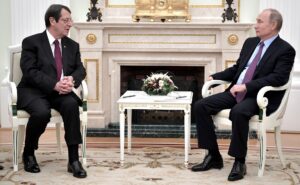
Nicos Anastasiades (then President of Cyprus) and Russian President Vladimir Putin, 2017. Photo: Press Office of the President of the Russian Federation / kremlin.ru / Wikimedia Commons, CC BY 4.0
Since Russia’s 2022 invasion in Ukraine, relations have soured between the two states: €1.2 billion in Russian assets have been frozen, with the Cypriot Deputy Minister for European Affairs, Marilena Raouna emphasizing that Cyprus has “completely turned the page” on Russian money.
Cyprus, being so near the entrance to the Black Sea, was forced to make a choice when the EU sanctions came into force: they chose to shift towards the West, sanctioning Russia, and chasing closer ties with the US.
The choice reflects that though the island is at the precipice of many cultures, it identifies above all as European, and will choose the bloc, even if it means economic loss and a security threat.
As the Cypriot Presidency began, a video began circulating on X showing two senior Cypriot government figures admitting corrupt practices has caused the resignation of Cypriot President Nicos Christodoulides’ chief of staff Charalambos Charalambous. Cyprus accused Russia of coordinating a “hybrid war” and called for assistance from the United States, Israel, the United Kingdom, and France.
Ukrainian President Volodymyr Zelenskyy, meanwhile, visited Christodoulides in the capital Nicosia to discuss strengthening sanctions and ensure Ukraine’s priority: to implement reforms necessary to join the EU.
Close Ties with Israel
Cyprus’ pull to the West did not mean they turned their backs on other partners: just days after assuming the EU presidency, Cyprus, Greece and Israel announced they would conduct joint military exercises. Though not an explicit alliance, the trio will cooperate “with a focus on energy, defense and security.”
For regional competitor Türkiye, this is yet another step towards destabilization as Cyprus and Greece have both turned towards Israel for advanced weaponry. Cyprus installed the Barak MX air defense system last September supplied by Israel. However, the weaponry is to replace the Russian equipment previously present on the island.
But the Turkish Foreign Ministry warned “the policies of the Greek Cypriot side undermine stability and peace in the region and risk triggering an arms race on the island.”
Despite its ties to Israel, the island swings both ways again: in 2024, the so-called ‘Amalthea’ corridor became an aid route to Gaza, with the backing of both Arab and Western states. President Christodoulides also proposed plans to use it as a reconstruction corridor.
The Presidency’s Program also explicitly states Cyprus hopes to advocate deeper cooperation and reinforce EU presence in the Middle East and the Gulf overall: the ceremony marking the beginning of Cypriot presidency was attended by both Saudi Deputy Minister of Foreign Affairs Waleed Elkhereiji, representing King Salman and Crown Prince Mohammed bin Salman, and Ahmed Aboul-Gheit, Secretary-General of the Arab League, suggesting Cyprus stands a chance to achieve this agenda as well.
The Leverage: Natural Gas Reserves
How can Cyprus swing across alliances? It’s not just its geographic position and multicultural heritage but also the gas reserves off its shores.
They have been the source of major maritime disputes, fueling the Greek-Turkish rivalry on the island. Maritime security is also an important part of Cyprus’ program for defense, promoting rapid implementation of the White Paper on European Defense and the Roadmap for Defense Preparedness by 2030.
A demarcation deal with Lebanon now suggests that Cyprus could start exploiting its natural gas with Lebanese Energy Minister Joseph Saddi adding his government has already asked the World Bank to conduct a “pre-feasibility study” on whether electric interconnectivity with Cyprus to alleviate Lebanese shortages.
Egypt’s Minister of Petroleum and Mineral Resources Karim Badawy also participated in Cyprus’ assumption ceremony, emphasizing the robust ties between the two states. Egypt has also been in discussion with Cyprus about the implementation of joint energy projects and even linking the gas fields to Egyptian facilities to re-export to Europe.
This is the biggest trump card Cyprus holds now. While European business benefits, both Middle Eastern and Northern African states can use the funds for their own developments.
While the feasibility of this is a while off, it is the leverage Cyprus needs to achieve other diplomatic goals on behalf of the whole bloc.
Migration: Where Cyprus Can Lead
Cyprus thus has a major political advantage over most other EU states for external relations. While they may not be the key to peace in Ukraine, they can assist Ukraine’s accession. Their fellowship with Israel gives them leverage not just in the politics around Gaza but also a way to influence the United States.
The biggest opportunity, however, lies south: its ties with the African Union and key North African states makes it a perfect broker of a better external migration system.
Human rights activists have protested to deals with North African states, for example, Libya, which is listed as responsible for 90% of irregular departures at the Central Mediterranean Route – the most frequented route in 2025. It has been accused of mishandling its migrant population at illegal detention facilities.
There have also been reports of major human rights abuse in Tunisia, Morocco, and Mauritania; all states where the EU funds detention and deportation efforts thus stands accused of complicity in horrible crimes.
Cyprus is well-placed to lead the bloc with the current set of political predicaments. Cypriot leadership has shown resolve and decisiveness in their recent turn towards the West, while maintaining good relations with the Southern Neighborhood. Their presidency is a chance for the EU to finalize its external migration agenda and perhaps even implement it.
Though member states have trouble agreeing to a strategy of how to deal with migration, the diplomatic push-and-pull has mostly focused on internal asylum procedures and the solidarity pool that would make it mandatory for states to take in a quota of migrants to alleviate pressure from border states, like Cyprus. External procedures have been far less controversial.
It is in the best interest of the EU as well, with a budget of 42 billion euros already set aside to roll out the Pact on Migration and Asylum between 2028 and 2034.
However, this will require careful balancing of defense concerns and the reform of the asylum and returns system. With Cyprus being such a small country, it is possible it will leave such matters to the Commission: but it should not pass up the opportunity to push the Council to deal with the migration question that is cleaving Europe apart from the inside.
A concentrated effort to implement the Pact on Migration and Asylum and bilateral deals with the most important transit states could better address the creation of return hubs and calm the storm that’s being created by far-right groups rising across the EU. It would lessen an internal political problem, address human rights concerns, and operationalize an external system years in the making.
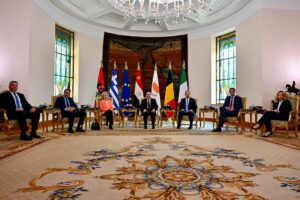
Karl Nehammer, Kyriakos Mitsotakis, Ursula von der Leyen, Abdel Fattah al-Sissi, Nikos Christodoulides, Alexander De Croo and Giorgia Meloni (from left to right) during von der Leyen’s visit to Cairo, Egypt, 2024. Photo: European Commission (Dati Bendo) / Wikimedia Commons, CC BY 4.0
Egypt is already entangled with Cypriot natural gas deals and the African Union is also a partner for the EU: through Cyprus, the bloc can reiterate its interest in the natural reserves Europe’s energy shift needs, push investments in poor regions to revitalize economies, and convince states who are already in cooperation with the EU over migration to adhere to EU procedures when utilizing EU funds in exchange for other investments.
While Cyprus is small, it doesn’t have to go at it alone: it only needs to set the agenda and push other EU states to decide swiftly and agree on an implantation strategy.
But in order to do so, it cannot lose its focus among the multitude of changing relations and deteriorating international order.