 By
By “The 28-point peace plan that the United States and Russia want to impose on Ukraine and Europe is misnamed. It is not a peace plan. It is a proposal that weakens Ukraine and divides America from Europe, preparing the way for a larger war in the future. In the meantime, it benefits unnamed Russian and American investors, at the expense of everyone else,” wrote Anne Applebaum, in her essay, just after the proposal surfaced. Since then, the fighting has continued, and no other counterproposal has been revealed.
Anton Bendarjevskiy, an expert on the post-Soviet region, sees the Trump peace plan as the only viable option, though it largely favors Russia due to battlefield and economic realities. Ukraine’s position has weakened, and Russia has shown resilience against sanctions. Both sides may claim victory, but the plan’s effectiveness depends on clear guarantees and unified Western backing. The recent scandals involving Zelensky’s advisers are seen as domestic issues, not directly influenced by US pressure. The Ukrainian anti-corruption agency (NABU) is actively investigating, affecting morale and leadership.
Trump’s Plan for Peace and Security Guarantees
According to him, Trump’s peace plan is currently the only viable option, though it favors Russia due to battlefield and economic realities.
I think this is the only workable plan at the moment, although it is true that it favors the Russians in many ways. Unfortunately, the situation has become worse for Ukraine in recent times, and Russia has proven to be sanction-resistant. As much as it hurts to say this, the economic sanctions have had less impact on the Russian economy; at least they have not had the kind of effect that would have plunged them into crisis.
Trump’s transactional approach has led Russia to consider negotiations, but without an alternative strategy, Ukraine’s position may deteriorate further in the coming months.
In response to our suggestion that the latest threat of embargoes on oil trading brought the Russians to the negotiating table, Bendarjevskiy said this clearly shows the politics Trump represents in ending the war. And here you can clearly see the hand of Keith Kellogg. He was the one who worked out his plan for Trump’s presidential campaign back in 2024 to end the Russian-Ukrainian war.
Kellogg’s commitment to Ukraine, although I would add in parentheses that when he was appointed by Trump as special envoy at the beginning of 2025, there was criticism of his person, that he wrote this plan, and what kind of pressure they want to put Ukraine under, and that he may not even be a good person. And now, in retrospect, we say what a great friend of Ukraine he was. This accusation probably made Kellogg’s position in the negotiations with Russia impossible, as he is considered too pro-Ukrainian for Russia.
Bendarjevskiy stressed that about 70 percent of the US proposal benefits Russia, and they are unlikely to accept less. European intervention has only complicated matters, the Russians can say that the West is divided and can’t offer a unified proposal.
“The kind of expectation that Russia would run out of missiles or battlefield equipment was basically not confirmed either, which was primarily due to the change in the course of the war. So the warfare by drones has allowed the Russians to rely primarily on drones, and they have been able to produce an increasing amount of that,” added the expert.
The central points of the plan reflect long-standing Russian territorial demands. The United States would recognize Russian rule over several Ukrainian regions, or oblasts: Crimea, Donetsk, and Luhansk, and Russia would, in practice, be allowed to keep territory it has conquered in Zaporizhzhia and Kherson.
Ukraine would withdraw from the part of Donetsk that it still controls—a heavily reinforced and mined territory whose loss would open up central Ukraine to a future attack.
Bendarjevskiy also highlighted the territorial issue, which matters most to Vladimir Putin because it is the only thing he can sell as a victory. Once the killing is over, Putin will also have to reckon with the economic damage caused by the Russian aggression.
Although he added:
The Russians started from the premise that they want to acquire the entirety of the four Ukrainian regions, and this has been the declared goal since June 2024. At the moment, the reality is the acquisition of two oblasts – Luhansk and Donetsk. But I have to emphasize this the bare minimum; Putin won’t settle for anything less.
The other key condition of this proposal is the security guarantees provided to Ukraine.
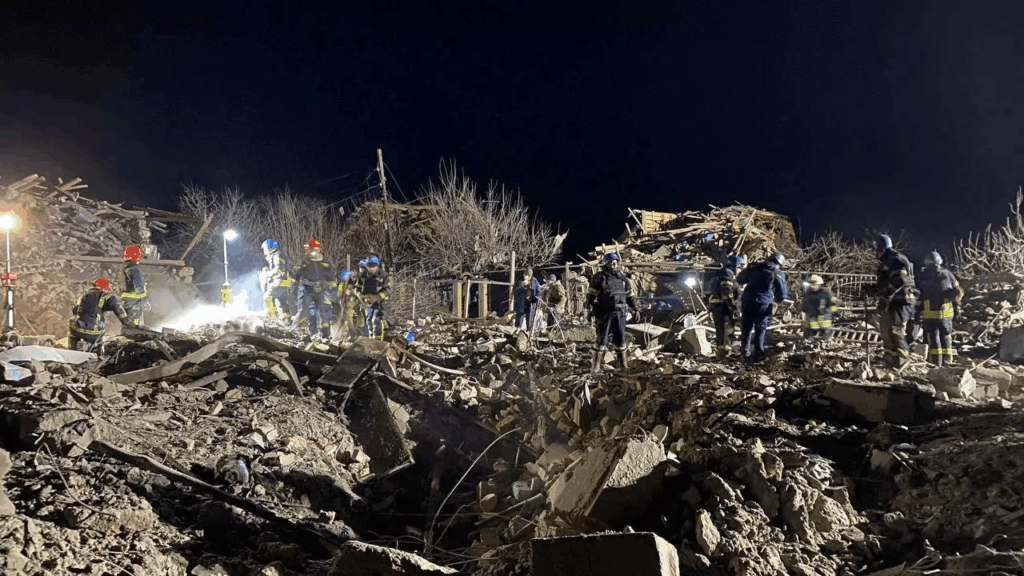
Destructions in Pokrovsk Raion after missile strike, 2024-01-06. Photo: State Emergency Service of Ukraine / Wikimedia Commons / CC BY 4.0
So far, even during the Joe Biden presidency, the United States has completely refused to give any military guarantees to Ukraine. Now, this twenty-eight-point plan at least mentions it in the fifth point: “Ukraine will receive reliable security guarantees,” the document reads.
“Although it is not exactly detailed what kind of security guarantees these would be. Obviously, from a Ukrainian point of view, this must be well defined, because it contained formulas like would defend Ukraine in the event of a major external attack. But what do we call a great attack? What do we call an external attack?” – asks Anton Bendarjevskiy.
Valerii Zaluzhnyi, the former Commander-in-Chief of the Armed Forces of Ukraine and currently Kyiv’s ambassador to the UK, wrote a study on potential security guarantees.
The strongest option, Zaluzhnyi argues, would be a nuclear guarantee, because nuclear arms deployment serves as deterrence. Bendarjevszkij stresses this is politically improbable: Russia would resist it, and Western governments could oppose it as well.
A second option would be NATO membership in the Zaluzhnyi plan, but the expert argues that it stopped being a realistic prospect years ago. “The last moment it appeared genuinely on the table was 2008; since then, the issue has largely disappeared from the agenda, while Russia has grown stronger.”
The third option – sending international peacekeepers – still seems conceivable, but he describes a glaring gap between requirements and willingness. Estimates range from 85,000 to 100,000 troops, yet concrete commitments are scarce. Britain is the only one that has made any serious offer, possibly 10,000–15,000 personnel, while other European pledges remain rhetorical when specifics are demanded.
The quasi-fourth model, which is in the “28 points plan,” shifts the guarantee away from NATO as an institution and toward the United States directly: a quasi-NATO commitment anchored in US power.
Bendarjevszkij likens it to the U.S. security concept underpinning Japan and South Korea—where an attack is treated as a direct American concern. This version would avoid stationing troops inside Ukraine but instead expand U.S. military presence in Poland, including reinforced Air Force units, to enable rapid response.
Finally, he describes the weakest option as “Israeli-type” guarantees: no formal promise of intervention, but extremely close support—Europe financing Ukraine’s resilience, and the United States supplying advanced weapons, technology, and large quantities of modern systems. The aim would be deterrence by capability. Yet he suggests Ukraine is likely to demand more than that.
“The rest are symbolic questions, I think. Such is the limitation of military forces, which, of course, is a question of sovereignty, because an aggressor is now quasi-telling a sovereign, independent country how large its forces should be. Russia wanted to limit it to 80,000 people back in 2022. Well, that would have been unacceptable. In addition to the original Russian demand, they also wanted to limit the number of different branches of arms, artillery, and air force.”
Ukraine’s Corruption Case can Bring Down the Leadership
The recent corruption cases reach the top leadership, i.e., President Volodimir Zelensky’s right-hand man, Andriy Yermak, and long-time business partner, Timur Mindich. Many consider it to be pressure from the Americans. It should be taken into account that the Ukrainian Anti-Corruption Agency (NABU) works in connection with the FBI; at least, the latter could definitely help NABU with information.
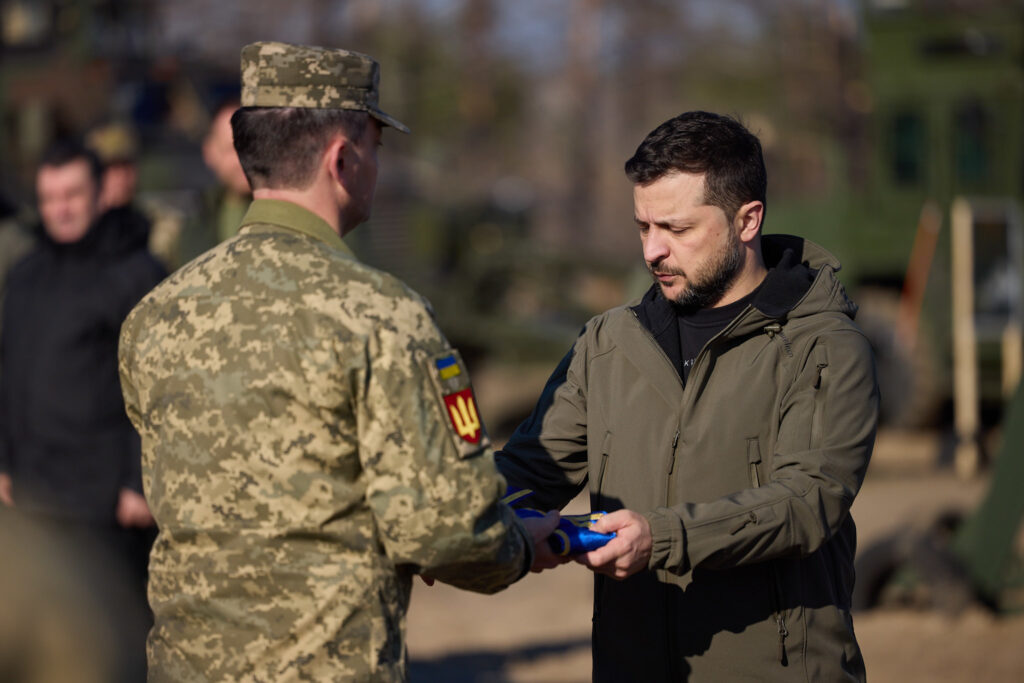
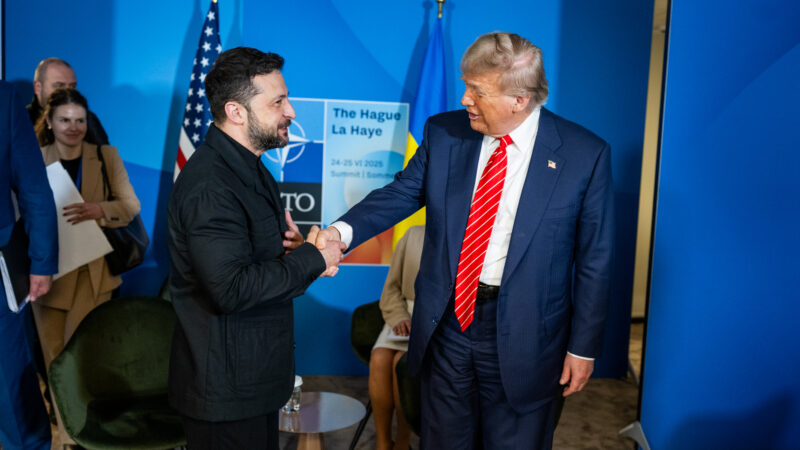
“On the occasion of the Day of Missile Forces and Artillery and the Engineering Troops Day, Volodymyr Zelenskyy presents state awards to Ukraine’s defenders.” by President of Ukraine, Public Domain Dedication (CC0).
Bendarjevskiy has a different opinion: “I think this is a Ukrainian domestic political issue. NABU started the investigation two years ago. During this summer, it became clear to the Ukrainian leadership that such investigations were going on here and that people could be involved at a very high level. To prevent the publication of this investigation that compromised Ukraine’s top leadership, Yermak took the NABU into his personal treatment, and they also tried to subordinate the NABU to the presidential administration.”
As a result, according to the expert, after this failed attempt, the NABU targeted Yermak, and they tried in every possible way to avenge him. This is obviously not unrelated to the fact that Yermak has many enemies in Ukrainian domestic politics anyway, because in recent years he has concentrated so much power around the presidential administration.