 By
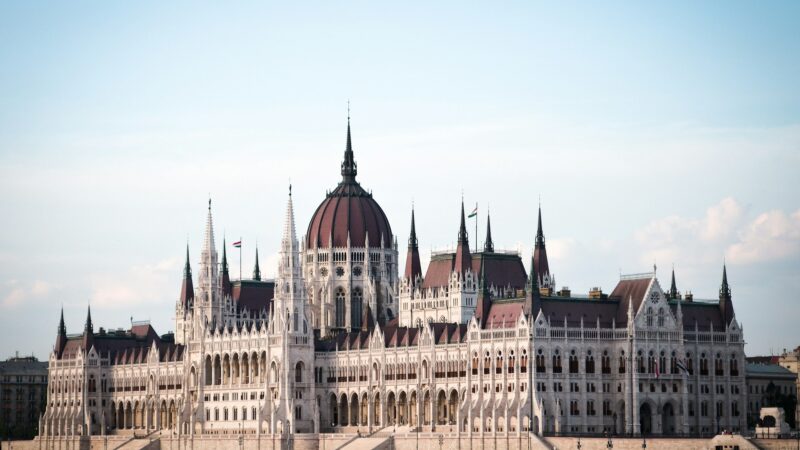
By The Hungarian elections on 12 April are expected to be a fierce battle for incumbent Prime Minister Viktor Orban, going up against Peter Magyar’s Tisza Party, which has been leading in polls for months.
The potential of a new leader in Hungary entices the international community, for whom Orban has become the primary example of a successful illiberal leader.
A strange duality emerged: US President Donald Trump has endorsed Orban, saying, “I hope he wins big,” while Russian foreign intelligence is already reported to have intervened on Orban’s behalf.
The contradiction calls for a closer look at Hungary’s international standing and at how the potential change of government could impact international relations.
The US: Losing a Leader of Ideology
The US has long viewed Orban as a right-wing inspiration towards successful conservative governance, with MAGA strategist Steve Bannon calling him a “hero to the nationalist movement in the West” for acting to destroy the “globalist evil.”
“We want this country to do well,” said Secretary of State Marco Rubio at a news conference with Orban by his side. “President Trump is deeply committed to your success, because your success is our success.” Vice President J.D. Vance shared similar sentiments when he was only a senator, saying the U.S. “could learn from” some decisions made by Orban.
If Orban lost the upcoming election, it would not only mean an end to his leadership but also the defeat of an ideology, a party, and the right-wing agenda in an election designed to benefit the incumbent government. The US, and many other right-wing politicians around the globe, would lose their go-to example for a longstanding representative.
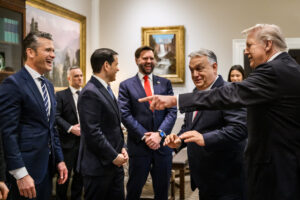
Hungarian Prime Minister Viktor Orban greets Vice President JD Vance and members of the U.S. delegation in the West Wing Lobby of the White House, Friday, November 7, 2025. Photo source: Official White House Photo / Mollly Riley / Flickr, United States Government Work.
“For MAGA, the two most important elections this year are those in Hungary and the midterms in the United States,” according to Timothy Ash of Britain’s Chatham House. This is because Magyar, despite being an ex-Fidesz member and a conservative himself, is not the right-wing conservative Trump’s rhetoric needs as his anti-corruption campaign’s main promise is to dismantle Orban’s regime, which the US President has been replicating.
“Hungary is this kind of proof of concept that the MAGA kind of politics can work,” Kim Lane Scheppele, a professor of sociology and international affairs at Princeton University, said. “If Orban loses, then it loses some of that luster.”
Orban’s loss would mean a blow to Trump’s pride and, more importantly, the loss of his primary ally within the EU. Despite the stakes, the US is not likely to intervene beyond rhetoric as Trump’s Middle East War has taken up most of the President’s focus, while his own popularity wanes at home.
“A lot of the dust that’s been thrown in the air with respect to Hungary and its relationship with the European Union will settle down after the election,” US Ambassador to the EU Andrew Puzder told Politico. As such, the US is more likely to act once the results are in.
Russia: Losing an Insider Ally
For Russia, Hungary is a key ally; as a NATO and EU member, it is a strategic point of contact with organizations otherwise hawkish toward Russian officials. This relationship was more clandestine at first but by the mid-2010s the change in attitudes was clear.
In 2025, an investigation by Hungarian investigative outlet Direkt36 and several Belgian and German partners uncovered information suggesting that intelligence ties were also strengthening between Russia and Hungary in 2014-2015, with Belgian sources saying Hungarian intelligence officers were referred to as “matryoshka dolls” whose reports were treated “with healthy skepticism” despite there being no evidence Hungarians handed information over to the Russians.
Several recent scandals show that the Moscow-Budapest line has strengthened greatly since, becoming essential for Russian intelligence.
One European security official told the Washington Post that Hungarian Foreign Minister Péter Szijjarto regularly called Russian Foreign Minister Sergei Lavrov during breaks at EU meetings, adding that these calls ensured “every single E.U. meeting for years has basically had Moscow behind the table.” Since the Russo–Ukrainian war began, he also made 16 official visits to Moscow. Orban himself visited four times, despite strong EU opposition.
Such a relationship is precious for Russian President Vladimir Putin’s regime: in an internal report obtained by the Washington Post, Russian foreign intelligence service officers suggested a “gamechanger” strategy, which would involve “the staging of an assassination attempt on Viktor Orban” to “shift the perception of the campaign out of the rational realm of socioeconomic questions into an emotional one.”
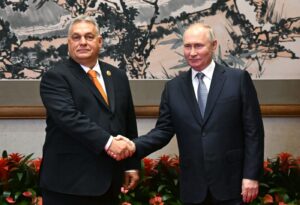
Hungarian PM Viktor Orban and Russian President Vladimir Putin in 2023. Photo source: Grigory Sysoev / Wikimedia Commons, CC BY-SA 3.0
Disinformation campaigns, a characteristic of Russia’s hybrid war tactics, are also afoot in Hungarian media, depicting Orbán as a “strong leader with global friends” and Magyar as a “Brussels puppet with no outside support.” According to the Financial Times, the Social Design Agency, a Kremlin-linked media consultancy, is responsible for the campaign attempting to influence Hungarians.
A fake Euronews lookalike website also surfaced in late March, with articles claiming that Magyar insulted Donald Trump and promised to undo all “key agreements” made with the US. Researchers have linked the campaign to Storm-1516, a Russian disinformation operation.
A team of three propaganda specialists have also been dispatched to the Russian embassy in Budapest to influence public opinions, as reported by the Hungarian investigative outlet VSquare. Sources said the three Russian military intelligence-affiliated men are already in the Hungarian capital.
The abundance of accusations combined with the Fidesz government’s Russia-friendly attitude warrantsthe assumption that Russia is ready to protect its most important European intelligence bastion by interfering.
According to their response to Euronews, the Hungarian Foreign Ministry officially considers keeping third-country parties informed “standard practice,” with Szijjarto saying that he not only keeps close contact with the Russian foreign minister but “also with the U.S., the Turkish, the Israeli, the Serbian ones,” adding “That’s what diplomacy is about.”
The EU is now limiting confidential information shared with Hungary, and its leaders are meeting in smaller groups. An official response has been delayed until after the election, with one diplomat telling Politico that any EU action would play into Orban’s hands, adding fuel to his anti-EU-focused campaign.
Inside Hungary: International Aspirations or Hungarian Problems?
Interference in elections is not only calling into question the sovereignty of a state but also its very foundations of democracy. In each state where interference happened, trust in public institutions and the fabric of democracy declined.
But in Hungary’s case, any foreign interference will end up benefitting Orban’s campaign.
During the 2022 elections, Fidesz went up against a six-party coalition. In that campaign, Orban focused on their foreign funding, alleging that then-US-President Joe Biden was influencing Hungarian elections by funding media organizations and NGOs. It prompted the creation of the Sovereignty Protection Office, which was tasked with maintaining a list of foreign-funded legal entities in Hungary, since they were viewed to be a threat to national sovereignty.
As such, the new opposition, Tisza, is especially cautious about its foreign policy standing, recognizing that this highly politicized area alienated many voters. Orban attempts to divert focus from a failing economy and issues in state-funded hospitals and schools to his international influence in an effort to maintain his “stable choice” image. But with Tisza leading the polls, Hungarians seem more interested in tackling domestic corruption, restoring Hungary’s standing as a trusted EU ally, and addressing issues like the cost of living.
As the campaign reaches its end, it seems that Russia has a vested interest in interference, while others – allies or foes to Orban – wait out the elections, leaving Hungarians in a tight spot.
Where Does that Leave Hungary?
Average Hungarians are stuck in an international powerplay, their only option being an uphill struggle against the country’s complicated (“free but not fair”) election system and a polarized political landscape. Whether Orban wins or loses, Hungary is unlikely to lose the international significance highlighted by this election campaign.
Some analysts have suggested the possibility of Orban refusing to give up power at all, even if he is defeated in the election. The European Policy Centre thinktank called such a possibility “an unprecedented situation” for the EU, where they are forced to deal with “an illegal and illegitimate government sitting at the table.”
In any case, a potential Tisza government would find it difficult to act, being surrounded by Orban-supporting structures and public officials, meaning that even if Orban loses, change will take time and coordinated efforts.
Whatever occurs, the coming elections are being watched by international actors as much as Hungarians; its outcome will not only decide Hungary’s future as a state but also its place in the European Union – and could begin a new chapter of volatile changes in global alliances.