 By
By Iceland has very close relations with the European Union. However, amid global unpredictability, this relationship may become even closer now that the government has promised a membership referendum within the next two years.
Half in, Half out
A few months ago, Iceland’s Prime Minister, Kristún Frostadóttir, stressed in an interview with Euronews that Iceland had a longstanding and positive relationship with the EU. The country has always upheld its responsibilities within the European Economic Area (EEA). This continued partnership is vital to Iceland’s economic stability and future, she added.
Iceland applied to join the European Union on 16 July 2009, and formal negotiations began on 27 July 2010. However, on September 13, 2013, the Icelandic government dissolved its accession team and suspended its application to join the EU.
On March 12, 2015, Iceland’s Foreign Minister, Gunnar Bragi Sveinsson, revealed that he had written a letter to the EU withdrawing the application for membership without the permission of the Icelandic parliament, the Althing. Thus, the European Union claimed that Iceland had not formally withdrawn its application.
However, in 1992 Iceland signed the EEA Agreement. The major goal of the Agreement is to expand the EU’s internal market while ensuring that the four freedoms (goods, labour, capital, and services) apply to its economy. Iceland follows the EU’s internal market regulations.
Iceland has also elected to participate in EU climate laws and is a member of the Schengen Area. However, several components of the EU are not covered by the EEA Agreement, such as the EU’s common customs and trade policy and its common agricultural and fisheries policy.
Referendum on EU Accession in 2027
Iceland’s pro-EU coalition government has promised a referendum to reopen EU admission talks by 2027. According to a study conducted earlier this year, 58 percent of Icelanders support holding a referendum on whether to resume accession talks—but support for EU membership is lower, with only 45 percent in favor, 35 percent opposing, and 20 percent uncertain.
If the majority votes ‘yes’ in such a referendum, discussions may begin. However, this does not guarantee that the membership bid will be successful; the final choice will most likely be made in a subsequent vote when negotiations are completed.
In June another opinion poll from Maksína found just over 54 percent of respondents were in favour of joining the bloc, with the majority saying they thought households would be financially better off as part of the EU.
The fishing sector, a significant economic and political force, has been an outspoken opponent, claiming that membership would result in a loss of control over Iceland’s fishing waters. For example, between 1958 until 1976, Icelanders fought the Cod Wars with the United Kingdom for exclusive fishing rights within a 200-mile economic zone.
Russia’s invasion of Ukraine on 24 February 2022 and the consequences of a trade war between its two largest trading partners, the EU and the US, on top of pressure from the U.S. to bolster defense and Washington’s threats to annex Greenland—seem to largely influence the Icelandic population’s decision.
As Prime Minister Frostadóttir doubled down in her recent interview, “Before 2027, we want to see if the nation wants to reopen these (accession) negotiations. And I’m sure the current geopolitical situation will affect it.”
Until recently, the question of whether to join the EU has only been an economic one; now it also reflects the Icelanders’ concerns about national security and common values.
A Country Without an Army
Iceland, as the only NATO member without an army but with a strategically significant location in the North Atlantic, holds a unique position in the alliance, particularly since the US President recently pressed the members of the alliance to increase their military spending.
Although the island nation doesn’t have a military, “that doesn’t mean we don’t have strong defences and a role to play in NATO,” Frostadóttir stressed in May.
Iceland needs to have “skin in the game” when it comes to defence and security in the High North and is looking at how to adjust its defence posture and spending accordingly,
said the country’s prime minister.
According to the country’s latest defense strategy, Iceland is boosting its defense capabilities within its current budget. This involves improving cooperation between civilian institutions, enhancing monitoring and response, and acquiring specialized equipment. Key actions include setting up a coordination structure within the Ministry for Foreign Affairs, working with the police and coast guard. They’ll also deploy an unmanned submarine for surveillance, enhance cyberattack monitoring, improve secure communications, and purchase anti-drone equipment.
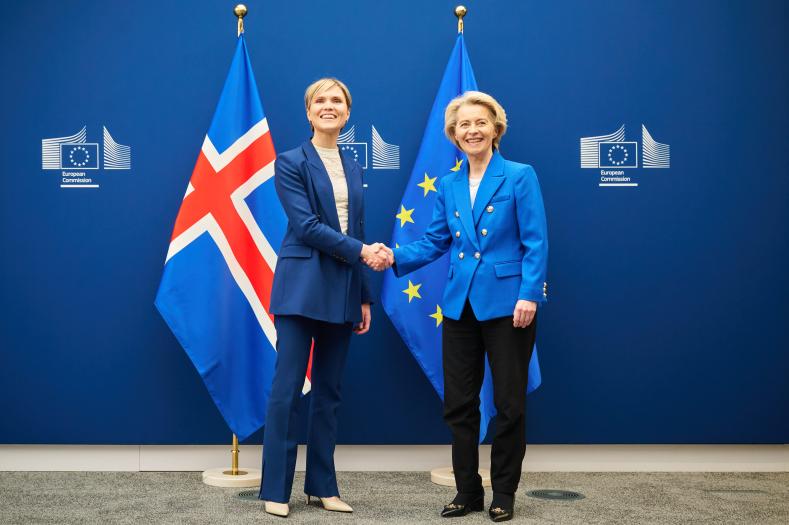
Kristrún Frostadóttir and Ursula von der Leyen Source: eeas.europa.eu
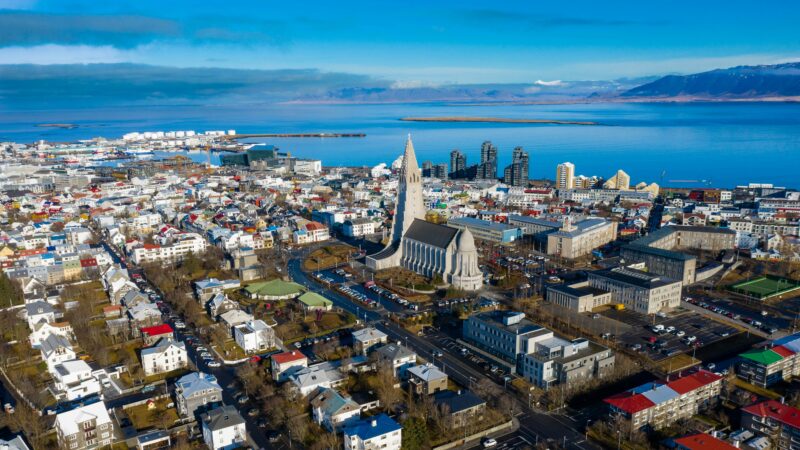
In a recent visit to Reykjavík, EU Commission President Ursula Von der Leyen and Iceland’s Prime Minister Frostadóttir initiated security and defense partnership talks.
The visit focused on hybrid threats, telecommunications resilience (undersea cable security), civil protection, and NATO-aligned Arctic security. The leaders talked about improving coordination in Arctic affairs, maritime security, infrastructure resilience, and Iceland’s possible participation in EU defense programs.
“This declaration will increase the visibility of the cooperation and underline that Iceland is among the EU’s closest partners in the field of security and defence,” Fostadóttir noted.
“There are already eight allied countries, including Norway, the United Kingdom and Canada. With this agreement, you will gain access to our SAFE project, which invests around €150 billion per year in security and defence,” von der Leyen highlighted.
The EU and Icelandic leaders also discussed Iceland’s participation in the EU’s secure satellite communications plan, which the island nation is lobbying for in order to lessen its reliance on the fragile undersea cables that provide worldwide access.
The discussions included increased trade engagement and a review of the EU’s Arctic strategy, with goals to expand environmental and regional cooperation beyond 2030.
“When it comes to the Arctic, we need to stand up. This is our area. Kristrún Frostadóttir stated in Brussels, “We need to have skin in the game when it comes to the Arctic, not that it is being run by others.”
“Russia’s aggression against Ukraine is vital to us, even though it is far away, because if they win on the eastern flank, they may shift their focus to the north, where we live. “So this is also our fight,” she said.
Russia and China have boosted their presence along the Northern Sea Route (NSR), a shipping path in the Arctic Ocean that connects the Atlantic and Pacific Oceans. This is due to rising temperatures, which make the route more doable over time, and China’s growing thirst for Russian commodities, notably fossil fuels.
Denmark, an EU and NATO member state, declared shortly after Trump’s return to the White House that it will invest €1.95 billion to strengthen its military posture in the Arctic and North Atlantic.
Iceland, along with Norway and the United Kingdom, two other NATO members, are currently utilizing AI to identify hostile activity in the Arctic.