
 By
By Before the launch of the iPhone 17 smartphone models, Apple announced moving production from China to India for iPhones bound for the US; all models of the new generations are to be Made in India, marking a major win for Indian PM Narendra Modi’s economic agenda.
While this marks a significant change prompted by U.S. President Donald Trump’s tariffs, it was not the sole reason behind the decision; iPhone had begun moving towards India as a manufacturer and a market for the last decade.
iPhone Moves Away from China
China accounts for about 80 percent of Apple production: 90 percent of iPhonesifically are assembled in the country with parts arriving from all over the world. Apple’s biggest assembly partners, Taiwanese Foxconn, which alone produces smartphones worth $1.3 billion, and Indian Tata have many factories here including Foxconn’s largest in the world. Before the tariffs were announced the two broke its records by shipping iPhones worth $2 billion to the U.S. in March.
China has been a go-to manufacturing market for electronics due to its massive cheap but highly skilled workforce and favorable shipping conditions. Investment continued despite the backdrop of political conflicts, providing China with a continuous bargaining chip on the global stage.
Politics overrode the markets during Trump’s first presidency and trade war against China. Later, another global phenomenon, one outside Apple’s control dampened profits. COVID-19 brought Chinese production to a complete halt as authorities introduced severe measures to deal with the outbreak. Many international restrictions also focused on China as the source of the virus.
While production soon recovered, it revealed a major weakness in Apple supply chain: most of Apple’s global manufacturing was concentrated in China.
If China falters, as it did during Covid, Apple falters. Overreliance on one state, which was expected to continue a rocky relationship with the US under the second Trump administration, would mean an all-or-nothing tactic impacting global revenues, hence Apple de-risking its global supply chain with the move.
Why India?
India’s Modi government has purposefully played into Western companies’ changing of tactics since the pandemic: the China Plus One strategy seeks to diversify manufacturing sites in an effort to avoid a pandemic-like fallout in production. Moreover, India’s economy is on the rise, recently surpassing Japan’s, and on the way to overcome Germany; which would mean becoming the third largest economy in the world.
India has the same pull factors as China, with a massive, expanding workforce of the largest population in the world, reduced corporate and import taxes, and a hunger for export-driven growth. The government giving out subsidies as production linked incentive (PLI) and beginning the Made in India campaign to promote inhouse manufacturing also favor giants like Apple to move in.
However, it is now also emerging as a massive market with a rising middle class who are looking to buy iPhones, while the Chinese market has slowly begun to push out iPhone in favor of domestic brands like Huawei and Xiaomi, despite its massive market potential.
Other countries provide less favorable conditions. Making iPhones in the US has been long-established to be expensive, analysts predicting a 25 percent increase on labor costs alone, estimating the final price to be at about $3500 instead of the current $1199. This cost is far more than in any other Asian location and so, manufacturing remains out of state.
Vietnam is the most likely candidate to snatch the win of the China Plus One race away from India, due to its more predictable domestic political climate. While it lacks the market opportunity and the scale of workforce India contends with, it is still expected to play a significant role in Apple’s diversification of manufacturing sites.
The diversification process could also involve Thailand and Malaysia, according to analysts.
China vs. India: An Evolving Rivalry
Due to the long-standing border dispute between the two countries, diplomatic relations have been scarce. Recently, they began warming relations, bonding over the shared burden of Trump’s tariffs, reinforcing Modi’s domestic standing as a respected statesman after Trump’s policies rattled his ratings.
China and India frequently find themselves agreeing on issues despite their differences, especially when it comes to the West-focused or US-led world order, as demonstrated during the Shanghai Cooperation Organisation (SCO) summit with Russia. The US remains skeptical of China and wary of their political influence, while India remains on their radar for its ties to Russia.
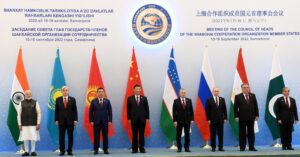
Leaders attends the 22nd Meeting of the of the Shanghai Cooperation Organization (SCO), in Samarkand, Uzbekistan on September 16, 2022.
Source: Wikipedia
However, China is a necessary partner before India can seize the opportunities it is being presented with. After the US, China is India’s largest trade partner and China is one of the biggest suppliers of components, machinery, and technical personnel to India.
If India is to become the next China, it needs Chinese personnel to train Indian workforce to become as highly skilled and efficient as the Chinese are. Recognizing this to be the dealbreaker, Chinese companies have already moved to switch heads of India operations to Chinese nationals despite preferring locals for these jobs in the past.
Other aspects, like setting up machinery, are also China-focused, requiring Chinese language skills, facilitating the need for Chinese workers to train those in India. Chinese managers have also been critical of companies moving to India.
While on the diplomatic scene, the two remain allied against Trump’s fist, in practice, relations continue to be icy amid constant tension both in politics and economically. Apple’s move to diversify its manufacturing and avoid the brunt of Trump’s taxes works for the company’s benefit but it also heralds a new tendency for other tech giants to follow, deepening the rivalry.
The release of the new iPhone 17 is a test for a new model of business, which could start India’s rise to a manufacturing hub as well as a world-leading political force that rivals China and the U.S. alike.