
 By
By How does hybrid warfare differ from conventional warfare? What moral and legal dilemmas does the weaponization of migration raise? How does weaponized migration fit into Russia’s geopolitical strategy? And how can we as Europeans respond to this new form of warfare?
To address these questions, we interviewed Dr. Csongor Balázs Veress, University Senior Lecturer and Associate Researcher at the Hungarian Institute of International Affairs, who recently published his book, “Migration as a Weapon.” In his work, Veress examines how political actors can exploit large-scale population movements to achieve political and military objectives.
Hybrid Warfare, a Method of Undermining Public Trust
What is hybrid warfare, and how does it differ from conventional warfare?
Hybrid warfare is one of the dominant forms of conflict in the 21st century, operating in the “grey zone” between war and peace. Its essence is the coordinated, synchronized use of various means – military, economic, political, informational, and civilian – to destabilize the enemy.
While traditional war in the (Clausewitzian) sense is characterized by an open, declared clash between armed forces and the intention to gain territory, hybrid warfare often aims to paralyze the adversary’s decision-making ability, undermine its social cohesion and break its will— while keeping it below the threshold of open armed aggression. The sophistication of the strategy lies in the fact that the attacker often uses methods that can be “denied”. These can include supporting non-state actors (proxies), cyber attacks, exerting economic pressure or even propaganda campaigns.
With these methods, the aggressor makes it difficult to hold the aggressor accountable and to carry out traditional military responses, such as the activation of NATO’s Article 5.
What role does information manipulation play in hybrid warfare?
Information manipulation is the backbone of hybrid warfare, not just a complementary element, but an independent battlefield. Its purpose is to shape perception and attack and influence the thinking abilities of the opponent’s society. Through disinformation (spreading deliberate, false information), misinformation and targeted propaganda, hybrid warfare seeks to undermine public trust in democratic institutions such as government, elections, or the independent media. This strategy amplifies existing social tensions, polarises public opinion and creates uncertainty.
The goal is to make the adversary’s population and decision-makers lose their common touch with reality, and become preoccupied with internal debates instead of responding to external threats in unison. The ultimate goal is to achieve decision-making paralysis and weaken social resilience.
Since when have the warring parties been using migration pressure to weaken their enemies, and what new developments has the 21st century brought in this area?
The weaponization of population movements is by no means a new phenomenon. Throughout history, we have seen many examples of empires or states deliberately resettling ethnic groups or directing masses of refugees to the enemy’s territories in order to destabilize the enemy, disrupt its ethnic balance or deplete its resources. During the Cold War, there were also examples of regimes (such as East Germany or Cuba) using the permission of their citizens to leave as a means of political blackmail.
However, the 21st century has brought a qualitative change. In the age of globalization, instant access to media and social media, the impact of artificially generated migration pressure is amplified many times over.
The novelty lies in the way modern hybrid strategies take advantage of the legal and moral commitments of destination countries, especially liberal democracies (e.g. international refugee law).
The aggressor’s goal is to present the destination country with an “impossible dilemma”: either it gives up its humanitarian and legal principles, which causes a serious internal political and moral crisis, or it takes in the arrivals, which overloads its social systems and also generates social tension.
What moral and legal dilemmas does the weaponization of migration raise?
From a moral point of view, the most serious problem is the degrading of human suffering to a mere instrumentalization. In this strategy, migrants, who are often fleeing real conflicts or deprivation, unwittingly become pawns in geopolitical games. It is a violation of human dignity when people are used as “human shields” to blackmail another state, ignoring their individual fate and fundamental rights.
On a legal level, the situation is extremely complicated. Destination countries are subject to international conventions (such as the 1951 Geneva Convention) that prohibit collective returns (the principle of non-refoulement) and require individual consideration of asylum applications. However, when the migration flow clearly becomes part of a state-led hybrid attack, the target country can invoke its right to self-defence and the defence of its sovereignty. The dilemma, then, is: how can national borders and security be protected against an act of aggression at the same time, while the state respects universal human rights and international law?
Russia’s Role in Mass Migration Waves
How does the weaponization of migration fit into Russia’s geopolitical strategy?
Russian geopolitical thinking, often based on the doctrines of Yevgeny Primakov or Valery Gerasimov, prefers to use asymmetric and “non-linear” forms of warfare. The weaponization of migration fits perfectly into this strategy as one of the effective tools of ‘managed chaos’. The goal is not an open military confrontation with the West, but to exploit and deepen its internal divisions.
Moscow considers the unity (or lack thereof) of the European Union’s migration policy to be one of the EU’s main vulnerabilities, its “Achilles heel”.
An artificially generated or amplified migration wave can amplify debates between Member States (e.g. on burden-sharing), feed populist and Eurosceptic political forces, and tie up the EU’s political and financial resources. This could divert Russia from its own other actions (e.g., in the post-Soviet space) and weaken the possibility of unified European action.
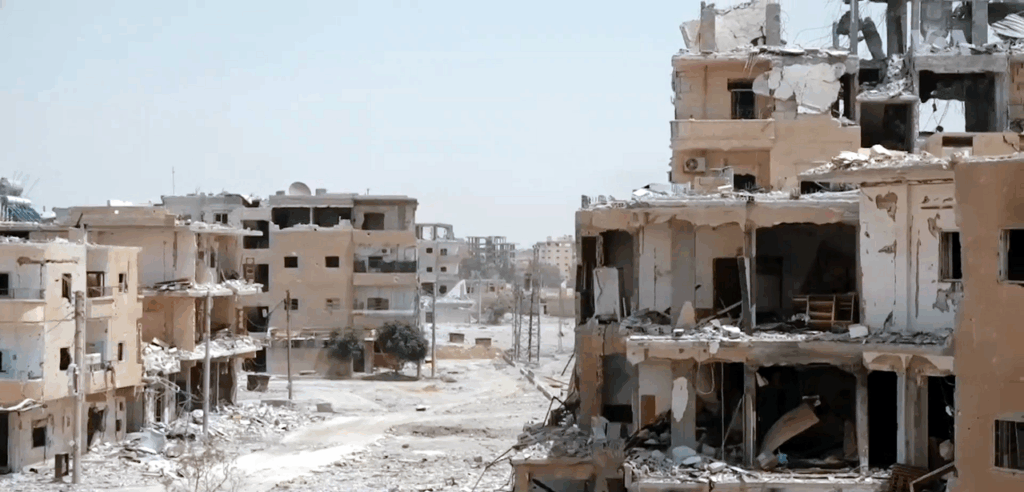
Photo by Mahmoud Bali (VOA) – US-backed Forces Press Deeper Into Southern Raqqa City, Wikipedia Commons
What concrete examples show Russia’s migration pressure on the EU?
Russia’s strategy in this area is often indirect, based on the “plausible deniability” of responsibility. A clear example was the case of migrants who suddenly appeared at the northern (Arctic) border crossings of Finland and Norway in the winter of 2015-2016. These people, who had previously been legally in Russia, were transported to the border by the Russian authorities in an organized manner, often equipped with bicycles (since crossing the border on foot was prohibited). This action was clearly a test of the border protection and asylum systems of the Nordic countries and a means of exerting political pressure, which started as suddenly as it ended after political negotiations.
(The border crossing points on the land border between Finland and Russia have been closed since 15 December 2023. The border crossing points for maritime traffic at Haapasaari, the port of Nuijamaa and Santio have also been closed since April 2024 – the editor)
To what extent can the great migration crisis of 2015 be considered artificially tempted mass migration? If so, what role did Putin and the Russian military leadership play in triggering it (with the escalation of the Syrian civil war)?
The migration crisis of 2015 was an extremely complex phenomenon. The roots of the crisis were real and deep-seated: the immense brutality of the Syrian civil war (which had been going on for years), the rise of the Islamic State in Iraq and Syria, the persistent instability in Afghanistan and the collapse of the Libyan state in 2011 were all real mass displacement factors. These factors in themselves represented a huge migration potential.
Russia’s role in this context was not to start the crisis, but to exploit it and, from a certain point, consciously escalate it.
An important temporal fact is that Russia intervened militarily in Syria in September 2015, when the migration wave had already reached Europe and peaked during the summer. However, their intervention – especially the Assad regime in power and the bombing campaigns that did not spare civilian targets (hospitals and residential areas), especially during the siege of Aleppo – clearly contributed to the prolongation of the conflict and the generation of new, targeted refugee waves in 2016.
Thus, while Putin did not “spark” the 2015 crisis, his military strategy in Syria deliberately counted on maintaining the migratory pressure on Europe as an important tool for destabilizing the EU and the blackmail potential of negotiations with Turkey.
Another hybrid attack took place on the Polish-Belarusian border in recent years. Can we consider it part of the above-mentioned Russian campaign against Europe, or is it entirely the Belarusian leader, Lukashenko’s project?
The migration crisis that developed on the Polish Belarusian border, which culminated in 2021 (and did not start in 2019), is a textbook example of hybrid warfare.
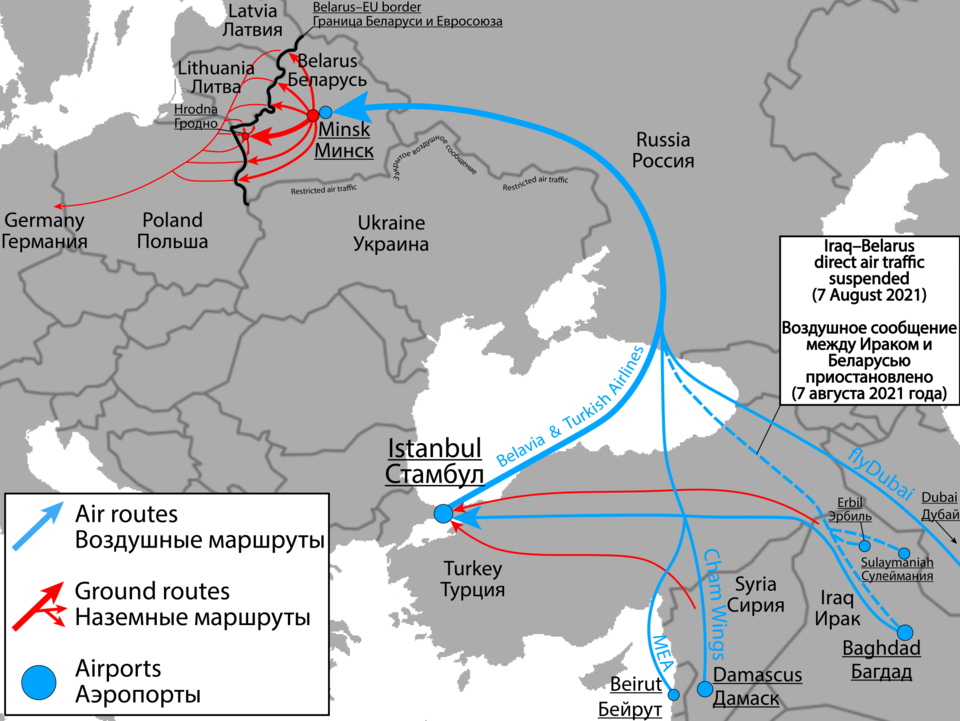
Main routes of illegal migrants to the Belarus–EU border Source: Wikipedia
Although the direct cause of the crisis was the revenge of the regime of Alexander Lukashenko for the EU sanctions following the fraudulent 2020 elections, it would be a mistake to interpret this as an independent action by Minsk alone.
The operation, in which state travel agencies organised migrants from the Middle East to Minsk and then transported them by Belarusian security forces in military escorts to the Polish, Lithuanian and Latvian border fences, far exceeded the capabilities of an isolated regime.
Given Belarus’s close military, political and intelligence integration with Russia (especially after Lukashenko’s political weakening in 2020), an operation of this magnitude, directly provoking the EU and NATO, would have been unthinkable without Moscow’s at least tacit consent, but much more likely without its active support and coordination.
The action was perfectly aligned with Russian interests: it divided the EU, created tensions between Poland and Brussels (due to legal disputes over border protection methods), and diverted international attention from the Russian military build-up along the Ukrainian border in the months leading up to the 2022 invasion.
How can the EU respond more effectively to this form of hybrid threat?
The European Union’s response to hybrid threats has traditionally been slow and fragmented, stemming from the different security interests and political cultures of the 27 member states. A multi-layered, systematic approach is needed to respond more effectively.
The first and most important thing is political unity and clear communication. Quickly recognizing the threat and clearly labelling it as a hybrid attack (as it eventually happened in the case of the Belarusian crisis) is essential to debunk the narrative of the aggressor.
In the longer term, the EU needs to increase societal resilience against information manipulation (e.g., by strengthening strategic communication and fighting disinformation).
There is a need to strengthen common border protection capabilities (such as FRONTEX), to share intelligence more quickly and efficiently between Member States, and to develop new legal frameworks.
This allows sovereignty to be defended against state-sponsored migratory pressures without the EU abandoning its core human rights commitments. In addition, cooperation with third countries (countries of transit and origin) and swift and targeted sanctions of entities involved in a hybrid attack (e.g., airlines, travel agencies) are key.