 By
By In the United Kingdom, the recent prosecution of former parliamentary researcher Christopher Cash and academic Christopher Berry, who appeared in court to answer allegations of spying for China, collapsed after Director of Public Prosecutions Stephen Parkinson said China would have had to be labelled a “threat to national security” at the time of the alleged crimes to continue prosecution. This recent spying court case has torn up old wounds over how the UK should position itself on the international stage, specifically concerning UK-China relations.
Parkinson, the highest authority on prosecution in England and Wales, added that while evidence was substantial and sufficient when charges were brought against the two men in April 2024, a new precedent set by another case earlier this year stipulated the need to label China a security threat.
Since the evidence proving the Conservative government referring to China this way at the time was deemed insufficient, the case collapsed.
In a letter to MPs, Parkinson said that current Deputy National Security Adviser (DNSA) Matt Collins, who compiled and provided factual evidence that was not confidential due to coming from intelligence services, seemed unwilling to call China an active threat to national security between 2021 and 2023, which was “fatal to the case.”
As DNSA, he is responsible for identifying and assessing threats to the UK’s national security.
Conservative Party Leader Kemi Badenoch has accused the Labour government of deliberately collapsing the trial to “suck up to Beijing.” Many other opposition figures suggested they did so by pressuring the Director of Public Prosecutions and ignoring evidence to do so. The government denies these allegations.
Such accusations followed a simple line of thought: Labour has been continuously nurturing its ties with China to improve relations. There are many, mostly economic, reasons for this government policy, but many argue it endangers national security in exchange for slow progress.
Years of On-Off Relations
The UK’s relationship with China was said to be in its ‘golden age’ in 2015, when Chinese President Xi Jinping made his first state visit to the UK, being greeted by Prime Minister David Cameron. A year later, then PM Theresa May echoed the statement, emphasizing the “global strategic partnership” in the building, preparing for a post-Brexit era.
Theresa May was the last UK Prime Minister to make a state visit to China, in 2018. During the terms of consecutive Conservative governments under Boris Johnson, Liz Truss, and Rishi Sunak, relations soured.
The Conservatives took on a hawkish view of China, guarding national security. Johnson aimed to continue business with them but isolated their investment in security-related issues. He also hoped to move away from relying on Chinese rare earth minerals, and his government excluded Chinese telecoms firm Huawei from the country’s 5G network. His policies were in constant swing from being hard on China to attempting to maintain ties for business.
Liz Truss hoped to clean up the confusion after Johnson’s politics. She wanted to change China’s designation, raising it to a “threat” to the UK’s foreign policy, from “systemic competitor” under Johnson. Close but just behind “the most acute threat” of Russia.
She even led an opposition within Johnson’s cabinet to stop TikTok from moving its global headquarters to London. Despite identifying as “fervently Sinophile,” Johnson rejected that plan in favor of a friendlier approach.
Rishi Sunak followed a similar path, announcing, “The so-called golden era is over.” He emphasized China as a “systemic challenge to our values and interests,” calling it authoritarian.
Sunak was also the one who coined the phrase “epoch-defining challenge” to describe China but also called it the “greatest state-based threat to our economic security.” His government further blocked China from investing in “sensitive” sectors and focused on excommunicating larger companies like Huawei. Despite pleas from former PM Truss, he did not change China’s security designation.
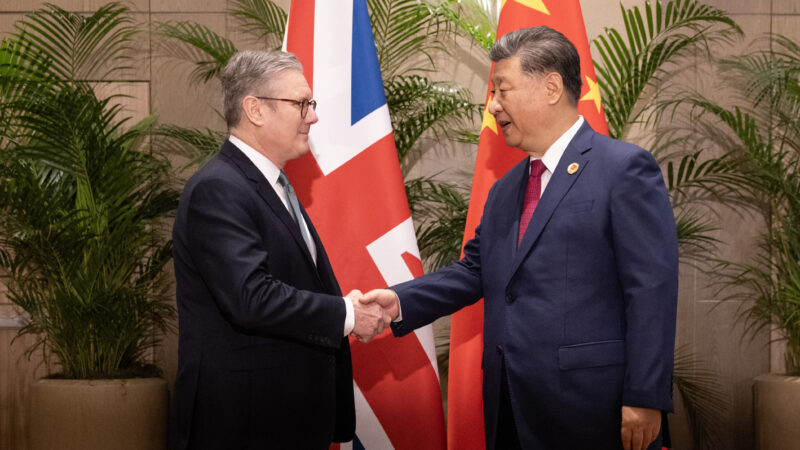
A new era in relations could begin now: talks of Prime Minister Sir Keir Starmer visiting China soon emerged after he became the first PM in years to meet with Xi Jinping at the 2024 G20 Summit in Rio de Janeiro, where he called for “consistent, durable” relations.
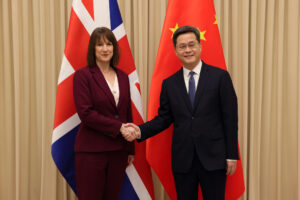
Chancellor Rachel Reeves meets with Minister of Finance for China Lan Fo’an at the Diaoyutai State Guesthouse in Beijing, China. Photo: Kirsty O’Connor / HM Treasury / Flickr.
Chancellor Rachel Reeves also took a delegation to visit China in January. She said a long-term relationship is “squarely in our national interest” as she discussed trade and investment to boost a stagnating UK economy, lifting those sanctions that have been in place under Conservatives.
With China being the world’s second largest economy and the UK’s fourth largest single trading partner, Starmer aims to “explore deeper economic co-operation.” The government reasons this is necessary as the “world will become more Chinese.”
The return to business-based relations echoes the golden era, sacrificing national security for economic growth. There is also initiative to collaborate on climate change and global health, turning away from the US as a partner.
At the same time, there seems to be an understanding of China as a threat on some level, with the government’s own national security strategy stating that Chinese “espionage, interference in our democracy, and the undermining of our economic security” are on the rise.
Chinese Espionage Feeds Off of Investment
But choosing national security would most likely require the UK to abandon business with China as much as possible, something that is highly unlikely in a global economy.
In China, the economy relies on exports to support the Communist Party’s internal supremacy by maintaining international influence on a scale that cannot be matched by any other domestic political force.
China invests across the globe, putting its money into foreign constructions and becoming privy to other countries’ domestic political landscapes. Meddling in cybersecurity, by mobilizing its telecommunications companies and its export of semiconductors and batteries, it gains information on a personal level that could be used to influence voters.
Now, with decreasing domestic demand, increasing job insecurity, and a housing crisis, China needs economic partners as well. But this does not mean that it will continue to be amiable to states criticizing its authoritarian politics in the future.
Meanwhile, it seems the Labour government is unwilling to label China an explicit threat. Their policy of appeasement allowed the largest Chinese embassy in Europe to take residence in the Royal Mint Court, opposite the Tower of London, equipped with extensive CCTV and patrolled by Chinese security. It put many on edge; critics feared that China would be able to tap into fiber optic cables carrying sensitive financial data, while pro-democracy protesters who fled Hong Kong after 2019 are afraid it could become a base for their capture.
In the spy case, after the Crown Prosecution Service informed a senior judge that there was no longer a case to be put on trial, Mr. Cash and Mr. Berry were declared not guilty, meaning they were acquitted. Since the prosecution charged them under the Official Secrets Act, their crimes cannot be prosecuted for a second time.
The government continues its “grown-up” policy despite warnings from its own agencies. MI6 and GCHQ both expressed concerns as China remains their top priority. Sir Ken McCallum, the head of MI5, has called attention to the potential of the Mint embassy as a spy base and labelled Chinese espionage as “a sustained campaign on a pretty epic scale.”
Others argue it’s already too late: the UK was the third largest recipient of Chinese investment after the US and Australia between 2005 and 2024. China is a large market and exporter, making it impossible to bypass. These critics argue that continuing relations, even with the threat to national security, is necessary while keeping a close eye on what Chinese companies and diplomats do on British soil.
Post-Brexit Scramble for Allies
The challenge is clear: finding partners after Brexit pushed the UK to seek faraway allies. With the US withdrawal from European relations, attention turns to Asia. But whether the slow gain is worth the UK’s security is questionable.
Putting all cards on one partner will not result in diverse business and a growing economy. Siding with China and allowing its espionage into the country could alienate other nations, especially in Asia.
Emphasizing cooperation and friendship does little to strengthen the economy, but looking weak internationally will worsen the UK’s standing and Starmer’s domestic ratings.
Starmer’s government must walk a fine line in appeasing China to somewhat return to the golden era but must not give so much as to allow China to take power from the government and exert its influence too far.