 By
By The age of the candidates was a central topic of commentary about the 2020 and, above all, the 2024 US presidential elections. Until Joe Biden withdrew from the race, Americans had the choice between 78-year-old Donald Trump and an 81-year-old Biden. Many people criticized this phenomenon, even accepting accusations of ageism.
Gerontocracy – dominating politics by old men – seems to have become a fashionable trend. Cameroon’s 92-year-old (!) president, Paul Biya, has just announced that he will run for his eighth (!) consecutive term.
If we look at the ‘aging world leaders contest’ we can observe some powerful competitors: Russia’s Vladimir Putin (73), China’s Xi Jinping (72), Narendra Modi (74), Turkey’s Recep Tayyip Erdoğan (71), Iran’s Ali Khamenei (85), and Brazil’s Lula (79) and the most significant of them, Trump (now 79).
Why the Baby Boomers Rule the World?
Except for Khamenei, all the leaders listed above were born in the aftermath of World War II; they are all part of the so-called baby boomers. As Vijai Maheshwari, writer and publisher, describes them, they are the most entitled generation, who are clinging on to the global power and disposing of unimaginable wealth.
Baby Boomer generation, despite being older, still maintains a strong grip on positions of authority and influence worldwide. This can be seen in politics, business, and other sectors.
In the United States, for example, boomers are responsible for the management of significant corporations and control two-thirds of the country’s wealth. The average CEO is a boomer. The narrative is consistent across Hollywood, the arts, and the media.
President Trump is a quintessential boomer, characterized by his hyperbole, arrogance, and innate sense of privilege, coupled with his blow-dried hair. He grew up during a time when everything was conceivable, as did many others of his cohort.
The media has labeled the majority of Russia’s youth as “Putin’s generation,” and they have opted for stability over change. Therefore, they continue to support the authoritarian president. President Putin also pledges to restore the nation to its former status as a major power during the Soviet era.
Putin’s endeavor to maintain his position in power throughout his lifetime has been met with a general lack of enthusiasm by the Russian populace. Boris Yeltsin, his predecessor, was a notorious alcoholic who disparaged the elderly. However, Putin, who is athletic, continues to exude energy and authority in his seventies.
China’s Xi represents a robust China that has been liberated from the constraints of Western imperialism and is prepared to confront the United States in the global leadership race, with its former grandeur reestablished.
And although over half of India’s population is under the age of 30, electors granted their graying, nationalist prime minister an additional five-year term last year. For the second time, even Brazil, whose population is as youthful as India, opted for their “grandpa,” Lula.
Boomer politicians even have control in tiny countries such as Hungary, which is led by Viktor Orbán. Orbán (65) is relatively young, but he has been in politics since his twenties. He successfully created a role model for a seasoned strongman-type politician who built his popularity on nostalgia and often xenophobia. His pledges of a robust state that enforces “traditional family values” and combats immigration and crime are echoed worldwide.
The “me generation’s” longevity is also attributed to the fact that boomers are inclined to provide support for their own. However, Bernie Sanders, 83, technically not a boomer, has a significant young follower base. Having an outsized impact on political life, they are twice as likely to vote as the youth. They are the voters who are dissatisfied with the current situation and often harbor fantasies of rewinding the clock and returning to a more straightforward and improved era.
Boomers, whose wealth was amassed during an era of unparalleled globalization, trade, and freedom of movement, now tend to turn to these grumpy grandpas for a reminder of happier, affluent times as borders increase and the world enters a recession.
Three Old Men and the Threat of Forever Wars
If we look at recent conflicts in Ukraine or in the Middle East, we find angry old actors whose behavior raises serious doubts about their judgment, common sense, motives, and even their sanity.
The term “Netanyahu-Putin-Trump triumvirate” was coined by Simon Tisdall, a columnist for The Guardian, to describe who are the main obstacles to peace on all fronts.
The Israeli PM, Benjamin Netanyahu, 75, understands that when peace arrives, he will face elections in which his shaky coalition may easily lose. It also implies he could end up in jail. That is why he expanded the Gaza conflict into Lebanon, Yemen, and Syria. Then he effectively persuaded Trump to bomb Iran. While Putin does not have to face being removed from office in a democratic election. He needs the war with Ukraine to maintain his power.
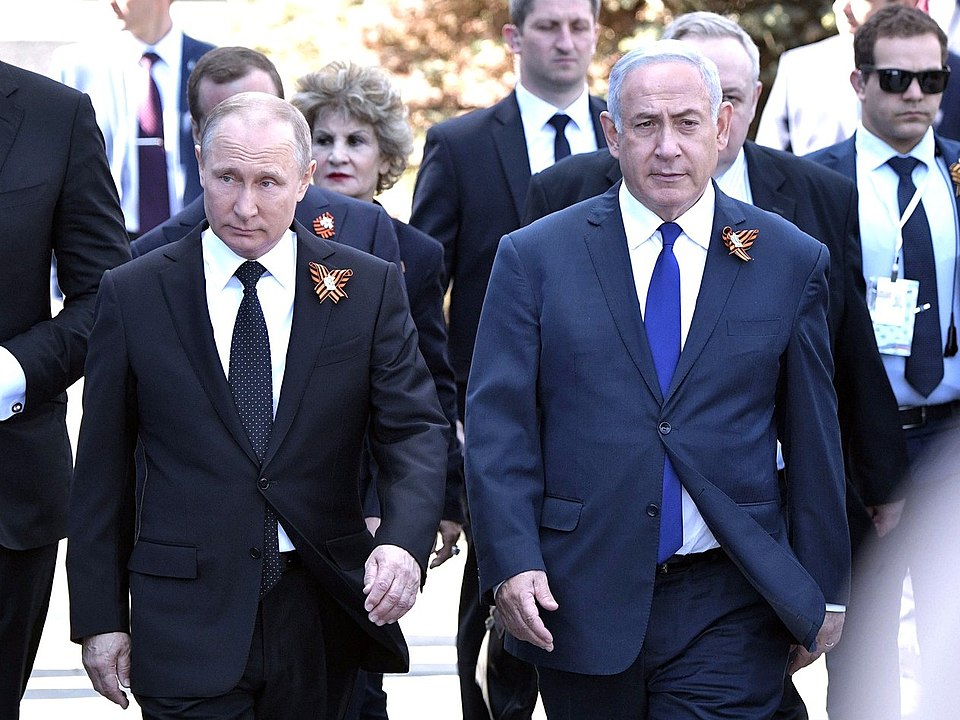
President Vladimir Putin and Benjamin Netanyahu at the Victory Parade, Moscow in 2018
The ICC wants both Benjamin Netanyahu and Vladimir Putin; both have pushed their country into pariah status, and long-running disputes maintain them in power.
Both the Israeli and Russian top leaders promote messianic, expansionist dreams of a “greater Israel” and a resurgent Soviet empire. As Netanyahu didn’t acknowledge Palestinians’ right to an independent state, likewise, Putin dismisses Ukraine’s status as an independent nation.
And the would-be peacemaker, US President Donald Trump, fails to recognize another fundamental similarity: neither of them wants long-term peace. If the fighting ends, they know they will face a possibly disastrous outcome.
Trump, who openly acts in line with the “madman theory”, pretends to be an unpredictable and irrational leader, hoping to have an advantage in international bargaining. Many argue that he is not just acting as a madman. However, this tactic has its own limitations, such as when your adversaries or sometimes your allies are aware of your playbook and know how to distract you.
If we look at Trump’s moves in the recent 12-day war between Israel and Iran, he first wanted to negotiate, but he couldn’t decide on terms, and his amateurish negotiators kept changing their position. Then he decided to bomb Iran, risking dragging the entire region—the world—into another bloody conflict.
The US president was too indolent to investigate the details. Instead, he went with his instincts, which are almost always wrong. That makes him easily fooled by savvy old foxes, like Netanyahu and Putin.
For years, Trump has shown his admiration for Putin, but now he became frustrated when he realized the Russian president doesn’t want lasting peace, or at least a ceasefire.
The American president, who would have done anything for a Nobel Peace Prize, failed to deliver his promise to end the Russian-Ukrainian war “in 24 hours” and also lost his interest in transforming Gaza into a Riviera.
Donald Trump may realize that his personality alone is not enough to solve the world’s problems. Interestingly, that would give hope in solving conflicts.
If he delegates the peacemaking to experienced diplomats, envoys, and mediators—in short, he should leave it to the people who want to do their job quietly, not looking for some kind of global grandeur.