 By
By Legend has it that weapons in Germany were once so scarce, that soldiers had to exercise with brooms instead of rifles. Committed to pacifism and demilitarization ever since the end of World War II, it was unimaginable that a German military predominance in Europe would come under consideration.
Yet recently, Germany has embarked on the most significant transformation in defense and security policy in decades, shifting from longstanding pacifism towards extensive rearmament. Succeeding governments of Chancellor Olaf Scholz and Chancellor Friedrich Merz have demonstrated commitment to increased defense spending and creating the largest and most powerful army of Europe. Under Merz’s leadership, Germany is projected to spend €162 billion on its military by 2029, up from €95 billion in 2025.
Soon the German army’s budget will exceed that of Britain and France combined. Germany was once a major source of conflict and aggression in Europe, yet today, this is largely welcomed by allies. In 1947, NATO was founded to “keep the Americans in, the Russians out, and the Germans down.” In 2026, the dynamics on which that premise was built on seem to have fundamentally changed.
Changing Security Environment
Germany’s demilitarization was decided by the Allied powers at the Potsdam Conference of 1945 that marked the end of World War II. Seeking redemption for the horrors of the war, Germany accepted this settlement. While its standing army reached over half a million at the height of the Cold War, it was always within the frameworks of NATO and overseen by US military command.
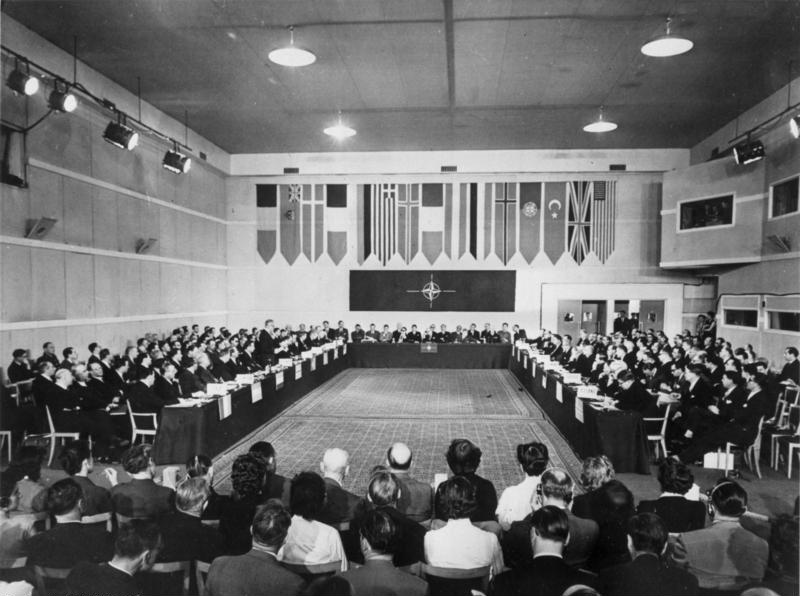
Admission of the Republic of Germany (West Germany) into NATO (Photo: Bundesarchiv / Wikimedia Commons)
Upon the collapse of the Soviet Union, Germany, much like other European powers, dramatically decreased its military capacity.
For decades, Germany’s defense policy was characterized by declining investment, in line with broader European trends.
Between 2007-2017, Germany was spending, on average, 1.2 percent of GDP on its military, and it was first in 2024 that the NATO spending target of 2 percent of GDP was reached.
Today, international politics seem to be shifting away from multilateralism and peaceful cooperation toward dynamics that call for the reassessment of demilitarization. From the expansionist and transactionist foreign policy of the US under the Trump administration, to the ambitions of Russia and China to reshape a more multi-polar world order, global developments point to an erosion of the rules-based order established after World War II.
The first Trump administration already signaled a weakening of transatlantic ties, with Trump criticizing his allies for not spending enough on defense. In his second term, this erosion has deepened, making clear that Europe can no longer rely on the US for its security. Recently, the US Ambassador to NATO even suggested that Germany could take on a leading role within the alliance, potentially assuming the position of Supreme Allied Commander Europe (SACEUR), traditionally held by an American.
Amid Russia’s ongoing war in Ukraine and the growing threat on Europe’s Eastern border, stronger European leadership in defense has become a necessity.
Estimates suggest that Russia could be ready to attack Europe by the end of the decade, with a 2023 Joint Threat Assessment-NATO report projecting readiness for large-scale war by around 2029. Germany’s increased role, once unimaginable, is now broadly supported by European allies, increasingly calling for greater strategic autonomy.
Germany’s Zeitenwende in Action
Berlin seems to have received the message. Upon the outbreak of the war in Ukraine, former Chancellor Olaf Sholz mandated a one-time €100 billion investment in defense, nearly doubling the previous year’s military spending. He called the Russian invasion a zeitenwende, a “watershed moment” requiring the overturning of decades of military policy and rethinking of Germany’s post-war national identity, transforming its role in the world into one that assumes more leadership.
Since his election in the spring of 2025, German Chancellor Friedrich Merz has also made military build-up a priority, promising the creation of the most powerful army in Europe in his first Bundestag speech.
He proposed reintroducing mandatory military service, but this was blocked by coalition partner Social Democrats. Instead, a new conscription law requires 18-year-olds to receive a questionnaire from January 2026, inviting them to register for military service. Mandatory response is limited to men and services remain voluntary, at the same time, clear recruitment targets have been established. This serves a push to expand the military by 100,000 new personnel by 2030. In the case that the voluntary registration fails to achieve set targets, obligatory registration may be reconsidered. The reform already shows impact: application for armed forces increased by 20 percent year-on-year with over 16 000 applicants and 5300 new recruits in February.
Merz has also pushed for the amendment of the constitution to remove limits on borrowing and allow increased defense spending.
Germany is now on track to more than double its defense expenditure, aiming to spend €650 billion over the next five years, reaching NATO’s target of 3.5 percent of GDP.
Much of this funding is directed toward revitalizing the domestic defense industry under a “buy German” strategy. After decades of reliance on US arms production, Germany aims to reduce dependency and stimulate its own industrial base, particularly as the automotive industry is increasingly under pressure from Chinese competition.

Pierburg Niederrhein plant (Rheinmetall) at the harbour in Neuss, Germany (Photo: Anil Öztas / Wikimedia Commons)
Public Opinion and Political Faultlines
German citizens grew up in post-war pacifism, which shaped a national identity defined by the avoidance of military build-up. A legacy of guilt continues to act as a constraining force on Germany’s full military potential.
This does not mean that Germans are unaware of the threat posed by Russia and the implications of reduced US engagement in Europe. While many support increased defense spending and the majority favors expanding the armed forces, a considerable part of the society remains opposed to full rearmament and prefer a more limited German role in European security.
Since post-war disarmament, Germany has been content to rely on the American security umbrella and its strategic culture has remained effectively undefined.
Attitudes seem to have shifted since the Russian invasion of Ukraine, but public opinion remains ambivalent. While 74 percent of Germans were concerned about the war according to a 2025 poll and over 60 percent believe they Europe could not count of the US in case of a Russian attack, a large minority thinks that Germany should “refrain from international leadership,” and less than third agree that military means are most effective to resolve international conflicts. Overall, a 2024 worldwide Gallup ranking of nations’ willingness to enter into combat for their country put Germany at the bottom of its list, surpassing only Austria and Italy.
Political debate reflects this uncertainty. The governing coalition broadly supports rearmament, with the Christian Democratic Union and its sister party, the Christian Social Union leading the push, while their partner, the Social Democratic Party (SDP), has acted as a moderating force, blocking proposals such as the reintroduction of conscription. Left-wing parties largely oppose rearmament, with the exception of the Greens, who have shifted towards defense investment and support for Ukraine. Critics warn that increased military spending could divert resources from social spending, fueling political backlash and a shift towards the far-right.
At the political extremes, both far-right and far-left actors oppose increased defense spending and advocate engagement with Russia, including renewed energy ties. Among them is Alternative für Deutschland (AfD), a radical right party polling around 26 percent. Although its nationalist stance constrained it to vote for the new conscription law, it has frequently blocked support for Ukraine, opposed sanctions, and called for the resumption of Russian oil and gas imports.
Europe Reacts
Although a militarily stronger Germany would once have alarmed its neighbors, its rearmament is now largely seen as a welcome step towards a stronger European defense. Crucially, this new strategy is embedded in multilateralism: a democratic Germany, part of the wider framework of NATO and the EU, presents itself as a cooperative rather than dominant power.
Britain has endorsed this shift, releasing a joint statement with Germany urging acceptance of a “moral” case for rearmament. But there is no better demonstration of this optimistic attitude than the 2025 inauguration of a German military brigade in Lithuania, unseen since the Nazi occupation during World War II. This time, however, it is received as an ally rather than an occupier, reflected in the broadly positive response of the Lithuanian population.
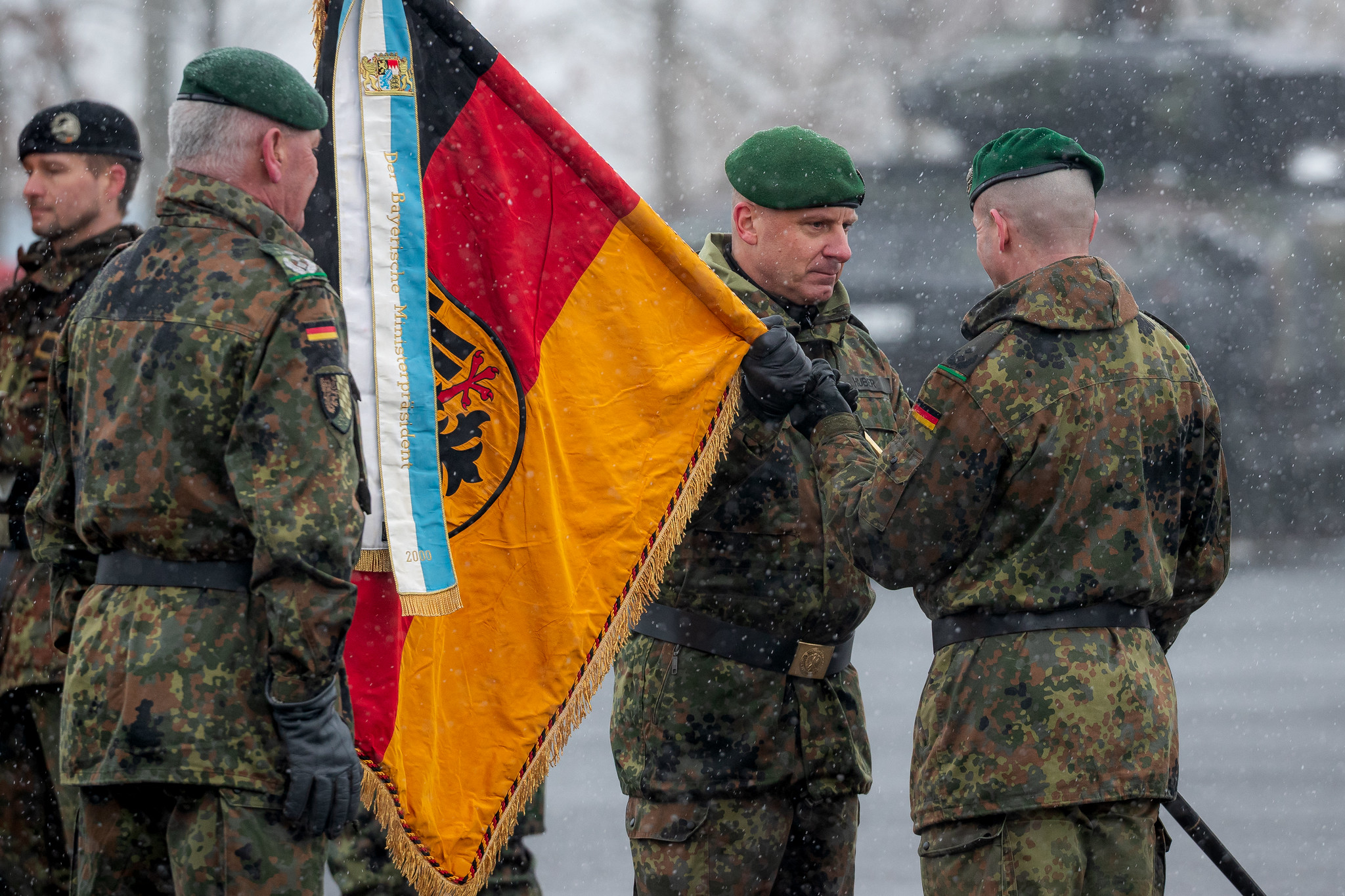
Brigadier General Christoph Huber (mi), Commander of Panzer Brigade 45 “Lithuania”, hands over the troop flag of Panzergrenadier Battalion 122 to its commander, Lieutenant Colonel Rayk Engel (re), at the roll call of the combat troop battalions Panzergrenadier Battalion 122 and Panzer Battalion 203 to Panzer Brigade 45 “Lithuania” in Veitshöchheim, on January 29, 2026 (Photo: Bundeswehr/Marco Dorow/Flickr.com)
Poland’s reaction is more ambivalent. In 2011, Polish Foreign Minister Radoslav Sikorski urged Germany to assume a stronger leadership position, famously stating, “I fear German power less than German inaction.” While this reflected acceptance of Germany as a central European actor, recent years have brought growing suspicion. As both countries emerge as the core powerhouses of the European security architecture, trust and cooperation have become critical. Opposition parties are strongly anti-German, while others consider a closer coordination between them as the most effective way of building defense against Russia while keeping an eye on German rearmament.
France, meanwhile, risks losing influence in a changing European security architecture.
Although President Emmanuel Macron was an early proponent of stronger European defense and strategic autonomy, Germany’s rapidly expanding military budget now overshadows France. Freed from constitutional debt breaks, Berlin can mobilize state funding on a scale that cannot be matched by the French government, already burdened with a debt above 110 percent of GDP, as well as nuclear maintenance.
The widening gap challenges the traditional Franco-German division of roles, where Germany took economic and financial leadership, while France led militarily.
Mistrust in French defense circles Germany is difficult to shake, especially when it comes to allowing Germany to assume a leading role. Although cooperation in the defense industry continues, tension persists. Most recently, the Future Combat Air System, a €100 billion joint project intended to be a cornerstone of Franco-German-Spanish defense cooperation, has been delayed over the division of responsibilities.
Finally, the rise of the far right AfD adds another layer of uncertainty. Germany’s ambition to create Europe’s largest army takes on a different meaning when considered in the context of a party that is nationalist, anti-constitutionalist, and pro-Russian. Many European allies of Germany worry about what a possible future coalition that includes AfD might entail, particularly given its position on Russia.
Power, Trust, and Responsibility
Germany’s rearmament today is seen as taking on responsibility rather than grasping for dominance, and few suggest that its growing military power is aimed at threatening its neighbors. However, Germany stands out as Europe’s largest economic and military powerhouse, and the memory of the past casts a shadow over any discussion of German military leadership.
Germany’s shift away from pacifism and toward increased defense spending is both necessary and overdue in an international context where the US is withdrawing from Europe and Russia poses an increasing threat.
The real question is how this transformation will be received, both domestically and among its allies.. For the EU, the challenge is to capitalize on this momentum and integrate a stronger Germany into its structures, while avoiding further fragmentation.
Berlin has the potential to assume a leading role in European defense and fill the void left by the United States. Such a central role, however, requires trust, something the US built over decades. For Germany, given its past, earning that trust may prove difficult.