 By
By Trumpian politics have been characterized by many as isolationist, steering the US away from international cooperation and back to dealing with domestic affairs.
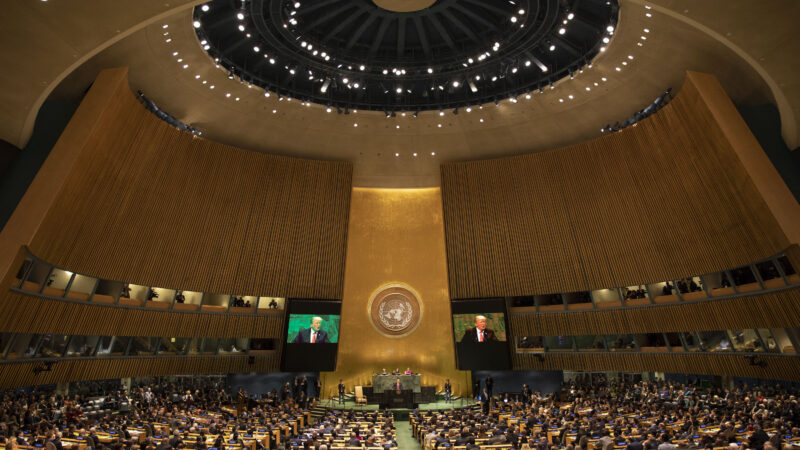
However, his speech at the UN General Assembly (UNGA) last week is the perfect representation of US politics under his leadership. It is not about countries or even about the United States. It is all a one-man show, focused on Trump’s personal image and project of power.
Isolationist vs. Interventionist
Isolationism has been thrown around in connection with both Trump administrations; after all, Trump has withdrawn the US from some of the most influential global alliances (like the WHO and the Paris Agreement) as well as cultural cooperations like UNESCO.
But isolationism is not clear-cut. Classic isolationism means a country does not involve itself with global affairs and shies away from any type of alliance while focusing on domestic politics.
As a foreign policy strategy, complete isolationism was always unfeasible. Even the Japanese Sakoku period of the 17th century, which prohibited foreign travel and strictly controlled trade with foreign states, required connection with those powers for trade.
In the globalized era, supply chains and interconnected financial networks make it impossible for complete isolation to work, not to mention that no one country has access to all the natural resources it needs.
While the US is in a more favorable position than most, Trump’s policies, which strive for control over the global current of politics, show that he prefers to be a leading voice in debates to control the narrative over remaining a spectator, suggesting he recognizes the limits to US isolationism.
Intervention on a Smaller Scale
Trump, while he does focus more on domestic politics, does not shy away from interventionist aspects; in his UN speech, he boasted of having negotiated the end of “seven unendable wars,” and while that statement is debatable, his active diplomatic meddling is undeniable.
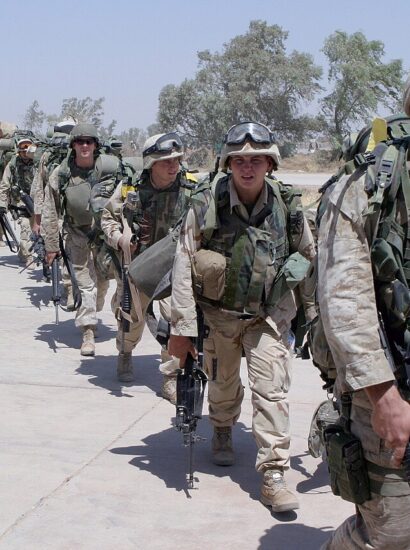
9/11 and the consequent ‘War on Terror’ showcased a US with interventionist foreign policy, where much of American politics centered around international missions and agreements. But intervention has a scale as well, on which Trump, again, seeks to withdraw in certain cases, while unilaterally intervening in others.
The UN-US Relationship
The UN itself was established to aid global cooperation and prevent the eruption of wars, a notion that rejects isolationism. While it cannot prevent interventions of sovereign states, it provides avenues for smaller states to pressure interventionists and an organization that helps without the stipulations of a sovereign nation with its own agendas.
Since it began as a US-led initiative, the UN has had to strike a careful balance of cooperating with the US and containing its interventionism.
That dynamic has been shaped by the Cold War and the War on Terror alike, but also by the massive amounts of support by USAID that fed development funds across the globe. Now, Trump seeks to tip the balance to get what he believes the US needs: a forum to show US prowess that outcompetes international cooperation.
Immigration
While withdrawal from Afghanistan meant US troops went home, the US President frequently involves other states in US affairs, and vice versa. In his UNGA speech, he specifically thanked El Salvador for taking on “jailing so many criminals” the US refused to keep due to being foreigners. Trump has made similar deals with African states, deepening cooperation and creating a political climate where isolationism is best avoided.
He recently ordered US forces to destroy a Venezuelan vessel, which killed 11 drug traffickers onboard – according to US intelligence. The move echoes classic US interventionism, which fashioned the US as a global policeman and its foreign operations as self-defense.
Tariffs and Climate Change
The trade deals also expose Trump’s interventionism; tariffs are government constraints on the free market, which, in this case, were utilized to unilaterally control the flow of goods on a global scale.
According to the US administration’s positions, climate change is an inconvenience: it necessitates expensive changes to the American energy sector as well as restricting what the US can do with its own resources internationally. The use of Russian oil is similarly ill-advised, since such an arrangement guarantees Russian influence will overcome US influence in the state in question. So, the President calls it a hoax.
So, while Trump’s foreign policy is more detached from international cooperation than that of previous administrations, it cannot be called isolationist.
Most of his policies do not seek to influence or guide by intervention or isolate for domestic benefit like previous administrations. Trump’s policies seek control over emerging global powers to return to complete US hegemony.
“On the world stage, America is respected again like it has never been respected before,” he said, suggesting that Trump hopes to ‘Make America Great’ by making it clear that it holds power over others.
President Over Country?
Throughout his speech, Trump compares other countries to the US, but only the US created under his administration, calling most of its actions his. According to Trump, the US is above the UN, meaning he is better than all the UN (“It’s too bad that I had to do these things instead of the United Nations doing them”). The US is in a golden age; despite “guns of war” shattering peace and “four years of weakness, lawlessness, and radicalism under the last administration,” the US is now “blessed with the strongest economy, the strongest borders, the strongest military, the strongest friendships, and the strongest spirit of any nation on the face of the earth.”
While analysts have attributed all sorts of strategies to Trump’s foreign policy, it can be argued that behind it all is no strategy at all, only the project of a man aimed at gaining influence over all things previously restricting him.
“No other country has ever done anything close to that, and I did it in just seven months,” he said during his speech.
As he continues to merge his own image with that of the US, it can be difficult to establish if this is for personal control or for US control. Or whether the difference even matters anymore.
Because his, and conversely the US’s, drive to control politically, economically, and militarily is the only strategy he is seeking to exert with both isolationist and interventionist foreign policy tools.


[…] if a leader questions the existence of climate change, as Trump did at the recent UNGA, the effects will reach their country nonetheless, forcing them do adapt […]
[…] Bendarzsevsky, an expert on the post-Soviet region, sees the Trump peace plan as the only viable option, though it largely favors Russia due to battlefield and economic […]