 By
By What is the job of a NATO Secretary-General? What can this one person do in the face of a war threatening our world order? While the political leader of a military alliance is a position with major limitations, it is one that is necessary and paramount so that diplomacy can triumph before a single weapon is drawn.
Featured in this year’s Budapest International Documentary Festival, ‘Facing War’ follows the final year of Jens Stoltenberg as NATO Secretary-General, while Russia’s war in Ukraine rages on. During a visit to Kyiv, Stoltenberg vows that the Alliance will stand by Ukraine ‘for as long as it takes.’ But as Western support falters and divisions among allies deepen, his promise hangs in the balance.
Stoltenberg stood at the helm of the alliance for a decade: his final year – and the invaluable documentary – demonstrates the continued need for a diplomat at the helm of a military alliance where personal relations have the chance to affect our fragile world order.
A Secretary-General with Grit
The North Atlantic Treaty Organization (NATO) is a complex machine of 32 sovereign nations collaborating on military defense. All decisions within the alliance must be unanimous and while decisions affect both military policy and military strategy, the alliance fundamentally has dealt with the most pressing questions through diplomacy.
The Secretary-General is the alliance’s top civil servant, responsible for steering negotiations and decision-making and enacting those decisions, as well as being the public face of the organization as its principal spokesperson.
While the official elected to the position holds it for four-year periods, this can be extended. Jens Stoltenberg was elected to the position in 2014 as ex-Prime Minister of Norway and extended four times. His tenure is the second-longest in NATO history, only coming short of Joseph Luns, who held the position for over 12 years between 1971 and 1984.
Throughout his years, he was a constant supporter of Ukraine’s sovereignty, coming into power right after the annexation of Crimea. He campaigned for more military support and more advanced weapons to be sent to Ukraine while maintaining that this would express strength towards Russia.
“The only way to end the war in Ukraine is to convince President Putin that he will not win on the battlefield. I don’t think you can change Putin’s mind (…), but I do think you can change his calculus. That he will realize that the price he has to pay to control Ukraine is too high. And the only way to do that is to deliver military support to Ukraine,” he told Christiane Amanpour of CNN in October.
However, getting the consensus from NATO members means one must be able to keep up the constant balancing act.
Balancing Multiple Levels of Governance
The documentary excellently portrays the limited toolkit international organizations have to serve their purpose. The stipulated need for a unanimous decision usually means lengthy, tense diplomatic missions and difficult compromises.
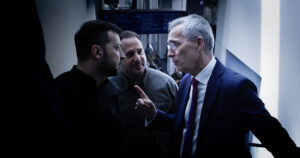
A screengrab from the documentary ‘Facing War’. From left to right: Ukrainian President Volodymyr Zelenskyy, his chief of staff, Andriy Yermak, and then-NATO Secretary-General Jens Stoltenberg. Source: BIDF.
Even a top NATO diplomat must respect nations’ sovereignty, understand the relations between those nations and their leadership, and know what each nation is willing to give. The Secretary-General’s personality defines the social interactions during those missions, his personal relations with each state’s chief.
Stoltenberg was regarded as a “consensus man” who, despite having no experience in military, rose to become the chief NATO diplomat as a reliable social democrat. His politics can best be summed up by one of his own speeches: as Prime Minister, he said Norway needed “more democracy, more openness” after Anders Behring Breivik’s gruesome terror attack in 2011 that killed 77 people.
Even after his NATO job, he continues to stand for transparency and democracy, believing that diplomacy can win over armed conflict.
“At some stage, this war will end. Most likely, it will end around a negotiating table. Our job is to ensure that Ukraine is as strong as possible around that table,” he stated to CNN.
It is not only his beliefs that shaped his style of leadership but also his personal relations with fellow leaders. While in office as Prime Minister of Norway, he had good relations with Russia, making him an ideal candidate to deal with the Ukraine crisis. He was able to broker a deal leading to the end of a long-time maritime dispute between the two states. His origins in the Nordics also gave him the relations necessary to involve Finland and Sweden as new NATO members.
His successor, Mark Rutte, became NATO chief right after stepping down as Dutch Prime Minister. To secure his election, he had to renew Stoltenberg’s promise that for his tenure, Hungary would not be required to participate in NATO activities supporting Ukraine outside of NATO territory. While this is a promise that was made by Stoltenberg as well, it held much less weight as he was the outgoing Secretary-General.
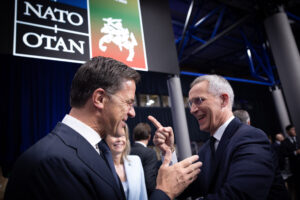
Meeting of the North Atlantic Council at the level of Heads of State and Government, with Sweden, Indo-Pacific Partners, and the EU, 12 JULY 2023. Photo: NATO North Atlantic Treaty Organization / Flickr, CC BY-NC-ND 2.0
Rutte was also known as ‘Mr No’ for being the voice of more frugal nations in the EU, especially in connection to the COVID fund but also overall reforms suggested by French President Emmanuel Macron as well.
In this balancing act, any sort of controversy can become leverage to gain something from the NATO chief; Stoltenberg was able to avoid most of this by remaining calm and always searching for compromise, far before becoming NATO chief, while Rutte struggled a bit more amid successive controversies.
Handling Trump – A Key to Success for Contemporary NATO Chiefs
As Deputy Chief of Staff in Stoltenberg’s Office at NATO Lorenz Meyer-Minnemann explains in the documentary, Stoltenberg was “in control of his temper.” His leadership implied that when he was forceful on something, it was a serious matter. This calmness set the tone for his negotiations, which often ended in NATO’s favour because of this.
Rutte’s approach is wholly different, cracking jokes and introducing levity to summits. In a famous instance, this style led to him calling Trump “Daddy” in relation to the Israel-Iran conflict.
“When you are Secretary-General of NATO, there is one clear responsibility, and that is to keep this alliance together,” Stoltenberg told CNN in an interview after stepping down.
To keep the US interested is a major part of this responsibility. This is especially difficult in the case of Trump, who has continued to withdraw the US from international organizations.
Stoltenberg was known as the ‘Trump Whisperer’ after he was able to keep U.S. President Donald Trump in the alliance – or at least to ignore stepping out of it – by securing each state’s promise to reach the 2 percent of GDP spending Trump demanded. Rutte hoped to follow a similar tactic, promising a 5 percent target but is far less convincing, having led a state that is one of the few that is still struggling to meet the 2 percent target Trump was adamant about.
Trump’s public image is incredibly important for his international relations: Stoltenberg himself looked back on the NATO summit of summer 2018, saying it could have been the end. He was able to appease Trump by doing what he told him to do in a note passed to Stoltenberg during the meeting. If he said NATO spending increased ‘because of’ Trump, the potentially disastrous meeting would end, and Trump would remain in the meeting and thus in the alliance.
But with Trump, there is also the issue of publicity – he is ever more outspoken, breaking traditional diplomatic practices by revealing one-on-one text messages with leaders, including Rutte.
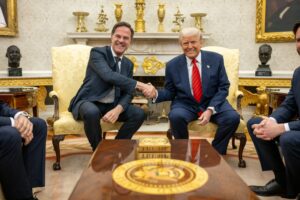
President Trump meets with the Secretary General of NATO, Mark Rutte, 2025. Photo: The White House on X / Wikimedia Commons, Public Domain.
“If people are tempted to appear powerful on social media, that risks leading to more rhetorical escalation rather than working behind the scenes to find win-win solutions,” former NATO spokesperson Oana Lungescu told the BBC.
While Rutte may be following the path of appeasement to achieve Stoltenberg’s results, mimicking the balancing tactics of his predecessor, Trump’s rhetoric escalates, changing the rules of diplomacy, and unmasking his private image to be even more appeasing than the public one – a major problem for someone that shows many faces to many diplomats.
A NATO Without the US?
The issue of US engagement has remained at the top of NATO’s problem list since Trump’s first presidency. Now, it is in more jeopardy than ever before.
President Donald Trump has made it clear that he finds it an imperative question of national and world security that Greenland be annexed by the US. His demand has made European allies question not only bilateral relations but also the future of NATO.
Before his first election, he said NATO was “obsolete” and that it would be “okay” if NATO dissolved. Then, allies worried about abandonment – now they fear an attack on their sovereignty, as Trump is essentially threatening military action against a state his office is supposed to protect through the collective efforts of NATO.
The challenge to manage this conflict may become Rutte’s defining moment as Secretary-General.
While with Ukraine, discussions have shifted away from NATO and more towards the EU, Trump’s expansion in the Western Hemisphere shows that NATO’s deterrence is still necessary in global politics.
As Trump threatens Greenland, its people’s right to choose their government, and Denmark’s own sovereignty, Russia watches. Its leaders can use Trump’s policy as a free pass to annex the whole of Ukraine, so they endorse Trump’s efforts, who, in turn, is appeased and happy with Russian leadership.
“Greenland [is the] ideal solution,” wrote Sergei Markov, a pro-Kremlin political analyst, on his Telegram channel, as it can break NATO. “Then the EU will be forced to stop its war against Russia.”
Though Rutte has remained largely silent on the matter, he has been working behind the scenes, discussing the issue with Trump. But the complexity of this problem is not likely to be dissolved overnight. Facing another War, the NATO chief must show resolve and negotiate as best he can; perhaps looking at his predecessor, we spectators can understand his position just a little better.
Disclaimer: The Long Brief got a screener for “Facing War” from the organizers of the Budapest International Documentary Festival but they had no further affiliation to the writing, publishing and promotion of this article. For more information about the festival and screening times, visit the festival website: https://www.bidf.hu/movies