 By
By GLOBSEC’s 10th annual public opinion report, Trends 2025: Ready for a New Era?, offers a panoramic view of how societies across Central and Eastern Europe (CEE) perceive security, democracy, global alignments, and resilience in 2025.
The survey was fielded between February and March of 2025 in nine CEE countries (Bulgaria, Czechia, Estonia, Hungary, Latvia, Lithuania, Poland, Romania and Slovakia), with nationally representative samples of about 1,000 respondents in each country.
As Europe grapples with new geopolitical pressures, the report reveals a region increasingly aligned around shared security imperatives and institutional trust —even when challenges remain, especially in the information sphere.
Defence and Security: A Shared Priority
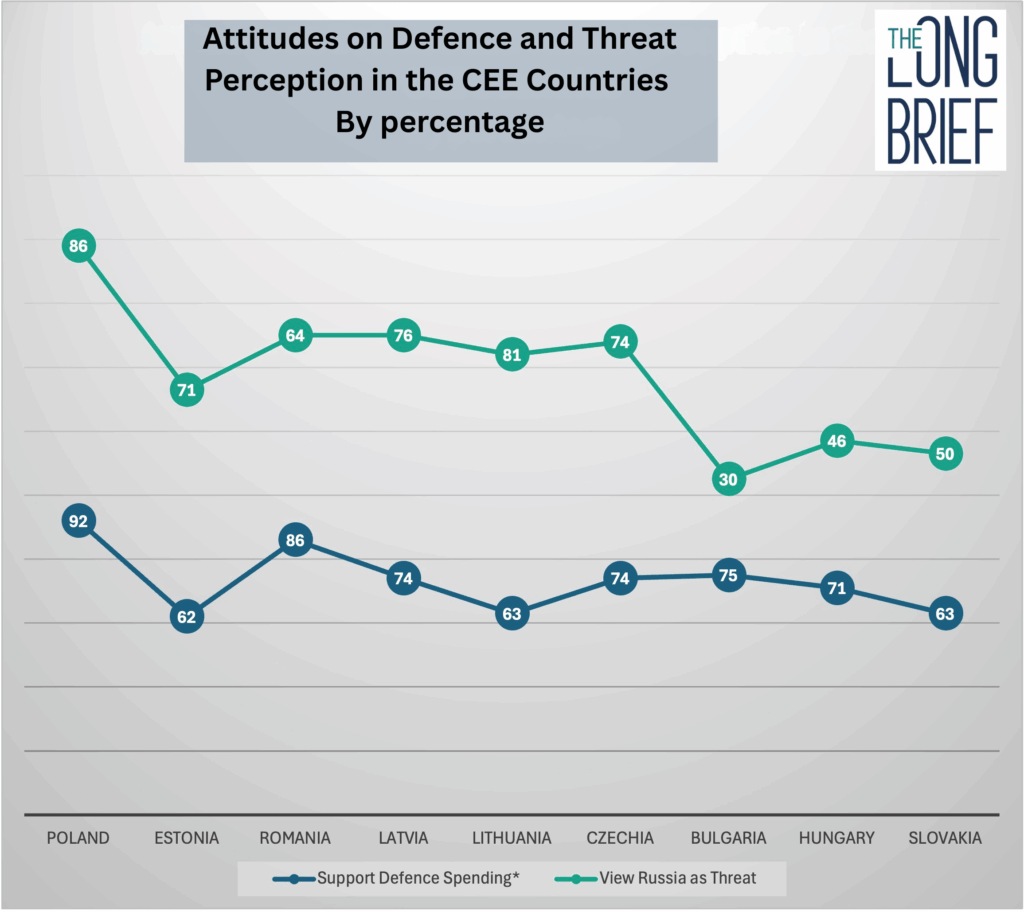
Public support for stronger defence is at an all-time high. Nearly three-quarters (73 percent) of respondents across the region believe their governments should increase defence spending—a remarkable figure for societies once more focused on economic transition than security posture.
The appetite for collective action is equally strong. Seventy-eight percent endorse invoking NATO’s Article 5 if an ally were attacked, up five percentage points from recent years.
NATO membership itself enjoys approval from 82 percent of respondents, marking the alliance as a pillar of regional security identity.
Country-level contrasts reveal the texture beneath these averages. In Poland, an overwhelming 92 percent support higher defence spending, and 84 percent say they would personally defend their country in case of invasion. Slovakia, however, stands apart: only 49 percent express readiness to fight, signaling persistent divisions over security obligations. Such disparities underline how historical memory, political leadership, and local discourse shape national resilience.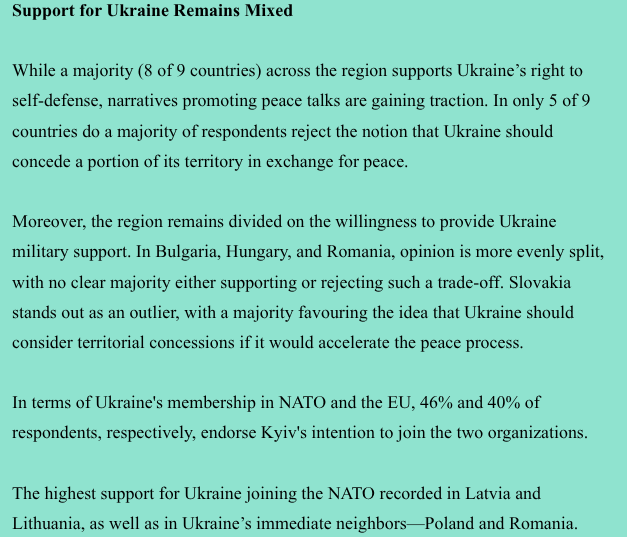
Perceived Threats: Russia, China, and Strategic Anchors
The specter of Russia continues to loom large. More than 60 percent of respondents identify it as the primary external threat—a sentiment particularly acute in Poland, the Baltic states, and Romania. By contrast, China elicits more muted concern, with only 34 percent labeling it a danger. However, Beijing’s strategic acquisitions—from infrastructure to media ownership—raise concerns among 58 percent and 56 percent, respectively.
Czechia remains an outlier: it is the only country where a majority see both Russia (74 percent) and China (53 percent) as threats simultaneously. On the other hand, Bulgaria is the only country in the region where more people view Russia’s specific hybrid activities (45 percent) as a threat than Russia itself (30 percent).
The European Union continues to serve as a vital anchor for the region, with a majority of respondents maintaining support for their country’s membership.
Seventy-eight percent of CEE citizens support their country’s EU membership.
Over the past year, levels of support have remained largely steady, with significant EU-related milestones such as accession to the Schengen area.
Source: GLOBSEC Trends
When asked about trusted partner nations, nearly half of respondents name Germany as their country’s most important ally, followed by the United States at around 40 percent. Only 11 percent cite China—a reminder that despite economic ties, public trust still gravitates westward.
This balance reinforces the idea of “European Atlanticism”: a cultural and strategic orientation that endures even amid calls for greater autonomy.
Democracy, Media, and Civil Society: Strength Amid Strain
Security, the report argues, cannot be separated from democracy. Citizens across CEE link resilience not just to military strength but to institutional integrity, independent media, and civic engagement.
In Hungary, 79 percent say their country should do more to support civil society organizations, while in Czechia, 57 percent express confidence in traditional media—a high mark for the region. Czech respondents also display lower susceptibility to conspiracy narratives; only 32 percent believe “hidden groups control the world.” Such findings suggest that robust media ecosystems and civic space can meaningfully reinforce democratic resilience.
Yet cracks remain. In several states, trust in political institutions lags behind faith in external partners. The report highlights that when media environments weaken or polarization deepens, disinformation quickly fills the vacuum—undermining both democracy and security.
The Battle for Information
The 2025 report devotes special attention to what it calls “information defence.” Across CEE, the information sphere remains a key vulnerability—one that adversaries exploit through disinformation, propaganda, and manipulation.
Many respondents report a desire for clearer government communication in crises, while researchers note that countries with stronger civic literacy show more resilience to false narratives. GLOBSEC analysts frame this challenge as central to the region’s next phase: if defence policy is about tanks and alliances, information policy is about trust and truth.
A Region Ready for a New Era
The 2025 Trends report captures a pivotal juncture in Central and Eastern Europe’s post-Cold War evolution. Once defined by transition, the region now defines itself by preparedness. Citizens see the world as it is, not as they wish it to be—and that realism may be the foundation for a more secure, democratic future.
While China and the Kremlin are recklessly attempting to undermine trust in transatlantic relations, the concept of “European Atlanticism” has been reaffirmed in the region.
European Atlanticism is a concept of cultural and strategic orientation that endures even amid calls for greater autonomy.
The test ahead lies not in public awareness but in political follow-through: transforming opinion into policy, and sentiment into structure. If that can be achieved, then GLOBSEC’s central question—is the region ready for a new era?—may finally be answered in the affirmative.