
 By
By The war waged by the United States and Israel against Iran has caused divisions within the European Union. In fact, many major countries, such as Italy, France, and Poland, have refused to provide military support for any operation, whether by air, sea, or land, in Iran. However, while they have criticized the war, they have also stated that it could have benefits, while recognizing that the Iranian regime and a potential nuclear bomb in its hands could be a bad thing.
Nevertheless, one country in particular has been the most outspoken and has openly rejected the war in Iran. That country is Spain.
The Spanish Stand
From the very beginning, Spain has strongly criticized the war waged by the United States and Israel, invoking international law and warning of its potential long-term consequences.
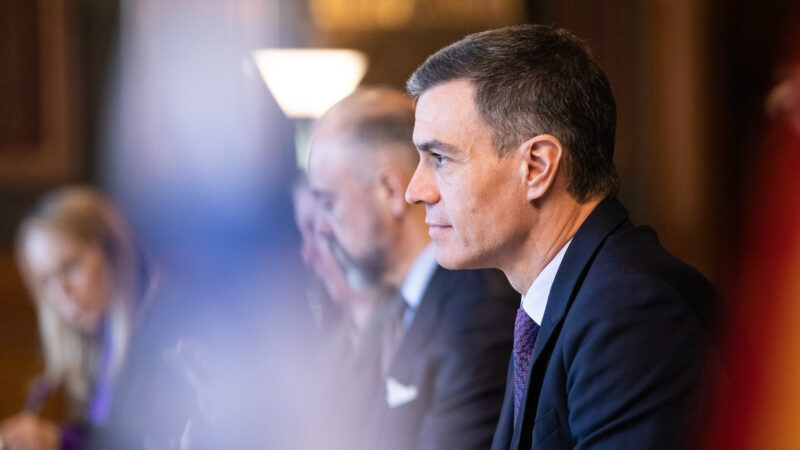
Spanish Prime Minister Sánchez (February 28th, 2026):
“We reject the unilateral military action by the United States and Israel, which constitutes an escalation and contributes to a more uncertain and hostile international order.”
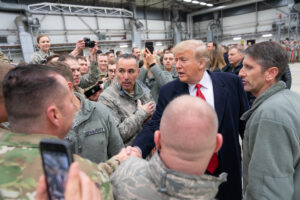
President Trump and the First Lady Visit Troops at Ramstein Air Force Base in Germany, 2018. Photo source: Official White House Photo / Shealah Craighead / Trump White House Archived / Flickr, Public Domain Mark.
In fact, aircraft intended for use at the bases in Spain had to be relocated to other European bases.
On March 30, Spain went a step further and closed its airspace to flights by aircraft participating in the war in Iran.
Defence Minister Margarita Robles confirmed this, stating:
“From the very beginning, it was made crystal clear to the U.S. military and American forces that bases would not be authorized, nor, of course, would the use of Spanish airspace be authorized for any actions related to the war in Iran.”
Other countries, such as Italy and Switzerland, have done the same, but Spain was the first European country to make that decision and state it openly.
Sánchez has reaffirmed this position several times throughout March in various statements, whether in interviews or in the Spanish Parliament itself.
“This is an illegal war that we don’t support. A ‘no to war’ message, that is no longer just Spain’s voice, is now embraced by the entire world.”
The Trump Administration Threatening Spain
Trump was the first to react, and he was very harsh, proposing to inflict significant economic damage on Spain:
“Spain has been terrible. We’re going to cut off all trade with Spain. We don’t want anything to do with Spain.”
He also criticized the decision to close the bases but argued that they could do whatever they wanted because they are U.S. bases and have every right to do as they please (which isn’t true):
“Spain actually said that we can’t use their bases, and that’s all right. We could use their base if we want. We could just fly in and use it. Nobody’s going to tell us not to use it.”
Wider Response from the US
U.S. Senator Lindsey Graham has been one of the most prominent and vocal critics of the operation in Iran. In fact, he had long been advising the president to launch a war in Iran as soon as possible. When Graham saw the Spanish government’s decisions, he openly criticized them, saying, “I want our bases and air bases out of Spain.”
He didn’t stop there: “To our friends in Spain: you have lost your way. I no longer want to do business with you,” he stated in his interview on Fox.
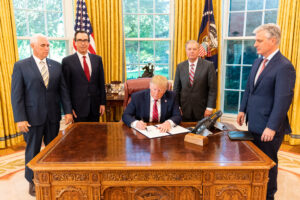
President Donald J. Trump, joined by Vice President Mike Pence, Secretary of the Treasury Steven Mnuchin, National Security Advisor Robert O’Brien, and Sen. Lindsey Graham, signs an Executive Order, 2019. Photo source: Official White House Photo / Shealah Craighead / Trump White House Archived / Flickr, Public Domain Mark
Finally, he asserted that Spain should not have U.S. bases:
“I would again recommend to President Trump that we close U.S. air bases in Spain and relocate to a country that allows these assets to be used to protect America and the world. The sooner this is done, the better.”
In April of this year, several news reports emerged suggesting that the United States might withdraw from NATO, a move that would represent a major shift and have far-reaching consequences. Spain is one of the main countries being singled out as responsible, although France and the United Kingdom also bear their share of the blame.
Why is Spain Making This Decision?
Furthermore, Sánchez holds this position not only because his party has a tradition of opposing participation in foreign wars, but also because it is something that goes down very well with the public. In fact, this has garnered some sympathy among a small segment of the conservative base that opposes foreign wars, a group that won’t translate into many votes, but it has slightly alienated Vox and PP voters.
Sánchez emerges stronger and remains the only leader in Europe to publicly challenge Trump, something no other European leader has done; if any have, it has been with great caution.
This may have negative consequences for Spain, especially economically, but it could also lead Spain to open up even more to China.
We’ll see what the long-term consequences are; it’s a risky gamble because while this stance may help him domestically, in terms of relations with the United States and Israel, he could end up severely disadvantaged.
However, in another international arena, one that many overlook, it is paying off, especially with Islamic countries. In fact, Algeria has lowered its gas prices, which is currently very beneficial for any European country.