 By
By The Catholic Church is undergoing a historic shift as its epicenter moves from the Global North to Africa, which is now the primary source of the religion’s growth and human capital.
Africa currently accounts for approximately 280 million Catholics, representing roughly 20 percent of the global congregation. While membership stagnates in Europe and the Americas, it has grown by over 30 percent in Africa over the last decade.
Projections suggest that by the 2060s, half of all Catholics globally will be African. Pope Leo XIV’s April 2026 visit reflects both his personal ties to Africa and the rapid rise of Christianity across the continent.
This transformation is characterized by several key pillars. These are the human capital, social and political leverage, and theological conservatism.
Human Capital
A century or so ago, Africans accounted for only around 1 percent of the world’s Catholics, with little power to match. According to the World Christian Database, there were 270 million baptized Catholics in 2025, representing a 140-fold increase.
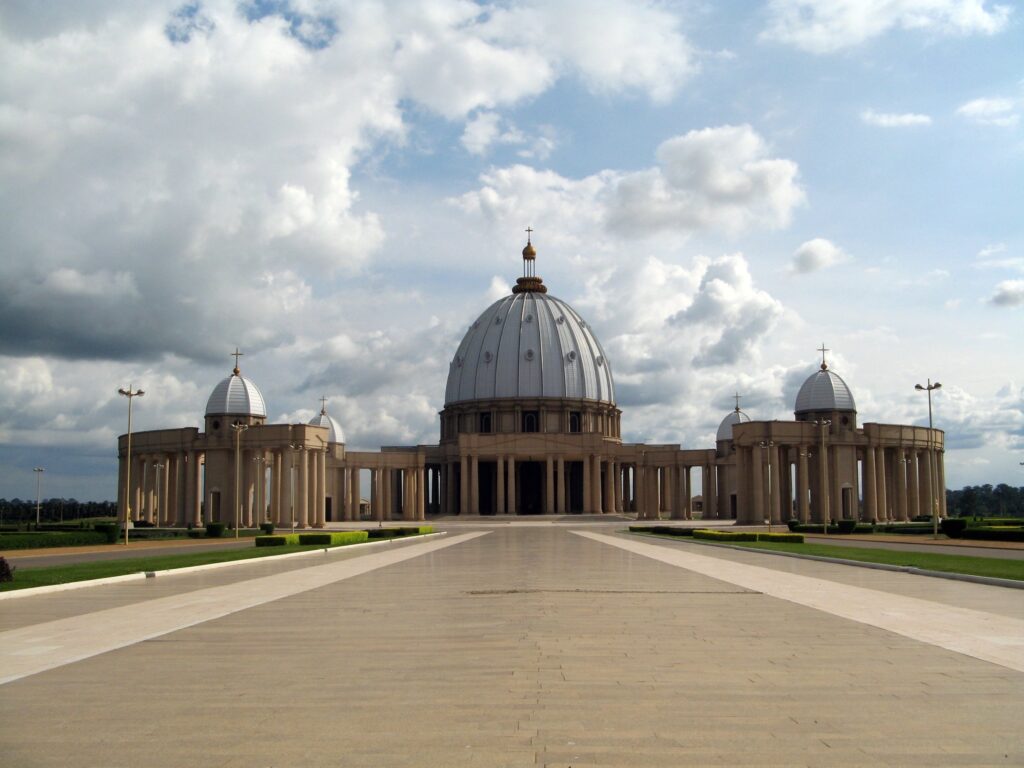
Basilica of Our Lady of Peace of Yamoussoukro. Photo: Felix Krohn on Flickr
Africa is the only region where the number of priests and seminarians is increasing, with priest numbers growing by nearly 3 percent recently. To meet the demand, the Society of Jesus (otherwise known as the Jesuits) has begun relocating parts of its archives from Europe to Africa.
For centuries, European missionaries traveled to Africa. Today, that flow has reversed.
African priests and missionaries are frequently traveling to Europe and North America to serve local congregations that are struggling with clergy shortages. There are about 455,000 Christian missionaries worldwide, of whom about 30 percent are Catholic.
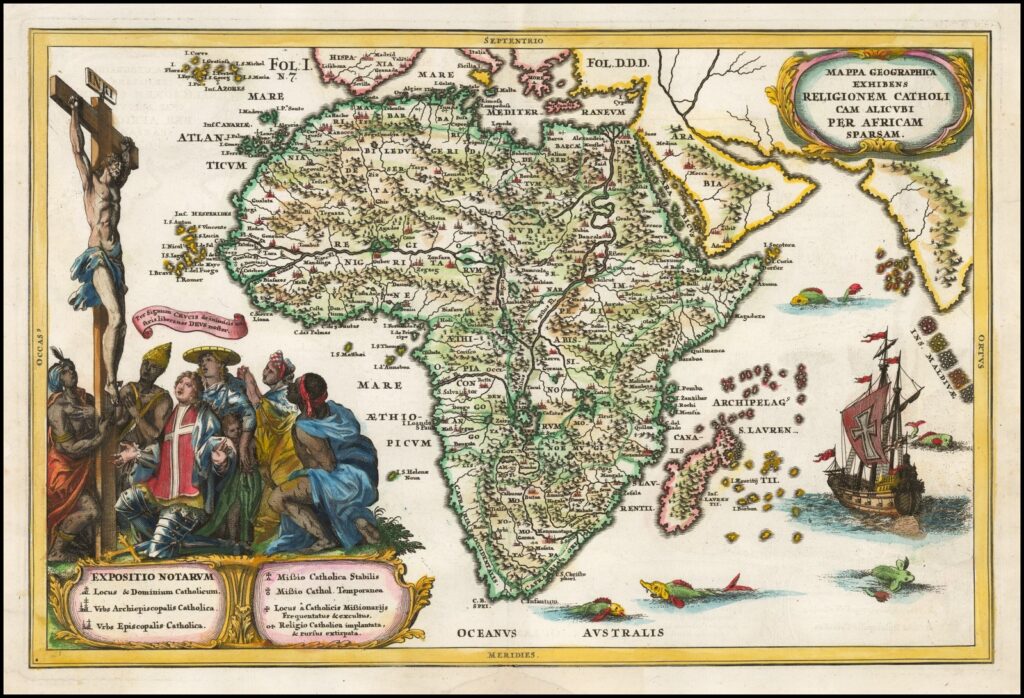
A geographical map showing the Catholic religion scattered somewhere across Africa, circa 1710. Source: Wikimedia Commons
However, Africa has yet to achieve true church equality. It has the world’s fewest bishops per parishioner: there are 365,000 believers per bishop, compared to 170,000 in Europe.
African Church leaders are similarly underrepresented at the Vatican, where only 12 percent of cardinals under the age of 80, who elect the Pope, come from Africa.
A diplomat from the Holy See told The Economist that greater representation of African bishops is “inevitable”, and many believe the next pope will be African
Despite the Church’s growing presence in Africa, however, it seems– like other mainline Protestant denominations around the world – to be losing ground to Pentecostal churches, which by many accounts are Africa’s fastest-growing Christian denomination. In furthering outreach to communities attracted to Pentecostalism, the Church faces the challenge of “modernizing” without sacrificing doctrinal fidelity.
Theological Conservatism
African church leaders are exerting more influence in the Vatican, often championing traditional stances on marriage and family. This has led to occasional friction with more liberal Western trends, most notably regarding LGBTQ+ rights and same-sex blessings.
When the Vatican department responsible for safeguarding doctrinal orthodoxy allowed priests to bless same-sex couples. Catholic leaders successfully pushed Pope Francis for an opt-out.
Which matched by increasingly forceful engagements in Africa’s public debates on sexuality and gender. With rare exceptions, most African countries consider same-sex activity to be illegal and socially unacceptable.
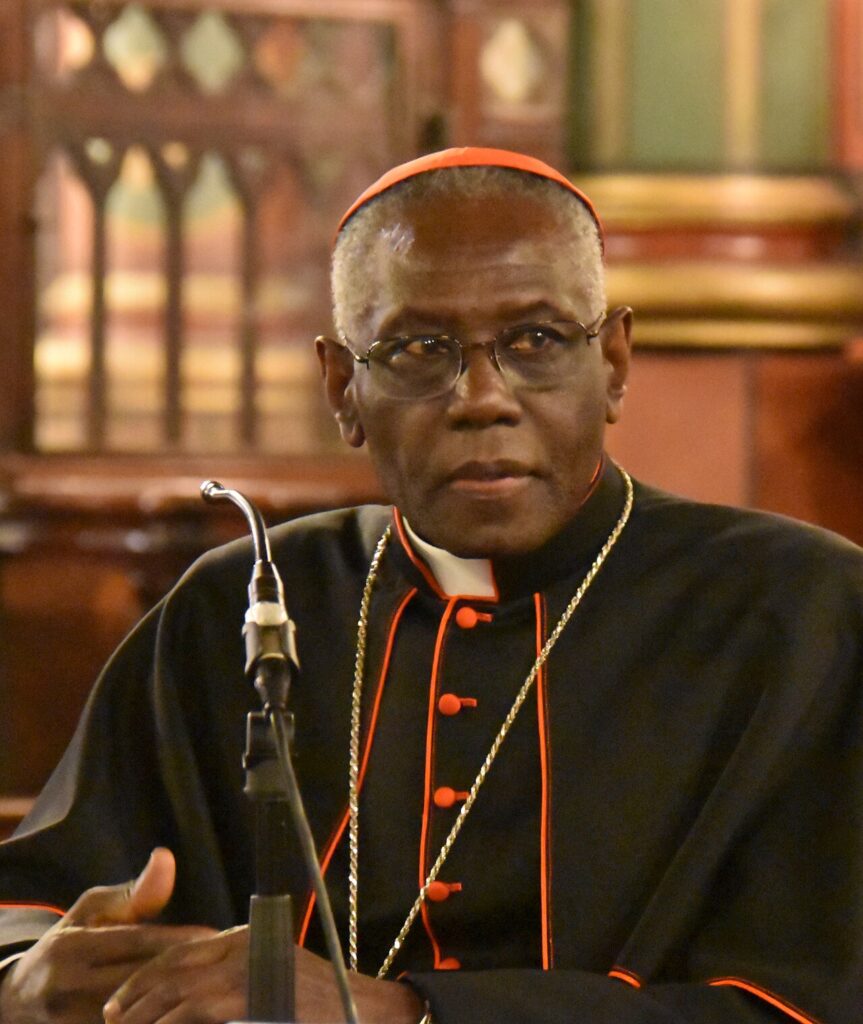
Cardinal Robert Sarah, who led the other African revolt against Pope Francis, for a more conservative liturgy. Photo by François-Régis Salefran on Wikipedia Commons
Catholic officials have recently been at the vanguard of movements across the continent to promote “family values,” limit abortion rights, and support anti-homosexual laws. This has led to conflicts with the Vatican and alliances with other denominations, including Pentecostals and Mormons.
In July 2021, Francis issued an apostolic letter titled Traditionis custodes, which imposed new restrictions on the use of the Traditional Latin Mass. African bishops successfully revolted against this decision, too.
Social and Political Power
In regions with ineffective governments, the Church acts as a surrogate state, providing education to one in nine primary students and managing extensive healthcare networks.
In a continent plagued by poverty and ineffective or corrupt governments, the Catholic Church addresses people’s needs and frustrations. It provides education: one in nine students in primary school attends a Catholic school. In many countries, it helps provide healthcare.
Despite its close early links to colonialism, the Catholic church in Africa today is widely seen as a politically independent institution: a champion of democracy, as it publicly calls out human rights violations and government corruption.
For instance, in Congo, its bishops have long helped mediate between the country’s warring factions, monitor elections and back pro-democracy movements. At a time when democracy in much of Africa is faltering, the Catholic church is an important bulwark.
As it grows, the Catholic church in Africa will encounter problems familiar elsewhere. Many congregants complain about a lack of financial transparency. Although relatively few cases of sexual abuse have been reported on the continent, a large and growing flock will draw scrutiny.
Its political interventions will make enemies. In countries with authoritarian leaders, such as Equatorial Guinea, critics say it has not intervened enough.
Cameroon, Angola, Equatorial Guinea: The Challenges and Opportunities for African Catholics
Pope Leo’s decision to make Africa one of the early destinations of his young papacy signals the continent’s importance in global Catholicism. His 10-day itinerary to Algeria, Angola, Cameroon and Equatorial Guinea is also historically significant; it’s a reminder of the continent’s foundational role in shaping the church, particularly in its first five centuries.
In Algeria, for instance, Pope Leo will walk in the footsteps of Augustine of Hippo (who lived around the year 400), his spiritual father, highlighting the African roots of Christianity.
In Cameroon, the central issue is division. The country still carries the legacy of French and British colonial rule, which left behind a fragile bilingual state. Today, the Anglophone crisis continues to destabilize the North-West and South-West regions, while insecurity caused by Boko Haram also affects the Far North.
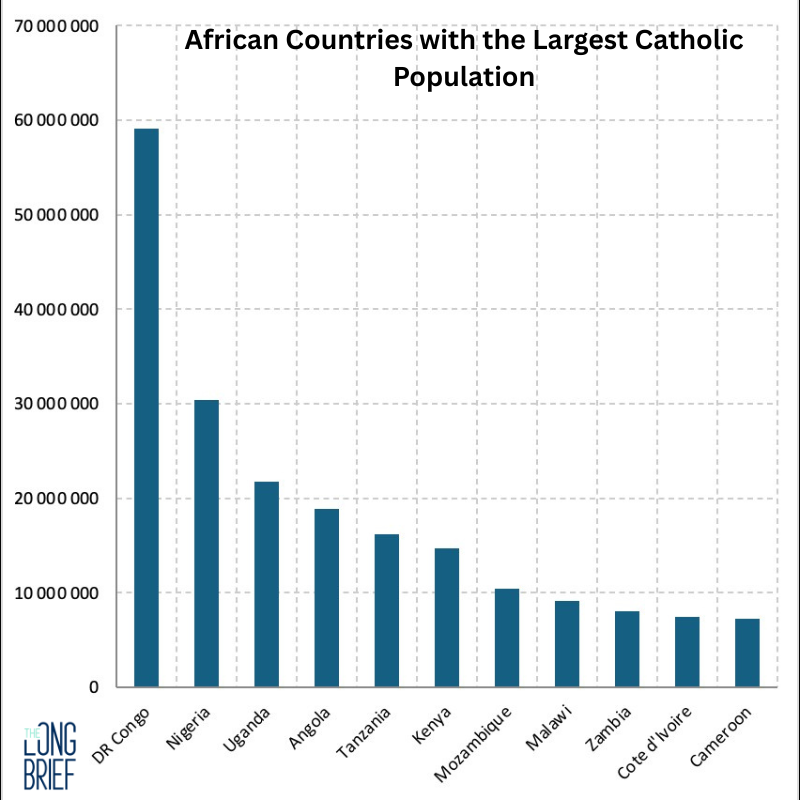
African countries with the largest Catholic population. Source: ARDA / World Religion Database
Pope Leo XIV’s stop in the Cameroonian city of Bamenda was highly symbolic because Bamenda lies at the heart of this conflict. Vatican News noted that the Pope met religious and traditional leaders there to appeal for peace.
In the Central African country, Catholics make up a large propotion (around 8 million of the nearly 30 million people), and the Church plays an important role in education, healthcare, and peacebuilding.
As per Vatican Press, 1,426 parishes, 3,300 priests, 2,218 major seminarians, and more than 26,000 catechists made up the Cameroonian Catholic Church. It also runs major education and health networks, including 1,668 pre-school and primary schools, 276 middle and secondary schools, 59 hospitals, and 279 clinics.
Angola’s defining trauma is its prolonged civil war, which ended in 2002, but its ramifications are still obvious in inequality, weak institutions, corruption, rural underdevelopment, and a significant reliance on oil.
According to the World Bank’s poverty figures, 32.3 percent of Angolans lived below the national poverty line in 2018, and the GNI index was 51.26, showing significant inequality.
Angola is a predominantly Catholic country, with around twenty million Catholics — more than half of the population. However, the country has only 1,511 priests to serve this large congregation, which suggests that growth is outpacing supply.
Equatorial Guinea is the smallest compared to the others, but proportionally, the most Catholic.
Vatican figures list 1.248 million Catholics, or 74.78 percent of the population, making it an overwhelmingly Catholic country. It has 5 ecclesiastical circumscriptions, 99 parishes, 265 priests, and 105 major seminarians.
Despite Equatorial Guinea’s oil wealth and upper-middle-income status, nearly half the population still lives below the national poverty line, and declining oil revenues could make poverty worse without reforms.
Across these countries, the Catholic Church is not simply a religious institution. It is a school system, health provider, mediator, conscience of society, and sometimes one of the few institutions with national reach.