 By
By Russia uses “soft power” tools – such as the media, culture, education, and religion – to advance its own geopolitical goals and spread disinformation. The most recent manifestation of this, Russia’s return to one of Europe’s most prestigious cultural platforms, the Venice Biennale, has sparked debate about how far the freedom of speech may go.
Russian Soft Power as a Tool of Justifying the Aggression
A primary objective of using soft power is to shift global public opinion toward a positive view of Russian politics and to command respect for its “great power” ambitions and civilizational status.
Soft power tools, including state media (Russia Today and Sputnik) and cultural institutions, even the Russian Orthodox Church, are instrumentalized to justify the invasion of Ukraine and portray Russia as a geopolitical counterweight to the United States and NATO.
Through the “Russkiy Mir” concept, the Russian leadership treats civil society as a tool to legitimize its aggression against Ukraine and undermine Western democratic values.
This concept functions as the primary philosophical and geopolitical framework utilized by the Kremlin to project influence beyond its sovereign borders.
Particular attention is given to the context of the war in Ukraine, where the education system and the church have become intermediaries for legitimizing Russian narratives and erasing identity.
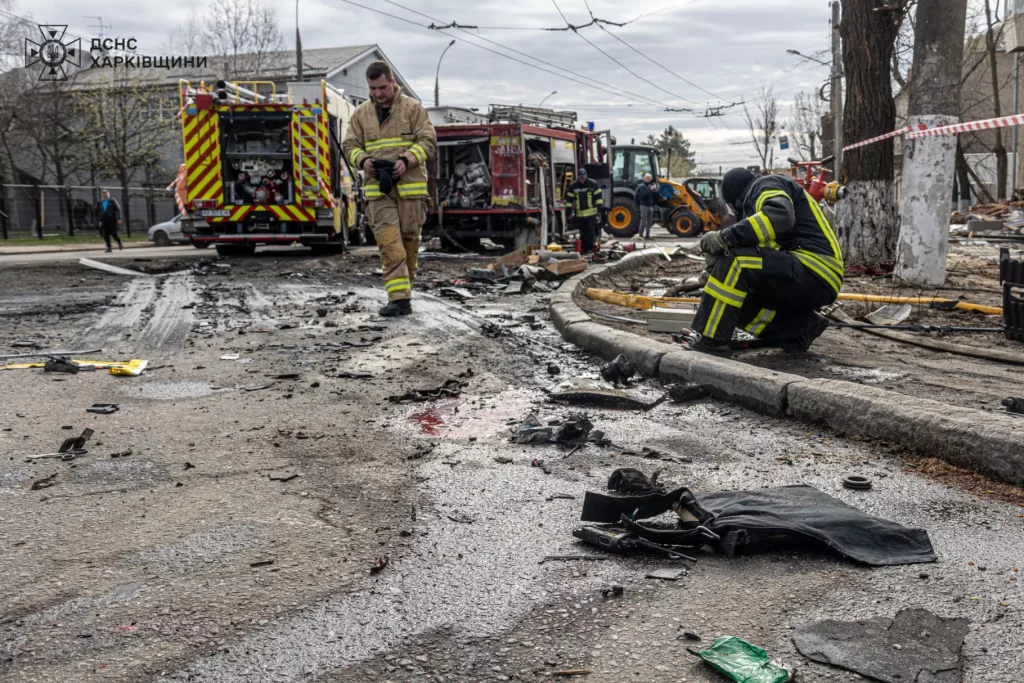
Destructions in Kharkiv after a Russian drone attack in the night on April 4, 2024 (Photo: State Emergency Service of Ukraine / Wikimedia Commons)
According to The Guardian, leaked internal documents from the Fund for Support and Protection of the Rights of Compatriots Living Abroad (Pravfond) indicate that the foundation finances propaganda websites aimed at Europeans, assisted pay for the legal defence of the convicted arms trafficker Viktor Bout and the assassin Vadim Krasikov. Pravond has also hiredd a number of former intelligence officers as the directors of its operations in European countries. Since 2022, Russia has actively extended its footprint in regions with less institutional hurdles, more anti-Western sentiments, and political neutrality. Moscow is also seeking political support and votes in international organizations in the Global South, Africa, and Asia.
The Cultural Front and Sportwashing
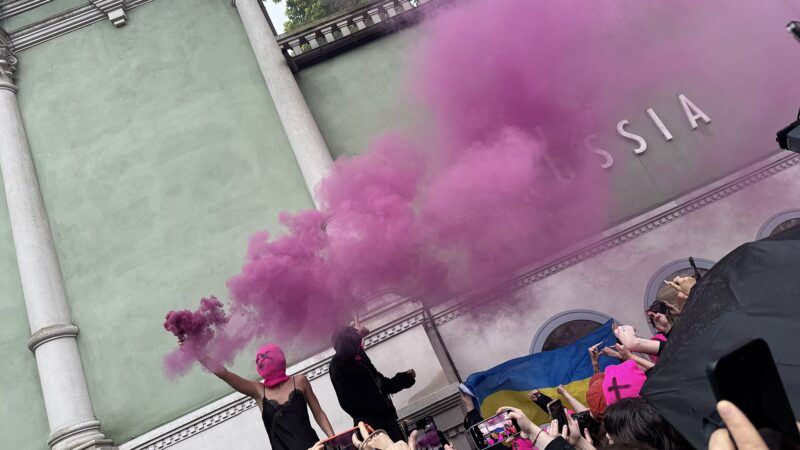
In May 2026, Irish journalist and filmmaker Caolan Robertson met Russian Ambassador to Italy, Alexey Paramonov, at the Venice Biennale. Robertson addressed Paramonov in the newly reopened Russian Pavilion. As shown in Robertson’s video, he publicly challenged the ambassador about the contradictions in Russian state actions, pointing out that the Russian military was actively bombing civilian areas and killing people in Ukraine while state officials were serving champagne at an elite international art festival.
According to biennale officials, eliminating the pavilion would constitute censorship rather than resistance to the Kremlin.
At the European level, Russia uses the “Russian Houses” and the Rossotrudnichestvo agency to organize exhibitions and lectures. These inculdes heritage exhibitions in Paris, displays on “resistance to Nazism” in Berlin, Budapest, Athens, and Madrid, and lectures aimed at rehabilitating historical figures like Ivan the Terrible or Peter the Great in Barcelona, Belgrade, and Rome. Romania, Poland, Slovenia, and Slovakia shut down these centers in 2022. Moldova followed in 2025, describing them as a “direct threat to national security.”
While Germany, France, and the Czech Republic, despite publicly supporting Ukraine, did not close the Russian cultural centers.
The biennale is not the first or only place Russia tried to whitewash its reputation. Over the past few months, global federations have begun readmitting Russian athletes into disciplines ranging from aquatics to gymnastics. Russia’s ban from football should “definitely” be lifted, said FIFA president Gianni Infantino, in February.
Russia attacks even on the cultural memory front as well.
This cultural offensive is managed through Government-Organized Non-Governmental Organizations (GONGOs), specifically the Russkiy Mir Foundation and the Alexander Gorchakov Public Diplomacy Fund, which utilize public diplomacy to mask ideological subversion.
The Media and Russian Orthodox Church—An Instrumentalization of Soft Power
Mass media sources such as Russia Today and Sputnik constantly disseminate Kremlin narratives while also disseminating disinformation in order to sow distrust in Western institutions and exploit societal divisions such as migrant integration challenges. RIA News Agency and other sources are state-run operations.
The Russian Orthodox Church (ROC) is more than just a religious institution; it serves as the principal force multiplier for the Kremlin’s psychological operations and internal mobilization.
The hierarchy gives philosophical cover for kinetic military activities, portraying geopolitical aggression as a transcendental conflict.
Patriarch Kirill, the Church’s leader, delivered a sermon soon before the Russian invasion, utilizing the “prodigal son” analogy to portray Ukraine as a wayward kid whose “return” to the father (Russia) was a spiritual necessity. Later, he referred to Ukrainian forces as “evil forces,” and said that Ukraine is a “Russian land.”
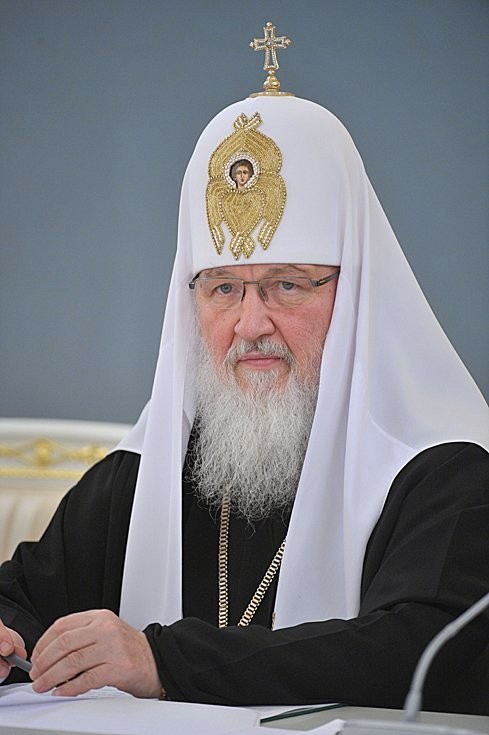
Patriarch Kirill of Russia at a Bishop Council in Moscow, 2013 Photo Russian President’s Press Office/ Wikimedia Commons
Then, as chair of the World Russian People’s Council, Kiril released the “Holy War” declaration. It presented the invasion as a battle against “globalism” and the “Satanic” West, demanding that all of Ukraine fall under Russian control.
Freedom of Speech vs State Propaganda
This year marked Russia’s first appearance at the Venice Biennale since the war in Ukraine began in 2022, as the following years saw its state-backed culture largely vanish from Europe’s major public events. As they said when they announced the pavilion, “We are not coming back, (…) we are always here.”
But for opponents of the Russian participation, Russia’s exhibition was less about artistic freedom than an attempt to reclaim international legitimacy after the country’s full-scale invasion of Ukraine in 2022.
Russia’s return to elite cultural spaces is not only about freedom of speech. It is about whether democracies can distinguish independent culture from state-backed reputation laundering.
Russia’s soft power is part of its war strategy. It seeks prestige, legitimacy, and influence—while missiles continue to strike Ukraine. Democracies should not help the Kremlin turn culture into camouflage.