 By
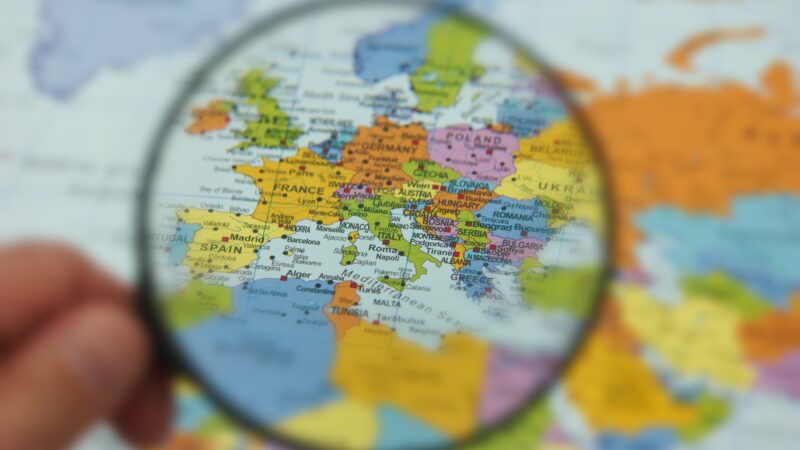
By Thirteen years after Croatia’s accession, the bloc’s last new member, EU enlargement is moving from rhetoric towards serious action. At a recent summit in Tivat, Montenegro, the 27 member states agreed to open a new phase in membership talks with Ukraine and Moldova. Of the 9 current candidates for EU membership, 4 are said to have potential to join by 2030.
Talk of EU enlargement seems to be everywhere, and, given current international uncertainties, even previously hesitant countries are weighing accession. Iceland, which paused negotiations in 2013, has decided to hold a referendum in August on whether to resume accession talks, while Norway is also reconsidering its relationship with the bloc, seeking safe harbor amid growing geopolitical instability. Meanwhile, British prime minister-in-waiting Andy Burnham is pushing for a mandate to reverse Brexit. Finnish President Alexander Stubb envisions an even more ambitious enlargement plan, advocating the expansion to 40 states. Such a bloc could include countries such as Canada, Britain, Norway, and Turkey.
This renewed ambition is driven by the mutual benefits of integration, underscored by Russia’s invasion of Ukraine.
Since 2022, candidates, realizing the risks of staying outside the bloc, have been rushing to anchor themselves in European security. Brussels, in turn, has its own interest in enlargement – expanding European influence and guarding against encirclement by Russia.
Enlargement is back on the table; the question is who can realistically join, and how the accession process could be reformed to enable faster integration without compromising its safeguards.
The Geopolitical Case for Enlargement
Motivation to advance enlargement is high. The road to membership, however, is long and complex, involving lengthy negotiations, sweeping reforms, and, most significantly, unanimous approval of current member states at every stage. This explains why no member state has joined in 13 years and why accession by 2030 remains ambitious even for Montenegro, a country that has been in membership talks for 22 years.
There is reason to reform this protracted process. European strategic autonomy and its ability to project power on a global scale are often based on size and scale. Reinforcing its commitment to enlargement is therefore in the EU’s own strategic interest.
Bringing in states that are already closely integrated with the EU economically, socially, and politically turns external vulnerabilities into shared responsibilities. Their integration also reinforces the EU’s position as a cohesive and influential actor in the international arena. Meanwhile, an extended European Single Market would stimulate economic growth and enhance competitiveness, increasing Europe’s economic weight in the global economy. A larger Europe would also provide more security to its member states by pooling resources across economic and security domains and reinforcing alignment with shared values.
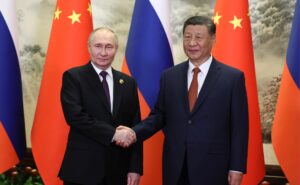
President of Russia Vladimir Putin with General Secretary of the Chinese Communist Party Xi Jinping in the Great Hall of the People in Beijing, during Putin’ state visit to China. Photo source: Kremlin.ru / The Official Website of the President of the Russian Federation / Wikimedia Commons, CC BY 4.0
In the context of Russia and China both vying for greater influence in the region, as well as the United States’ growing ambivalence toward the EU, expanding towards the Balkans and Eastern Europe has strategic benefits beyond general enlargement. Political actors across the EU have not hesitated to underline this.
Already in December 2024, European Council President António Costa claimed that “enlargement is the most important geopolitical investment in peace, security and prosperity” towards which the EU “needs to work harder and faster.” In March 2026, the European Parliament issued a press release calling enlargement a strategic investment in Europe’s security and stability. Most recently, at the Tivat summit, French President Emmanuel Macron underlined the region’s geostrategic importance as Europe’s energy, security, and migration chokepoint.
Securing this strategic region, then, becomes a geopolitical necessity to prevent other global powers from exploiting the void left by a dwindling European presence.
Since Russia’s invasion of Ukraine, enlargement has also come to mean building a defensive shield and reinforced border against Russian encirclement. This shift moves EU enlargement from expansive growth to protective consolidation.
Although geopolitics has shaped every round of EU enlargement, the present wave is particularly driven by the confrontation with Russia. The war in Ukraine has changed both what motivates enlargement and what it means for European stability and security. The EU previously envisioned enlargement along the lines of merit, with candidate countries progressing through negotiations according to their degree of alignment with European values and principles.
This logic has been partly displaced, as more urgent matters, chiefly security, now drive fast-tracked paths to candidacy, best illustrated by Ukraine’s ability to secure candidate status within four months in 2022, a pace without precedent. Geopolitical urgency has become the principal driver of accession, but merit-based criteria still govern the substance, creating a dilemma between speed and rigor.
Caution, Readiness, and the Cost of Waiting
Nowhere is this dilemma more visible than in Ukraine’s case. Integrating the country into the bloc, along with its vast agricultural sector and energy potential, would contribute to Europe’s strategic autonomy by reducing its dependence on Russia across strategic sectors such as energy, food, metals, and raw materials. Its ongoing war with Russia has also enhanced its military capabilities, which would prove an essential asset to European defense.
Previously, Hungarian obstruction put Ukraine’s progress in deadlock; a change in Hungarian leadership, however, enabled the opening of a new chapter in its accession negotiations. Yet while the new Prime Minister, Péter Magyar, lifted Hungary’s veto, EU leaders have yet to find consensus on the conditions under which Ukraine should pursue membership.
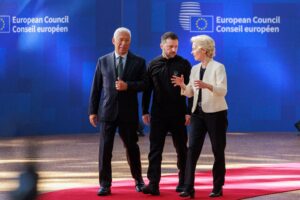
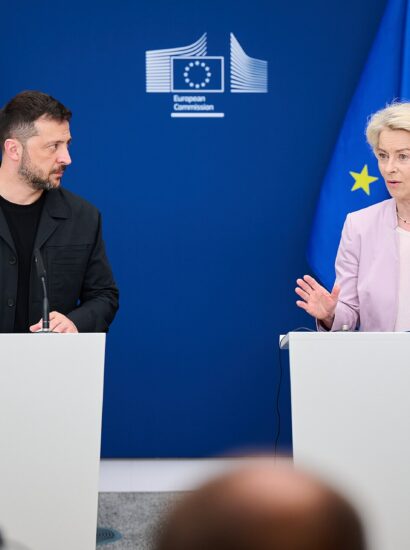
António Costa, Volodymyr Zelensky, Ursula von der Leyen at a Special meeting of the European Council, 2025. Photo source: Dati Bendo / © European Union, 2026 / Wikimedia Commons, CC BY 4.0
Generally, member states seem to favor the existing merit-based approach, which would entail all candidates, including Ukraine, progressing slowly through accession talks while gradually aligning with EU rules, regulations, and values. They remain committed to this position because they believe that whatever “creative” path is opened to Ukraine ought to be available to other candidates in the name of fairness.
Treating Ukraine differently could undermine talks with the Balkan states or discourage their membership ambitions. Meanwhile, too rapid progress for all might open the door to countries that, without a deep enough commitment to reforms, could suffer setbacks in anti-corruption measures or the enforcement of rule of law, similar to those seen in Hungary.
It would also leave too little time for the internal institutional reform necessary to enable efficient operation once the bloc expands from 27 to potentially over 35 members. Enlargement on that scale would require changes to decision-making, such as abolishing the veto in foreign policy, to avoid political gridlock. Waiting for reform that could involve treaty change would, however, postpone enlargement even further and risk pushing the process down the political agenda.
In spite of this, member states acknowledge the need for enlargement reform to make accession smoother for countries that have been waiting for years. Without a clear and credible strategy, the EU risks weakening the confidence and pro-European commitment of partners in the Western Balkans, Ukraine, Moldova, and Georgia, potentially slowing their reforms and encouraging them to turn to other geopolitical actors for support. Continued hesitation and disagreement would leave a vacuum that Russia, China, Turkey, or the Gulf states are ready to fill.
EU Membership Lite?
To overcome this deadlock, some have proposed more creative or gradual integration models, as a way to introduce an “EU membership-lite” into the system. At the Tivat summit, Macron announced a joint Franco-German proposal to create a strengthened gradual integration process. Under this proposal, a country meeting specific EU alignment criteria could gain entry to particular bloc formats, such as participating in European Council summits.
Other options include “halfway” integration models, such as accelerated access to the single market and Schengen zone in exchange for forgoing veto rights for several years. German Chancellor Friedrich Merz also floated the idea of a Ukrainian “associate member” status that would allow Ukraine to attend EU summits and ministerial meetings as an observer.
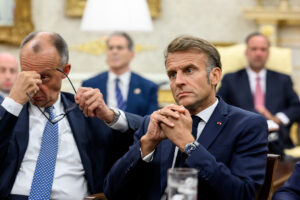
German Chancellor Friedrich Merz and French President Emmanuel Macron attend a high-level meeting at the White House, Monday, August 18, 2025, in the Oval Office. Photo: Daniel Torok / The White House / Flickr.
This could be seen as an interim step towards membership, nevertheless, others see such proposals as stalling full integration into the bloc. Unlike the traditional chapter-and-cluster model, where meeting requirements leads to ratification, gradual integration deepens cooperation with no specific guarantee of eventual membership. With no specific link to the formal accession process, such “halfway” integrations could be seen by candidates as a replacement, a limbo of indefinite integration without the benefits of full membership, and could propel them toward partnership with Russia or China out of frustration.
Already, years of stalling have led to a significant decline in support for accession in a number of candidate states. In Serbia, public support for membership has dropped to below 50 percent, while Belgrade is maintaining increasingly close ties with Russia and deepening defense and security cooperation with China. Similarly, in Georgia, even as public support for the EU remains strong, the government appears to be strengthening its relationship with Russia and drifting away from the goal of membership.
A Manageable Enlargement by 2030
Four candidate countries are considered to have a realistic chance of joining by 2030: Albania, Moldova, Montenegro, and Ukraine. Of these, Albania, Moldova, and Montenegro are far less contentious than Ukraine, since member states remain wary of admitting a country still at war.
Rather than experimenting with “halfway” integrations, it might be wiser for the EU to concentrate on the three candidates with the greatest chance of achieving membership by 2030. Demonstrating tangible progress could then encourage remaining candidates and reinforce their commitment to an accession process that, however tricky and lengthy, still leads somewhere.
Rather than offering candidates a consolation prize, observer status, or access to the single market without any binding commitment to shared responsibilities, the EU should build concrete accession tools that enable and accelerate reforms in rule of law, media freedom, and public participation, all necessary for alignment with EU values by 2030.
EU enlargement has largely remained on hold since Croatia’s accession. In the 13 years since, the bloc has actually shrunk, from 28 to 27 members, following the UK’s departure, a contraction that has coincided with a gradual erosion of EU influence and geopolitical weight.
Albania, Moldova, and Montenegro form a small, manageable group, with a combined population of less than 8 million. Their accession would be unlikely to generate instability, yet it would signal that the EU remains capable of growth, expanding its influence and reasserting its power on the global stage.
Enlargement has historically been a tool of stability, prosperity, identity, and security, not an optional policy tool but a central component of the EU’s ability to adapt, endure, and prosper, and one of its most effective responses to crises. It may be time for the EU to reconsider that role, and to commit more fully to enlargement as a tool for responding to the challenges it now faces.