 By
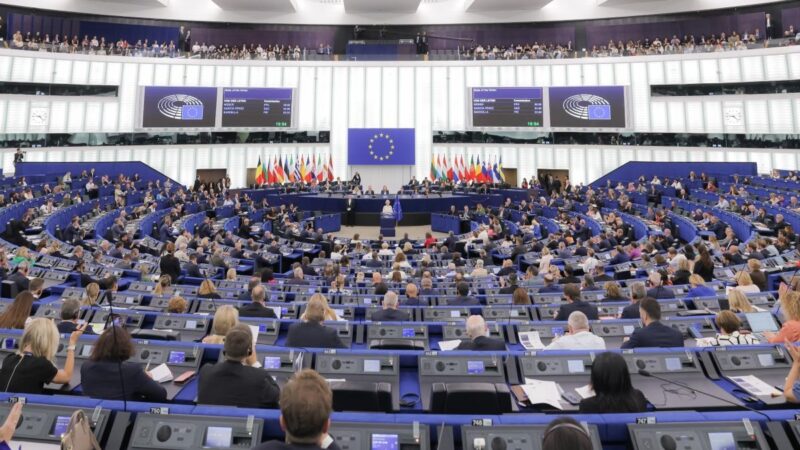
By The State of the Union address (SOTEU), delivered annually by European Commission President Ursula von der Leyen, is a pivotal moment for outlining the European Union’s strategic priorities, legislative goals, and vision for the future.
This year’s address focused on European sovereignty and security, climate and artificial intelligence, social policy, affordable housing, Ukraine, migration, democracy, and enhanced transatlantic cooperation with Canada.
To achieve these ambitious objectives, eight new initiatives and at least five new frameworks and proposals were announced.
Although the phrase ‘there is nothing new under the sun’ may apply, the details need closer examination. The following analysis breaks down the 10+1 topics addressed, as well as notable omissions, in the approximately 70-minute speech.
1. Europe’s Sovereignty in an Unstable World
Europe is stronger but operates within an increasingly uncertain international environment. Von der Leyen’s opening statement established the central argument of the speech: Europe must determine its own course. As she emphasized,
“Because in this world, the fate of Europe must remain in the hands of Europeans.”
According to the Commission president, Europe is now better equipped to defend itself than ever before, having radically overhauled its approach to homeland security and increased defence spending by almost 80 percent in the past five years.
2. Competitiveness, Single Market, Investment and Innovation
The economic section of the speech addresses that Europe has a strong advantage of its single market but does not exploit its full potential because of the red tape.
“We have a huge market, world-class industry and services, a rich pool of savings and one of the world’s leading currencies. And yet, we still fragment our capital, networks and purchasing power.”
The Commission president wants EU countries to agree on a new “pact against gold-plating” — the practice of adding national requirements when implementing EU legislation.
3. Energy Independence
According to VDL, Europe needs to electrify and reduce its dependency on imported fossil fuels. She pointed to a few things Europe needed to do: “We must invest faster. We must speed up grid connections. We must develop storage,” she said — and highlighted the Commission’s goal of doubling the share of electricity in Europe’s energy mix by 2040.
If it happens, energy imports will be €260 billion cheaper per year, Von der Leyen promised.
But she offered no further plans or initiatives to ensure the bloc’s long-stagnant electrification rate can ratchet up — nothing on electric vehicles, heat pumps, batteries, industrial electrification, or other elements. The Commission did, of course, propose an Electrification Action Plan, but nothing happened.
Von der Leyen described the trade imbalance with China and dependence on Chinese critical materials as economic and strategic vulnerabilities. “Our trade deficit with China is now €1 billion, (…) we are more than 80 percent dependent on China for many critical raw materials. 90 percent for some rare earths.
UVL proposed stronger trade action, diversification, stockpiling and a European Corporation on Critical Raw Materials.
4. New Strategic Partnerships with Canada
Canada is presented as a particularly close democratic, economic, technological and security partner.
The speech proposed an “Alliance for the Future” and raises the idea of Canada becoming the EU’s first associate member– although no one knows exactly what this means.
Energy will be one key area of cooperation with Canada, von der Leyen told MEPs. The two already collaborate on nuclear power, clean tech and methane mitigation. Moreover, she stressed the success of the Canada-EU trade agreement: “Thanks to CETA, our trade in goods has grown by 75 percent in less than a decade.”
While addressing Mark Carney and referencing the cooperation between Brussels and Ottawa, von der Leyen emphasized, “This is not a partnership against anyone else, but for our common strength.”
5. Climate Resilience
Climate change is identified as one of the two major “tipping points” facing Europe. The Commission president defended the EU’s environmental objectives, urging member states to ‘stay the course on our climate targets’ and to ‘step up dramatically on preparedness’ following a summer marked by extreme heatwaves and widespread wildfires.
The speech also addressed water scarcity and security. Von der Leyen proposed the European Water Initiative and pledged to “present a European Heatwave Plan” in the future, though she did not provide further details.
6. Artificial Intelligence, Technological Sovereignty and the Future of Work
This is the second tipping point of UVL’s address, because she argues for both stronger AI safeguards and homegrown technological capabilities for Europe.
The Commission president is invited the major AI labs to Brussels to discuss efforts to “pace the frontier” of AI development.
The underlying principle is that AI should enhance human capabilities rather than replace human decision-makers. “The point is that AI needs to empower our doctors. Not to replace them.”
7. European Security, Defence and Support for Ukraine
Commission President Ursula von der Leyen outlined plans for the EU to accelerate work on anti-ballistic missiles and so-called strategic enablers, and to create its own version of NATO’s Article 4.
Another key proposal will be the creation of a European Security Council.“For a long time, we have discussed a leaders’ format focused on the security of our continent, with partners like Canada, Ukraine, the UK, Norway and others involved,” she told the audience.
The EU should also invest in joint defence projects with Ukrainian companies.
“At the heart of this collaboration is Freyja. Here, we are bringing together the Ukrainians’ combat experience and innovative strength with Europe’s technological leadership.
According to her, Freyja is just the beginning. “With the remaining funds from SAFE, we will set up a new programme for joint projects with Ukrainian companies.”
8. Social Europe
The speech links technological change to employment and subsequently expands to address the broader European social model, including jobs, regional development, care, housing, and women’s rights.
“We will invest in our regions, so everyone has the “right to stay”. We will launch a European Care Deal to address the challenges linked to our demographic changes.” There was also a half-sentence about the future launch of the first-ever Housing Act but without giving further details.
9. Migration, Asylum, and Border Security
Just two months after the warning of the Ceuta incident, von der Leyen called for a European Emergency Response Framework, which would give EU countries in similar scenarios “time-limited and strictly defined flexibility in standard procedures.”
She emphasizes the importance of border security and strengthening the bloc’s border agency, Frontex.
However, she did not mention raising the agency staff numbers, as she has called for previously. The Commission president did not forget to mention the roots of the problem, but it
10. Digital Fairness
Von der Leyen aimed at social media, which she said was stealing childhoods, and vowed tougher action to protect kids online, including keeping some minors off popular platforms like TikTok and Instagram.
“No social media under the age of 13. No personal account under the age of 15,” she said, adding platforms would also have to introduce “safe design” for under-18s.
+1 European Values and the Future of Europe
The conclusion revisited the EU’s origins as a peace project and proposes convening a new Congress of Europe around the 70th anniversary of the Treaty of Rome, with the aim of developing a vision for the next generation.
She also remembered his old foe, Viktor Orban, mentioning the importance of the turning point on 12 April, “The day the Hungarian people took their future into their hands. (…) They brought Hungary back to where it belongs: at the heart of our Union.”
Von der Leyen assessed that the turnaround in Hungary was indirectly attributable to the EU institutions’ commitment to the Rule of Law: “Thanks to our Rule of Law Reports, any issues are now detected early and addressed through dialogue. (…) Respecting the rule of law and fundamental rights is a must for EU funds. It has to be front and centre in the budget. Now and in the future.”