 By
In the earlier days of the Internet, people were told not to believe everything they read online. Now, news consumption and political debate alike are moving increasingly online and onto social media.
The UK’s state regulator for communications services, Ofcom, stated in their 2026 News Consumption Survey that 73 percent of adults access news using online intermediaries such as social media, compared to 57 percent who access news directly. In the US, Pew Research Center also reported in an August survey that digital services were the primary source of news consumption (59 percent), with social media in a near-tie (26 percent) with news websites and apps (27 percent).
Citizens are not the only ones affected: politicians also utilize social media to examine their voters’ opinions and to discover social discourse. However, when this bleeds into policymaking, it has a similar effect on the communication between voter and politician that it does on everyday relationships: it creates distance and miscommunication.
Social Media and Isolation
Getting news on social media is problematic for several reasons: its content is aggregated without the traditional values of journalism and is instead market-driven. This means that news outlets must not only adapt to fast-paced modern life but also compete with online entertainment and social interaction. This frequently leads to sensationalism and misrepresentation due to having to condense run times.
This bleeds into political discourse, distorting real-life issues, as each person’s algorithm creates a social and opinion bubble, making it increasingly difficult to see another’s perspective or to carry calm, informed political discourse.
That is a problem for democratic statecraft, where free, informed discourse is the assumed basis of voting rights and political mandates alike.
But it is not only the voters who are caught in an opinion bubble; as social class gaps widen, politicians are increasingly distanced from primary voters. This is not only true in a political sense, like a left-wing politician trying to understand a right-wing voter: policymakers tend to be older, often leaving younger generations misunderstood; policymakers were educated in more high-end private schools, misunderstanding those unable to reach such levels.
As many state premiers are preoccupied with international relations and keeping the right-wing at bay, day-to-day politics often fades. This is not necessarily because policymakers fail to see issues plaguing citizens but because the priorities of policymakers are very different from those experiencing their governance.
So what can be done?
When Politicians Fail, Citizens Must Step Up
As policymakers fail to address issues, the most immediate way to bring issues to their attention is civil activism.
Research shows that civil activism is on the rise, with the media frequently covering recent Gen Z protests across the world. But this is not a long-term solution and should only be a last resort.
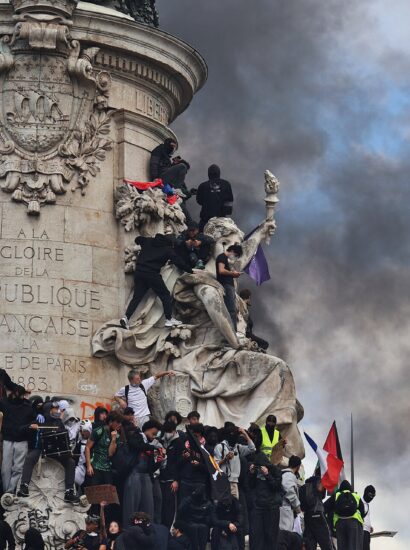
In France, French President Emmanuel Macron faced criticism for the police force used on student protesters, but addressing the primary issues that sparked protests – an underfunded system that overworks students and deepens social divides – were soon overshadowed by the discourse over violence in social movements and how to contain them.

French students protest in Paris, France in 2026 (Photo: FreCha / Wikimedia Commons)
But the initial reason for the protests was that the French government failed to address the problem for years, which protesters said forced them to raise awareness in new ways. Even once the government promised change, their credibility had been so damaged for the students that the protests continued as they believed measures lacked “sufficient means of implementation.”
Politicians should remain attentive to the concerns of their constituents even after being elected. This is especially true nowadays, when many politicians are not elected for their social prowess or convincing manifesto, but as the lesser evil out of a myriad of unsavory candidates.
However, this is an increasingly unpopular attitude toward governance.
As a result, grassroots civil activism prompted political movements that stepped out of the digital world, speaking to voters directly.
Triumphs of On-The-Ground Politics
The increasing gap between policymakers and citizens are most prominent where it is not only a phenomenon caused by digitalization and social divides but is also reinforced by autocratic regimes.
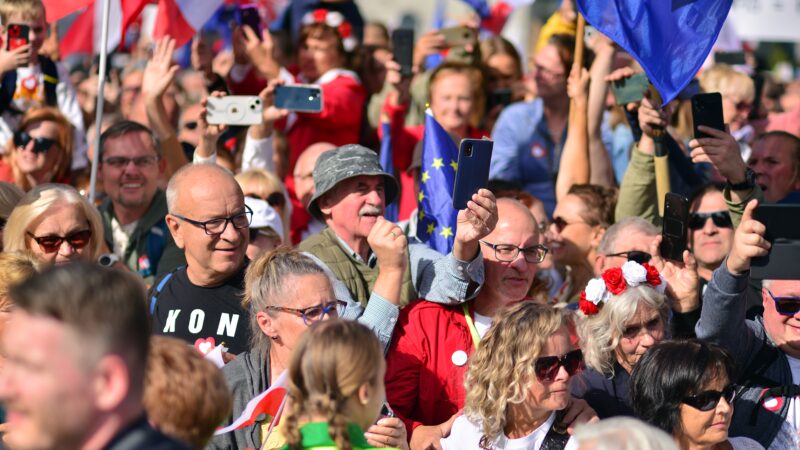
Hungary’s now–Prime Minister Peter Magyar’s election campaign was largely successful thanks to his continuous countrywide campaign, where he toured across the country for rallies and discussions with voters. This also extended beyond Hungary’s borders to the ethnic Hungarians in Romania, a key group for his opposition.
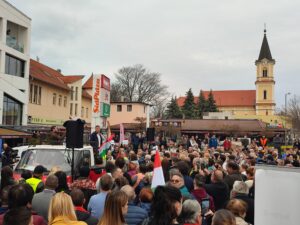
Magyar Péter speaks at a small rally in Siófok, Hungary, March 2025. Photo source: SNRTZ / Wikimedia Commons, CC BY-SA 4.0
The move communicates well in several ways: firstly, it shows the politician’s interest in catering to voters despite their personal discomfort. Secondly, it helps that the voters are asked about their concerns in their homes, so the politician can catch a glimpse of how citizens live. It also creates a direct line of communication between the two, without the noise of social media or even traditional journalistic reporting.
For Magyar specifically, this was a targeted strategy to outdo his opponent, Viktor Orbán, whose allies controlled the Hungarian media. His direct campaign bypassed Fidesz’s main tool for propaganda.
In Serbia, the situation was similar: student-led protesters built an opposition party that won over President Aleksandar Vucic’s administration. The students led protests for two years before creating the Students’ List out of experts, university professors, teachers, and other non-partisan individuals as the opposition. The student movement once again bypassed the state’s media control by initially mobilizing on social media but taking actions such as organizing a cycling tour across the country to raise awareness of the incumbent party’s corruption and promoting their party.
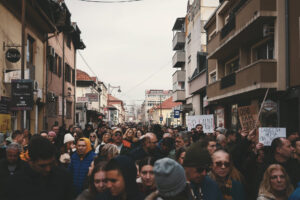
Protests in Cacak, Serbia, regarding the fall of a concrete canopy in Novi Sad. Photo source: Dejan Krsmanovic / Flickr, CC BY 2.0
In the US, Democrats utilize a similar tactic in the recent election: candidates emerged representing renewed emphasis on direct voter engagement and communication grounded in citizens’ lived experiences, instead of allowing polarized rhetoric to be the focus of elections.
A Subversion of Tendencies
The election of New York Mayor Zohran Mamdani was in large thanks to his grassroots politics but also his utilization of social media. In part, he created videos in the style of social media influencers, making the algorithm work for him by reaching various voters online. He also pursued traditional media coverage to remain competitive with opponents on conventional channels. But it was his grassroots efforts that brought his election success as well as his continued approval ratings.
Additionally, he ensured social media formed a direct line of communication between New Yorkers and himself, using it as a hotline to spot issues across the city; many of the videos showing dangerous potholes that disappeared a few days later have gone viral and contributed to the mayor’s global success.
Returning to grassroots politics and ensuring that voters are actively involved, rather than being passive subjects, would help subvert the current global decline in democracy. These practices create stronger communities, reinforce trust in government, and simply make for more effective governance.