 By
By The use of the term ‘middle power’ has risen significantly in the past month after US actions in Venezuela and rhetoric on Greenland have convinced the world that while Donald Trump may not be US President forever, his ideology will have a long-term influence on US and global politics. As such, the United Kingdom, as a middle power that now operates outside the EU, must rethink its Brexit-era plan of relying on the ‘special relationship’ to make up for the trade lost with the European Union and seek other alliances.
Such an endeavor must involve realigning with the EU on a wider policy spectrum, and there are fewer obstacles on this path than first meeting the eye.
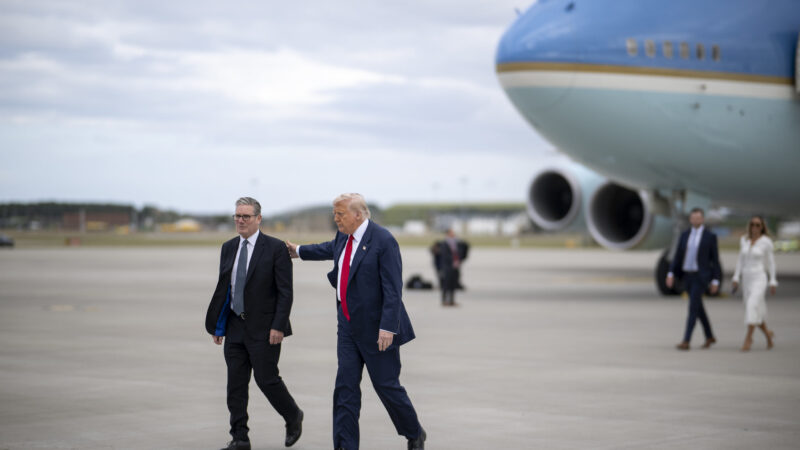
Starmer Stands Up to Trump’s Insults
The active and enthusiastic UK entry into the US’s conflict in Afghanistan battered Tony Blair’s government. Critics argued young British men lost their lives for a cause that wasn’t theirs. The move also strained relations with then-fellow EU members, especially France and Germany.
Many analysts argued this choice defined a turning point in the state of the ‘special relationship’, as it was a controversial move that clearly signaled Britain’s willingness to prioritise the US over Europe in international relations.
That relationship has since weathered the lengthy process of campaigning for, voting on, and even implementing Brexit. Consecutive Conservative governments largely followed the ‘Global Britain’ strategy that emphasized “the importance of deepening our relationships with allies and partners around the world” over European cooperation.
Now, Trump has derailed these efforts: first, by threatening Greenland; then, by criticizing the Chagos Islands Deal, yielding the territory to Mauritius, struck by the Starmer government; and then, by directly hitting a sore spot by saying European troops stayed away from the front lines in Afghanistan after joining the war on terror under NATO, invoking Article 15 of its founding Treaty.
As tension mounts between Trump and the EU, the UK is caught in between, without a clear path forward. The combination of post-Brexit tensions and Trump’s unilateral approach to foreign relations leaves the UK abandoned and without a steady footing in a turbulent world order.
The situation can deteriorate further should the UK remain on the threshold without drawing an ideological line for Trump to stop at. So why hesitate?
Labour Infighting Means Cautious EU Alliance
Prime Minister Sir Keir Starmer, a Remain supporter, has always been cautious about EU relations, taking every step slowly, reassuring Eurosceptics of his own party as well as wider British society that he has no intention of returning to the EU, only a reset to relations.
But resistance remains, and it is doubtful to ever go away. Especially as Starmer’s standing in his own party is being called into question, leaning more towards Europe is a logical choice but one the PM will be hesitant to make as it could cost him his position.
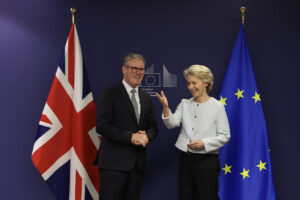
Prime Minister Keir Starmer meets Ursula von der Leyen, President of the European Commission. Photo: Number 10 / Simon Dawson / No 10 Downing Street / Flickr, CC BY-NC-ND 2.0
But looking around British politics, an anti-Trump atmosphere has been emerging. The popularity of Green Party leader Zack Polanski has spiked recently, and he would go so far as to leave NATO to sever the UK’s defense ties with the US. Liberal Democrat leader Ed Davey called for an end to appeasement policies when it comes to the US. Conservative Party leader Kemi Badenoch agreed with Trump on the Chagos deal, but his Afghanistan comment forced her into rebuttal as well.
While his own party is divided on the matter, this could just be pulling at Starmer’s leadership, especially as he blocked a potential rival, Andy Burnham, from the chance of becoming MP.
There is not just a dissatisfaction on the political level; an opinion poll by IPSOS revealed that Brits have been skeptical of the special relationship, the President, and Starmer’s diplomacy since the tariffs of April 2025.
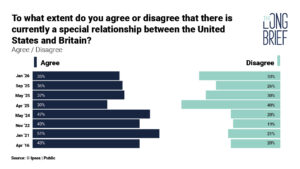
Results of the IPSOS poll. Base: 1,058 Online British adults 18–75, 7–8 January 2025. c.1,000 British adults each month.
IPSOS also measured a growing willingness to make Europe the primary partner of the UK (50% of respondents) over the US (21%) or the Commonwealth (12%). The poll findings were released before the Davos World Economic Forum, on January 12.
The current strategy seems to bypass the EU and economic partnership by leaning on NATO membership and defense collaboration. A major point of agreement with the EU is the support of Ukraine – but this needs more coordination as well.
But the end of the special relationship doesn’t only apply to selective policy areas – it means a collective overhaul of how the UK deals with other allies and how a post-Brexit society can agree on warming to Europe once again.
Where Else Can the UK Find Allies?
If the EU and the US are not viewed as primary partners, then logical alternatives with strong standings are on the other side of the world.
Though the AUKUS deal remains backed by Trump, it is questionable whether the alliance will work as intended. Australia, the other partner in the deal, remains a partner for the UK, but its geopolitical position means its priorities greatly differ from London’s.
Canada has emerged as a leading voice of a new alliance, critical of Trump and favoring a global coordination. A new strategic partnership has been in the works since Trump started his tariff war. It collapsed in 2024, restarting in April as Canada was hit with higher tariffs. Canada is also partnering with Europe, implicating that an alliance with them will mean growing closer to Europe with time.
Long-term politics can change under a new UK government, under a new US President to engage with. But Starmer must react now, and his reaction cannot be as lukewarm as it has been previously, or he could stand to lose more than just his domestic leadership race.
By teetering, Starmer is exposing the UK to the potential of standing alone, missing out on Europe’s development and defense while its allies remain out of reach.
Starmer’s recent choice to abandon certain policies and make a strong stance against Trump signals he is willing and capable of acting now. But the question remains whether he will extend this approach in trade and defense as well, and whether it will be enough to solve his predicament.