
 By
By Albertans are heading to the polls in October to express their opinion on whether they should remain a member state of the Canadian Federation. Meanwhile, U.S. President Donald Trump has launched a trade war against Canada and is showing maps of the country with an American flag draped over it.
Against this backdrop, Canada’s place in its historical political community is in question: internally, the continuity of the federation is under renewed pressure by Alberta’s secession ambitions, externally, during the second Trump administration, its longstanding alliance with the United States has become less reliable.
As a response, other political blocs are being considered as sources of stability and belonging. In his speech in January 2026, at the World Economic Forum in Davos, Canadian Prime Minister Mark Carney announced the end of the old order and called upon middle nations to cooperate to balance the increasingly coercive great powers.
Ottawa looks for other regional powers to strengthen its strategic network and reduce reliance on the US both in economy and defense.
Carney has recently visited Beijing to launch a strategic partnership with China, and restored high-level dialogue with India after years of fallout. Canada is also engaging in closer cooperation with Europe in the fields of trade and defense, including through the EU’s SAFE defense financing program. The strongest option for collaboration is a a strengthened partnership between Canada, Australia, New Zealand and the United Kingdom in the form of CANZUK.
Policymakers in Ottawa must now figure out what political community Canada can rely on when both its internal federation and its external North American security and economic order are being called into question.
Canada’s Internal Community: Federation Under Pressure
The public consultation in Alberta this October will essentially be a referendum on holding a referendum: citizens will get to say if they want to remain in Canada or to proceed with a binding vote on secession.
The development takes place after months of political turmoil: the oil-rich province, often referred to as the Texas of Canada, has seen the rise of a movement against the federal government, that, under the premiership of Justin Trudeau introduced climate-centered policies that have constrained the growth of Alberta’s oil and gas industry.
As opposed to the more well-known movement in the province of Québec, which is rooted in a sense of common identity, history, and language, Albertan separatism has been a marginal movement never supported by over 20 percent of citizens. It was driven by grievances of being exploited by less wealthy states and milked through taxes that Albertans do not have control over.
Today, under the leadership of Mitch Sylvestre, it is becoming attractive to broader audiences, with recent polls showing 35 percent support for secession.
The movement has also been strengthened by cross-border political influences, especially the influence of American conservative populism. Separatist activists are in contact with the US administration and have asked for funding and other assistance. The Trump administration has denied providing any, but high level meetings between the leaders and U.S. State Department officials are confirmed to have taken place. Additionally, MAGA supporters have publicly backed Alberta separating from Canada.
Although the idea of joining the US remains unpopular with the majority of Albertans, separatists imagine a close alignment with their neighbor with a common market and zero tariffs on both sides. The administration seems to agree with that vision, with Treasury Secretary Scott Bessent calling Alberta a “natural partner for the US.”
Still, for many citizens in Alberta, even the idea that a referendum on secession is scheduled is absurd and an important segment of the population simply wishes to use the referendum as a signal to Ottawa to express their perceived injustice.
Indigenous groups are worried about possible setbacks their legal rights might suffer if their treaties with the country were to be called into question or renegotiated.
Albertan Premier Danielle Smith, although she relied on separatist votes to get in power and appeared to endorse the movement, is now cooperating with Carney to meet Albertans’ demands.
Since then, the federal government has overseen concessions to previous environmental regulations with agreements made for a new pipeline and exemptions in place for the province’s energy industry from several environmental laws.
Altogether, although secession remains unlikely, the movement does pose structural threats to Canadian unity. The danger is not that Alberta is on the verge of independence but that separatism has become a bargaining tool inside Canadian politics exactly at a moment when external pressure from the US is growing.
Canada’s North American Community: the US as an Indispensable But Unreliable Partner
For most of the Cold War period, Canada could treat the US as a stable ally integrated in its foreign policy. The two countries shared the world’s longest undefended border and cooperated through the transatlantic security alliance, as well as their bi-national military alliance, the North American Aerospace Defense Command (NORAD). This stability allowed for their relationship to evolve into one of the closest bilateral relationships in the international system and dispelled any doubt that Canada should be wary of depending on it.
That stance has weakened over Trump. He has repeatedly referred to Canada as a potential “51st state” and imposed tariffs on Canadian steel, aluminium, and autos inflicting significant damage to the Canadian economy, heavily dependent on trade with the US. This, coupled with reported communication between his administration and separatist leaders in Alberta, has made an old anxiety of Canadian politics resurface: that the proximity of the great power can be a threat as much as it can be security.
The ‘decades-long process of an ever-closer economic relationship between the Canadian and US economies is now over,’ declared Carney in October, amid a trade war launched by the second Trump administration.
Even so, economic dependence remains an issue, Canada’s economy is still structurally tied to the US.
Around 70 percent of its exports go to its southern neighbor as it is the principal market for Canadian energy, manufacturing, and agriculture.
Even if most Canadian goods enter the US duty free through the CUSMA agreement between the US, Canada, and Mexico, already implemented tariffs reveal how quickly Washington can turn interdependence into leverage.
Meanwhile, CUSMA is also up for renegotiation this year. The agreement, shielding 90 percent of Canadian goods from tariffs and covering $1.3 trillion of cross-border trade, was negotiated by Trump in his first term. Although it does not officially expire until 2036, parties can withdraw from it with six months notice. Despite ongoing meetings between Canadian and US officials to review the deal until the July 1st deadline, Trump has recently threatened not to renew the agreement at all.
“Because to be honest with you, the United States does much better. We don’t need anything that Canada has, we don’t need anything that Mexico has, but they need everything that we have, and they have to treat us better” he toldreporters at the White House last Wednesday.
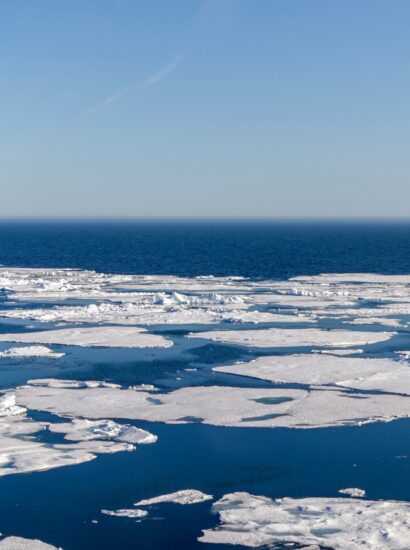
Trump’s renewed interest in Greenland has also deeply unsettled Canadians because the same logic of safeguarding Arctic access and natural resources could also be applied to Canada. It has raised fears that Washington might seek greater control over Canadian Arctic waters or interfere in domestic politics to leverage internal divisions and destabilize its neighbor.
As a response, Ottawa has reportedly started planning scenarios involving US aggression, with Canadian officials now publicly recognizing that American pressure could pose an existential threat. Issues once taken for granted, such as NORAD or Arctic defense and intelligence cooperation, are now being reconsidered.
But Canada cannot easily decouple from the US. Geography, trade interdependence, and defense cooperation make that impossible.
However, the once reliable political anchor has now become an exposure, which is why Carney attempts to diversify trade and looks for deepening ties with other partners. His broader aim is to double Canada’s non-US trade by 2035. Although an ambitious aim, this would still not eliminate Canada’s dependence on the US market.
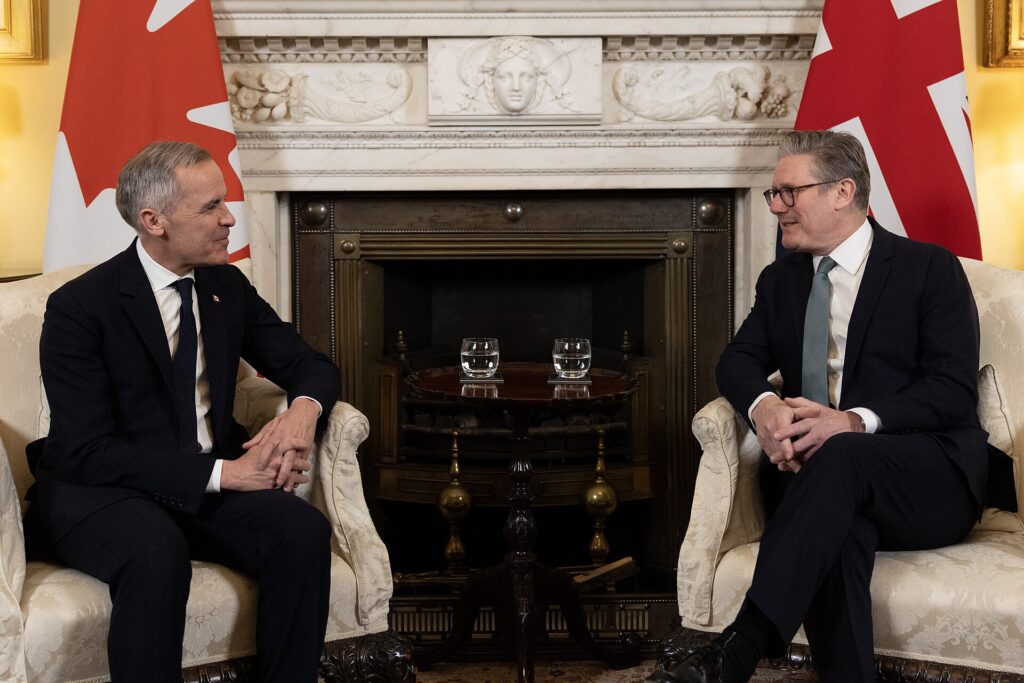
Canadian Premier Dan Carney meets with British Prime Minister Keir Starmer on March 17, 2025 (Photo by Simon Dawson/10 Downing Street)
Canada–UK Relations: Updating an Old Relationship
Search for alternatives have brought old relationships back into the focus, ones that, given a strong partnership with the US, had become more symbolic than strategic.
Today, Canada has more reason to emphasize its historic partnership with the United Kingdom and its place within the Commonwealth of Nations, or to push for progress in the recurring idea of a CANZUK alliance with the UK, Australia, and New Zealand.
Renewed attention to Canada–UK relations was evident after Carney’s meeting with UK Prime Minister Sir Keir Starmer in London this February. The meeting focused on strengthening economic and security ties between the two nations and reaffirmed their commitment to collective self defense. They also set up the Canada–UK Economic and Trade Working Group to support their growth and innovation partnership, emphasizing modernization and a new economic reality: they vowed to cooperate in digital trade, critical minerals, sovereign AI infrastructure, and defense procurement.
A broader framework for their cooperation could be the Commonwealth, an international association of 56 states, mostly former territories of the British Empire. An old infrastructure for partnership dating back to the beginning of the 20th century, the Commonwealth connects its members through their use of English, as well as cultural and historical ties. The cooperation has not collapsed, despite serious debates in some member states and weakening attachment to the British crown that has led to several states removing the monarch as head of state.
In the wake of Brexit, the UK hoped to revive its historic network as a substitute for the European Common Market, but its success was modest, and the alliance’s relevance today remains uncertain. Although the Commonwealth counts democracy, human rights, and educational cooperation among its objectives, it lacks the budget and the enforcement mechanisms to pursue that meaningfully. The credibility gap is hard to ignore: over half of the world’s countries that criminalize same-sex marriage belong to the Commonwealth despite its pledge to support human rights. Today, its most important role is in climate cooperation, as it includes numerous small Caribbean states that find it vital to engage in dialogue through the framework of the association.
A more ambitious option is the proposed CANZUK alliance between the UK, Canada, Australia, and New Zealand. Advocates of the initiative imagine closer cooperation through freer trade, labor mobility, and coordination in defense, military procurement, and critical minerals. The alliance would be undeniably impactful: it groups together four wealthy democratic nations with close historical, cultural, and language ties, as well as similar legal systems and shared strategic and security challenges.
The imagined multilateral free trade agreement would be similar in scope to the European Economic Community and would create the world’s largest economic grouping in terms of GDP.
Therefore, the integration of these four economies would create a bloc with considerable power, capable of exerting influence in trade negotiations. Geographically, the alliance would stretch from the North Atlantic to Indo-Pacific regions, which, combined with their considerable collective naval power, would translate into real geopolitical weight.
The idea of CANZUK is not new, the first mention dates back to 1967. The proposal is therefore often framed as a renewed partnership between four countries tied together by history. Polls show strong support for the alliance in all the four nations, with over 70 percent approval rates in every country.
However, CANZUK also has limits that might prove difficult to overcome. On the one hand, it risks being perceived as a nostalgia for imperial or ‘Anglosphere’ fantasy, especially where imperial history is particularly uncomfortable.
National identities and geographical distance also complicates deeper integration of their economies. While advocates continue to campaign for the union, the governments of the UK, Canada, Australia, and New Zealand have not officially confirmed plans for creating a formal, EU-style bloc.
Between Communities
While closer cooperation is possible and can give Canada more room for manoeuvre, its proximity to the U.S. and deep infrastructural integration mean that no alliance can substitute for that relationship. This is the limit of Canada’s alternatives: they can reduce exposure but cannot fully eliminate dependence.
Canada’s search for alternatives is not a unique dilemma. Many US allies are trying to reduce their dependence, keeping in mind that decoupling cannot be immediate.
Europe talks of strategic autonomy, Asian partners try to diversify supply chains, and India has signed several strategic partnerships to balance its reliance on the US. The lesson is the same for Canada: diversification is possible, but it is slow, laborious, and as of now, incomplete.
The dilemma Canada faces is therefore not a choice between communities, but managing several imperfect ones simultaneously while also balancing domestic political instability.
The federation, although strained, still holds, while American partnership is indispensable despite recent ruptures. Meanwhile, alternatives exist, but are incomplete. Integrating these political communities and navigating the ambiguities they might pose is the challenge Ottawa needs to tackle.