

 By
What are the key issues in this year’s mid-term elections: migration, the war in Iran, or the trade war? Or will bread-and-butter issues tip the balance? Or the local issues – such as the construction of large data centres powering AI, and the local candidates’ ties to the community – influence the final result?
We asked Tamas Magyarics, Hungarian historian, former ambassador, and research fellow, about these issues and about how the Democratic Socialist candidates can transform the Democratic Party.
The interview was finalized on October 27.
In your opinion, what issues are shaping the current mid-term elections? To what extent might Donald Trump’s foreign policy blunders – such as the war against Iran and the misguided trade war – prove to be a dominant factor?
Well, according to a survey, foreign policy isn’t among the 10 most important topics in the midterm elections. Iran is there because fuel prices are rising due to wrong Iranian policy, but otherwise, the Russian-Ukrainian war is not a topic in elections.
It is true that the referendum is also about the president, and this is not good news for Republicans, because in the polling market, President Trump’s approval rating is around 35-38 percent. On the other hand, local issues matter: if a very popular local candidate runs for representative or senator, they can counterbalance an unpopular president.
Right now, people are placing bigger bets on Democrats winning the House of Representatives. Of course, there are some interesting things here; in recent months, there has been a lot of talk about redistricting congressional districts.
In states like California and Texas primarily, both parties redrew the congressional districts, and obviously, in order to favor themselves.
Now, if we look at all the redrawn districts, Republicans could have gained only two or three more seats against Democrats.
National generic congressional ballot shows that the Democratic Party is gaining about 10 percent ahead of the Republicans nationwide. But we should treat this with caution for two reasons. First, based on past experience, Democrats have been regularly overrepresented by 3-4 percentage points over the past 20 years.
Second, it is not a national vote, but in Alaska people vote separately, and in Kansas they vote separately, and in Texas, and so on.
And this is where things get much more interesting, because in the Senate the Democrats would need to take four seats from the Republicans. Right now, Republicans hold a 53–47 majority. If they win only three seats, that won’t be enough, because in a tie, the vice president has the casting vote.
Democrats hope to win seats from Republicans, out of the 35 seats Americans will vote on. But the Democrats have to hold their current seats if they want to occupy the Senate.
Which key states are Democrats expected to win?
Of these five states, only North Carolina currently shows a lead of nearly ten percent, so it is safe to assume that they will win the election there. In the other states – Texas, Maine, Alaska and Ohio – however, the margin is between one and three percent in favor of the Democrats. This is typically within the margin of error; moreover, if we add the further four percent by which they are generally overrepresented, the situation is at least favorable for them.
Their position is somewhat uncertain in three states, particularly in Michigan, where the candidate is a highly divisive figure.
Abdullah El-Sayed, the democratic socialist.
Yes, on the one hand, he is a democratic socialist, and secondly, he is a radical Muslim. Furthermore, he wasn’t even locally embedded.
He was born into an Egyptian immigrant family.
Well, that wouldn’t be very interesting. The thing is, this immigrant, Ilhan Omar, is interesting because that isn’t her real name, and she’s been accused of entering into a sham marriage with her own brother. She said, as far as she knew, she hadn’t married her brother.
But back to El-Sayed: first, he’s made some pretty questionable statements; second, he is running against Mike Rogers, a moderate Republican.
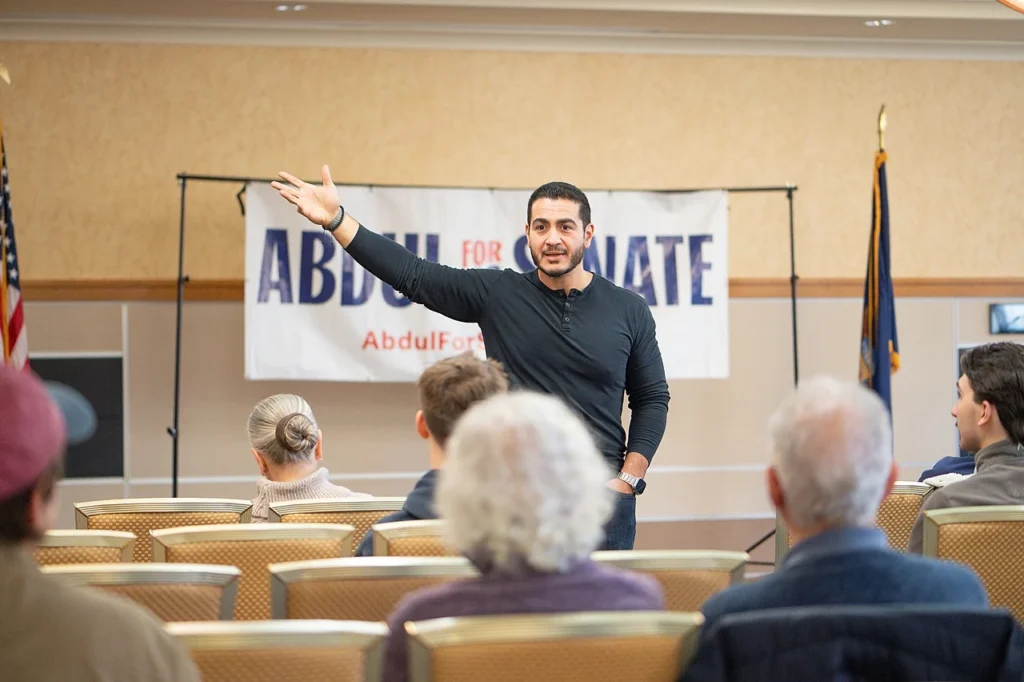
Abdul El-Sayed at a campaign event. Photo by Conlan Houston – CC BY-SA 4.0
Another important issue in Michigan is the Canada-US tariff war. So from this point of view, Trump’s tariffs and counter-tariffs help the Democrats more. But the difference between the two, according to the latest estimate, is 1.9 percent, which is well within the margin of error.
Which are the other two to-close-to-call states?
Minnesota and New Hampshire, which the Democrats probably will keep.
Are there any races where you expect surprise?
Interestingly, these two states used to be bulletproof Republican states: Iowa and Kansas.
Here, however, the Republicans are leading, but by less than 1 percent over the Democrats.
What about the candidates? Are they representing the Trumpist faction of the Republicans?
Yes, in the primary elections, Trump obviously supported the MAGA candidates over the moderates, and these Republicans won their primaries.
New surveys show young Republicans, or those who lean toward Republicans, are less enthusiastic.
In 2024, roughly 60 percent of those under 45 voted for Trump, but now only 45 percent would support the Republicans.
As the American political system is extremely fragmented, independent voters represent a very important electoral base. How are the Republicans performing amongst them?
Among so-called independents, the Republicans have a 15-percentage-point disadvantage.
The American political spectrum is roughly three-fold. They used to talk about 50-50, but now registered Democrats and registered Republicans are 35-36 percent, and one-third are roughly independent. The latter serve as the balance beam.
So, if that’s the case, Democrats have a better chance of winning.
I also want to talk about another close Senate race, surprisingly held in Texas. The Republican candidate is Ken Paxton, and the Democratic candidate is state representative James Talarico, who has a historic chance of winning in a state the Republicans haven’t lost since 1994. When I hear Talarico talking, it makes me feel like he is a moderate Republican.
Yeah, pretty much is the thing. He is religious, and he also supports strong border policy. So he’s trying to play both sides.
Returning to the above-mentioned issue, Trump has often forced his own MAGA Republicans into the nomination position against mainstream Republicans. Here, he endorsed a man with a rather troubled background, Kent Paxton, who was ultimately nominated by the Republicans, and it is obvious that the difference between the two candidates matters a lot here.
What do you expect during the last week of the campaign? Will there be any surprise?
We are in the final stretch of the race, and both sides are now putting a great deal of energy into it; in fact, both sides have raised $100 million. Obviously, all of this is concentrated in those places where the duel can definitely come out, and Donald Trump is kind of on the road. He’s mainly visiting these battleground states, so Maine, Arkansas, Ohio, Michigan, and Texas.
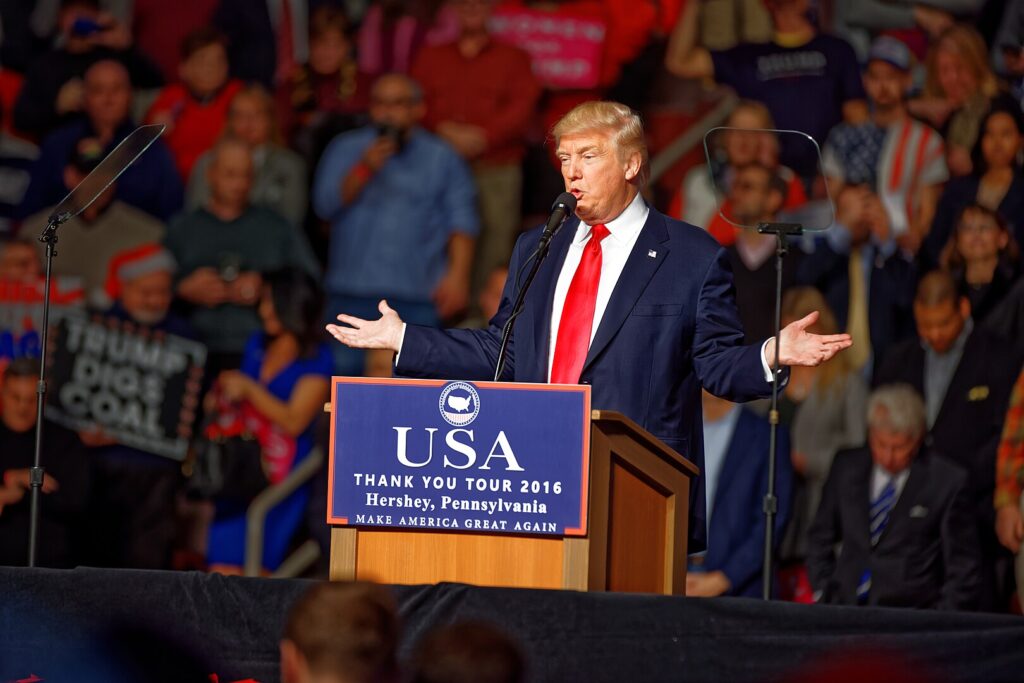
President-elect Donald Trump on his victory tour in 2016 (Photo: Michael Vadon / Wikimedia Commons)
On the other side, the Democratic Party is bringing in its big gun, former president Barack Obama. I’m not expecting a dramatic change; it is not very likely, for example, that the price of gasoline will suddenly drop by half.
So, Trump’s recent deal with Putin to buy diesel won’t materialize in this very short time?
The truth is that this diesel deal is a kind of spectacle. It’s about 300 thousand tons.
That’s two percent of the US’s monthly consumption. It matters most in agricultural states, where farming vehicles run on diesel. Many of these agricultural states are also battleground states, like Iowa and Kansas.
The U.S. uses more than 10 million tons of diesel per year. So these quantities that the Americans will buy from Russia are not such quantities that can fundamentally change the price of fuel or the price of diesel. Well, you can campaign on this – that Trump is working on this – but for the people at fuelling stations, they see that diesel is still over six dollars per gallon.
And as we know, fuel prices are affecting everything else.
Yes, high fuel prices will create a chain reaction: when transportation costs are high, retail prices rise, and so does the cost of living. The heating season is coming, and many people use oil for heating.
People can hold Trump and the Republicans accountable for saying that this was not their campaign promise. But interestingly, people don’t trust potential Democratic leadership much more than they would if Republican leadership remained.
If we’re talking about campaign promises, what about the $5,000 for every American if the Republicans win? How serious can it be?
To tell the truth, it cannot be serious. It is not going to help. If energy prices stay high long term, retail prices go up, and rent goes up. People can calculate that a simple 5,000 dollars, if these prices remain high, will disappear in half a year. So it’s unlikely, especially since it’s technically unfeasible.
This is a campaign tactic, nothing more.
Many people say an unexpected event could influence the results; now, would this be a black swan: Lula’s victory and the defeat of Trump ally Flavio Bolsonaro in the Brazilian presidential elections?
It is possible, but the Latino vote is more interesting there.
This has also changed since the 2024 presidential elections.
Yes, then 43 percent of Latinos voted for Trump; now it’s much lower. Here’s the Democratic Party lead, with 40 percentage points.
What caused this change? Is it because of the federal government’s immigration policy, or something else?
Interestingly enough, a significant portion of Latinos are in favor of secure borders and legal immigration. There is a phenomenon where once someone arrives first, there is no solidarity for the next one, and obviously they don’t want competition in the job market.
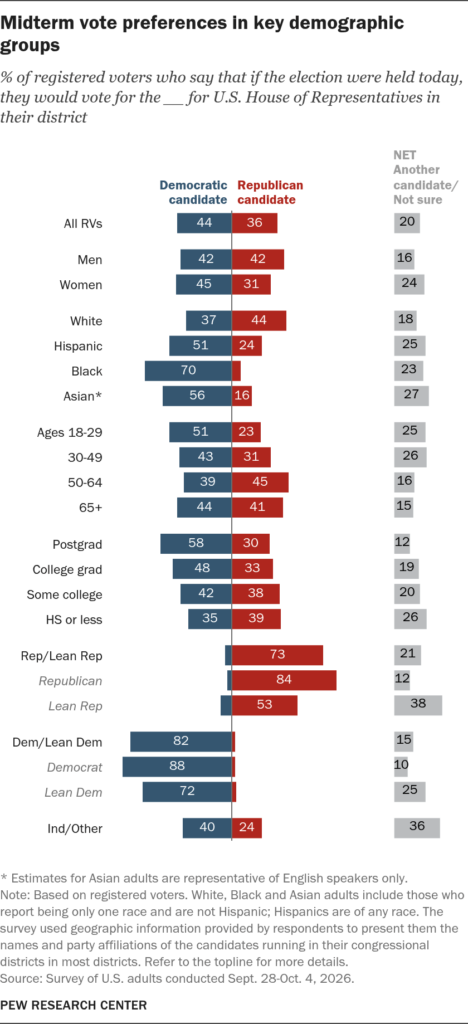
Midterm vote preferences in key demographic groups. Source: Pew Research Center
But in general, Latinos – just like other minorities – could be angry at the Trump administration because of the brutality of the mass deportations and the murders committed by ICE.
Yes, of course, the negative reputation of ICE is obviously being used by Democrats. However, it is not a popular idea that Progressive Democrats want to abolish ICE, because it performs quite serious homeland security tasks.
And this is one of the things that El-Sayed and the Democratic Socialists are promising.
That’s why the Democrats can have difficulties. Namely, in several places where the Democratic Socialists (DSA) beat more moderate Democrats, it caused friction within the party and can alienate more conservative Democrats.

Families Belong Together – San Francisco Rally – Photos by Fabrice Florin, CC BY-SA 2.0
Would the DSA ruin the whole Democratic Party?
They’re not there yet, but they’re trying. Especially these “Young Turks”: Ayanna Pressley, Ilhan Omar, Rashida Tlaib, Alexandria Ocasio-Cortez. For them, politicians like Nancy Pelosi and other centrists are counted as too soft.
The DSA members want to change the elderly, white Democrats, even Hakeem Jeffries, who is the minority leader of the House of Representatives and a Black politician.
So they go a little too far, because they cover up issues that the majority of Americans would not like to see, among other things, defunding the police.
And they also want to demolish institutions like prisons, and moreover, the Senate and the presidency itself. How could these statements be taken seriously?
Indeed, they have quite amazing ideas. The DSA politicians, along with the Greens, support removing fossil fuels as soon as possible.
Then what would the tractors use as fuel: wind turbines or solar energy? They saw that going in this direction is quite significant.
However, this could also be a disadvantage for the Democrats, because although they are only a minority within the party, they are nevertheless identified with the party as a whole.
Yes, well, the Republicans obviously highlight that the Democratic Party is more of a left-wing party, and Donald Trump merely says they are “communist”.
Interestingly, these Democratic Socialists are Bernie Sanders’ faction, who made a fair living out of denouncing capitalism.
Despite that, Sanders is a good speaker with strong charisma, which is currently lacking among politicians.
I agree with that. I remember that in 2016, before the presidential election – Bernie Sanders was already quite elderly at the time – a round-table discussion was held in Hungary, which I also attended. The moderator asked the audience who they would vote for. Surprisingly, about 60 percent voted for Sanders, and only 30 percent for Clinton and 10 percent for Trump.
We should mention the most famous representative of the DSA, Zohran Mamdani, who has been the mayor of New York for about a year. How did he manage to fulfill his campaign promises, in other words, to what extent has one of the strongholds of capitalism become communist?
It’s unlikely that Wall Street would join the Communist Party. Obviously, Mamdani tried to fulfill his promises; he opened community stores and taxed the rich above a certain threshold. However, he realised that if the wealthy left New York, there would be no more tax revenue for the city.
So, of course, from the mayoral seat, Mamdani sees the world differently.
Obama was a classic example of this: when he was elected, and until then he received the announcements, at least a version of them, and when he became president, he said that he had no idea that there was such a difference between what the actual announcement was and what he received as a president.
Then let’s mention the Republicans: as far as I can see, the foreign policy is more divided- that is, the unconditional support of Israel, the Iranian war- is there anything else?
As I mentioned earlier, younger Republican voters are more disillusioned with Trump’s policies than those over 45, who still support him. So far, more than 55 million Americans have voted by mail and in person.
So the election agenda is very important: how much they can mobilize from their own voters on one hand, and how much they can motivate from the independents.
Currently, on a personal level, the Democrats are more enthusiastic than the Republicans, but that may change. In general, Republicans are the ones who don’t vote early.
According to a Pew Research Center survey conducted at the end of 2025, 59 percent of American adults believe that the country’s best years are behind it. 64 percent of Democrats and 53 percent of Republicans share this view. What is the source of this unprecedented pessimism?
The standard of living of the middle class has, generally speaking, stagnated; tuition fees have risen sharply; house prices and the cost of renting have soared; due to globalisation, large corporations have outsourced many jobs, and even the Trump administration has been unable to bring them back.
US global primacy still holds, but power has become more dispersed in recent decades; the post-Cold War ‘unipolar moment’ in America has passed, and a so-called ‘peer competitor’ has emerged in the form of China.
Domestic political life has become highly polarised; the number of issues with a so-called ‘national consensus’ has declined.
Lastly, if you had to guess, what would be the results of Tuesday’s elections? Will the Democrats secure both houses?
Yes, the truth is that I’m a reverse Cassandra, because in 2008, I thought that Clinton would win the election, and Obama won.
Well, I would even say the House of Representatives will be Democratic, and the Senate, given these very narrow differences in several races, could be held by Republicans; however, they may also lose one or two seats.
What would the situation be for Trump if Democrats occupy the Senate after all? Would he be a lame duck?
Yes, he will be like that for a while, because House Democrats have already announced that they will begin impeachment proceedings. So, Trump and his team will spend half of their time going to the Capitol to testify.
It is certain that in the budget negotiations and in much more they. They deliberately stand in the way of everything, hoping to fight their way to some sort of compromise. But Trump may not be able to compromise. Then there will be even more chaos, and more mud-slinging.