 By
By On 18 November 2025, German and French policymakers, representatives of civil society, and academics came together in Berlin for the Summit on European Digital Sovereignty. Some topics, like that the AI bubble that could cause a stock market bust like the fallout of the dotcom boom of the 1990s and early internet company surge in the early 2000s, were carefully avoided.
Instead, the conference focused on severing the EU from reliance on US tech giants and their control over political dialogue through algorithms. The shift brings about an interesting new avenue for European sovereignty; to step out of a US controlled online space, even if it means giving up a field where the EU’s soft power allowed it an invisible global influence.
The EU Cannot Be a ‘Vassal’
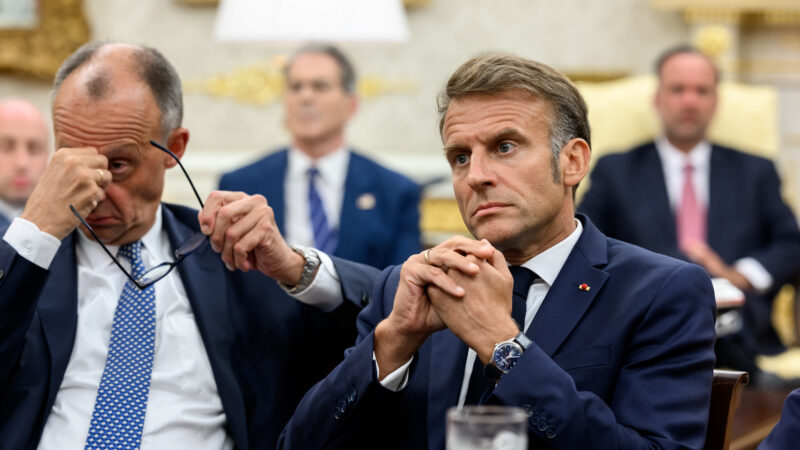
“Europe doesn’t want to be the client of the big entrepreneurs or the big solutions being provided either by the US or by China, we clearly want to design our own solutions,” French President Emmanuel Macron stated at the Summit.
He has been echoing his stance for years now, emphasizing that in the digital space, the EU is letting others lead while the bloc follows, quietly influencing development through regulation.
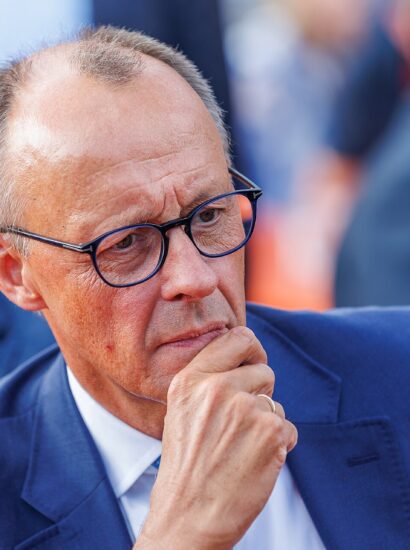
“The tectonic shifts we’re witnessing around the world – in political and economic centers of power – require swift action in the digital sphere, as the questions of the future will be decided in the digital realm,” German Chancellor Friedrich Merz echoed.
“We are seeing the systemic rivalry between the United States and China – two major powers, also two digital superpowers – which are vying for technological leadership. Europe must not cede this field to them,” he added.
Both leaders focused on the need for the establishment of a “European preference” to overcome the Chinese and US giants ruling over the sector as Chinese companies have strong ties to the government and its surveillance regime, while the US prefers home-grown companies, leaving Europe to contribute to the growth of either market.
“We prioritized during the past few years regulation of our domestic players,” Macron said. “We have to innovate before regulating”.
Innovating before regulating became the catchphrase of the day, as regulation is all Europe had for years. As technologies like AI penetrate all sectors and even the political arena, the issue may no longer be one of economics and profit but of political sovereignty and concern for a security policy independent from the US.
The Invisible Power
‘Free Internet’ is no more: as governments gain influence, an authoritarian actor like China uses it to constrict and survey their populations, bringing public opinion under Draconian control. Meanwhile, deregulated markets, like in the US, face social unrest over disinformation in the digital space, and excessive influence of tech giants.
The different political environments should have led to fragmented internet governance. Instead, it resulted in an eclectic global set of norms, where to access certain markets, all had to adhere to said market’s governance to a certain extent.
Efficiency dictated these norms to be incorporated in overall tech development, resulting in the EU’s “regulatory power.” This meant that European regulations were utilized by companies and institutions abroad to be able to access the vast EU market, leaving the EU on the sidelines.
This invisible power has allowed Europe to not be completely shut out but meant a completely reactive policy. Carving out a European slice in the tech sector would be an asset economically and politically alike. Done right, this shift would mean an expansion of the existing regulatory power the EU has, not its elimination.
Deregulation of the European Market May Backfire
The European bureaucracy, known to be ‘excessive’ and many times suffocating businesses with its constrictions, has caused issues for AI and other tech companies within Europe. The new digital simplification package the Summit introduced hopes to alleviate such an issue to allow more breathing room for the innovation leaders would bring about digital sovereignty, as per expectations.
But the most major danger will still be there: the control of opinions, dialogue, and influence on voters through the digital sphere. What Oxford Professor of sociology Philip N. Howard called “computational propaganda” is not restricted to authoritarian regimes only; it could be argued that democracies provide opportunity for more people the “use of algorithms to produce, distribute, and market untruths that serve ideology.”
This kind of influence is in the hands of developers, not in the hands of policymakers, which could open a new avenue for lobbyists. It would be politicians turning to tech giants for influence as voters turn away from legacy media and more get their information from social media.
Or – what will hopefully happen – it means US controlled dialogue will be met by an equally influential European algorithm that will diversify political discourse.
Either way, from a security and political standpoint alike, digital sovereignty becomes more a question of need than a question of whether it is necessary. With Trump’s increasing negligence of Europe in global politics, the bloc must ready itself for a future where the digital space is used not just as a bargaining chip but as a weapon against governments, which instrumentalizes the voters those governments depend on.
On the other hand, digital development is more complex than investment and regulation, as the US continues its Cold-War-like rhetoric and the EU sees a race it is left out of.
Too Late?
Critics argue that so far, the EU merely talks but is unable to act: for example, implementation of its AI regulation – desperately needed to forego disinformation – is being delayed. As development continues, by the time the behemoth of European legislation catches up, completely new legislation may be needed.
Overall, a renewed Franco-German lead has been established in the post-Brexit EU, complete with taking steps away from a bipolar world order in which the bloc must surrender either to the US or China.
On the other hand, its digital policy remains a bit overshot, with big words and careful, slow action as Europe deregulates to allow innovation but still refrains from becoming a Fortress Europe in digital development by keeping its doors open for foreign companies.
In order to achieve what leaders preach, the EU has to speed up its program or its political independence, which it currently hopes to strengthen on all fronts, may get caught in the crossfire as well.