
 By
By Before the elections in April, Hungarian politics were on the homepages of news websites all over the world. Peter Magyar and his TISZA party have since gone on to win the elections by a landslide and have insisted ever since that Hungary is returning to Western orientation and foreign policy resting on Hungary’s agenda but also on its Euro-Atlantic alliance. Foreign policy is usually in the second or third tier in the news when a new government forms but something happened last week that is worthy of a mention.
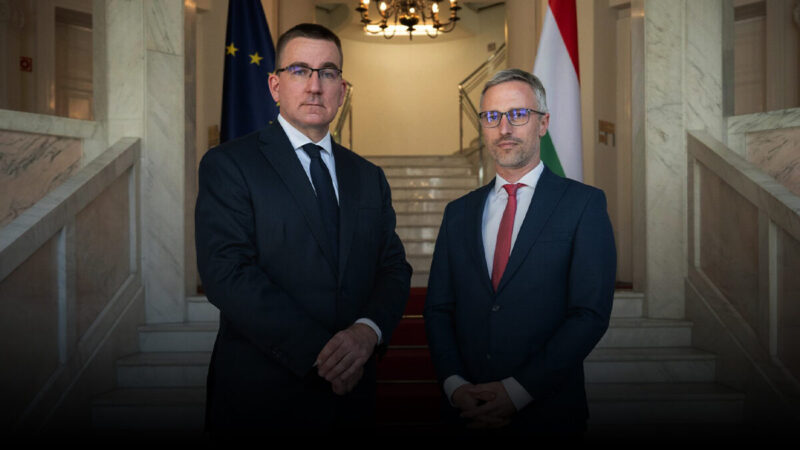
Hungary’s state-sponsored foreign policy think tank and research center, the Hungarian Institute of International Affairs saw the appointment of its new leaders: geopolitical expert and foreign policy commentator Botond Feledy as general director and security policy expert and Russia expert Andras Racz as deputy director general for research and scientific affairs.
The two new executives have been lauded by many in the press and the academic sphere alike, being well-known figures in both. Feledy has been a foreign policy expert, on his own as the sole editor of the Heti Feledy newsletter, which later turned into the foreign desk of Partizan, one of the most important mediums of Hungarian opposition under the previous governments. Racz meanwhile had been teaching and served as a researcher at the German Council on Foreign Relations (DGAP) while being a senior analyst at numerous domestic and international research institutes.
Racz was particularly affected by the Fidesz government turning the campaign hotter and hotter in early 2026. As a teacher at Corvinus University of Budapest a Russia-themed conference organized by him was cancelled by university leadership for political reasons. He also appeared on multiple podcasts and covered Russian politics and the war in Ukraine extensively. He was one of the experts constantly calling out Russian attempts at interference in political campaigning in Hungary and followed news closely when details of former Minister for Foreign Affairs and Foreign Trade Peter Szijjarto and Russian foreign minister Sergey Lavrov’s real relationship were brought to light.
Botond Feledy said in an interview that, instead of engaging in work based on ideology, the institute will carry out decision-preparation work for the Ministry of Foreign Affairs, and they aim to be active at a stage when information can still be fed into the system.
“A new Hungarian foreign policy strategy is being drawn up, and the institute is set to play a role in this as well,” Feledy added speaking to Hungarian news portal 24.hu.
According to a statement from the Hungarian Institute of International Affairs, the institution aims to further strengthen its role in providing expert input for Hungarian foreign policy decisions, expand its international academic and professional cooperation, and enhance its engagement with society.
In the coming years, the latter will be key. Not only because citizens are entitled to be informed on how tax money is being utilized but also because education will be key when it comes to security.
During the campaign leading up to the general election in Hungary many attempts were made by Russia or its proxies to somehow intervene – in March VSquare reported that high ranking officers from Russia’s military intelligence agency GRU had allegedly arrived as diplomats of the Russian embassy and it was widely believed that Russia would employ methods already tried and tested in Georgia earlier.
Many of the attempts – including the so-called Golden Convoy affair and a suspicious backpack wrongly but intentionally alleged by members of Fidesz to be an explosive device planted near train tracks in Serbia – were thwarted in communication by experts like Racz, Feledy and former officer of Hungary’s Constitution Protection Office, now professional leader of Hungarian national security organizations Peter Buda, alongside journalists like VSquare’s Szabolcs Panyi.
Thwarted in communication insofar as Racz and Buda frequently appeared on Hungarian newscasts and gave detailed explanation on why one or other manoeuvre was an attempt for interference. Afterwards, these machinations were rendered largely ineffective on undecided voters or supporters of opposing parties.
Alongside its core functions – academia and taking part in decision-making as an input device – this is what the renewed Hungarian foreign policy institute will have to take up, maybe by having two leaders for the two functions (high politics and informing the public) and maybe by using the infrastructure and other assets of Fidesz’s former projects like the Mathias Corvinus Collegium, now owned by the state.
The intent is undoubtedly there and hopefully the experts and background needed for all that will be in place soon.
Because there is a lot to be made up for in a country whose former foreign minister, Peter Szijjarto was so entrenched in being a vehicle for Russia that after the mutiny organized by Wagner mercenary organization leader Yevgeny Prigozhin he even called to ask if his Russian counterpart was okay.