 By
By State sovereignty is paramount in international relations, yet its definition remains elusive. The lack of a clear definition allows each country to relativize how it understands sovereignty and what it allows as lawful or even morally right to reach its goals in foreign policy.
This relativization can become dangerous, not only when one country justifies invasive foreign policy but also when a government intrudes on its citizen’s for ‘protection.’
The discussion regarding state sovereignty is a divisive one that is not expected to reach a conclusion – perhaps ever. Yet, its inspection shows gaps in foreign policy reasoning, allowing the reveal of the true political agenda behind rhetoric.
A Lack of Definition
The idea of state sovereignty is strongly connected with nation-states. A nation-state is sovereign; therefore, that nation has obtained self-determination: no outside force has the right to infringe upon this sovereignty and dictate a nation’s way of life.
Legally, this means the state has final authority above any other institution within the nation. Politically, this can be understood as unlimited power to coerce or as a somewhat limited power that allows a state to remain independent.
Each political theorist has their own view of what sovereignty is, how it should be determined and controlled, or exercised externally. But most analysts will agree that sovereign states are the most basic actors in international relations.
In the modern day, leaders tend to speak more about independence, with a few notable uses of ‘sovereignty’ to define a country as self-determining.
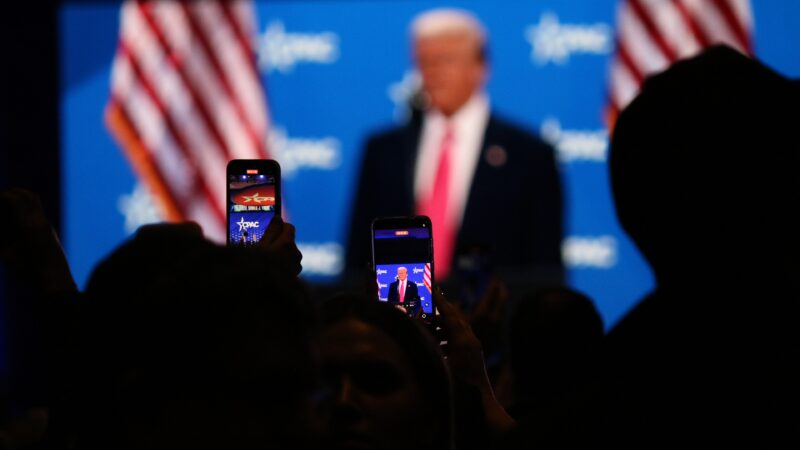
For Donald Trump’s United States, independence is a foundational aspect of its statehood. Historically, this has led to preventive wars: like Iraq and Afghanistan, where the Bush Doctrine justified the invasion by the need to stop threats before they inflicted their attack on the US. The US has the right to do this, they implied, because any sovereign state has the right to protect itself.

President Donald Trump delivers remarks on Wednesday, March 15, 2017, at the American Center for Mobility in Ypsilanti, Michigan. Photo source: Official White House Photo / Shealah Craighead / Trump White House Archived / Flickr, Public Domain.
Trump’s ‘America First’ policies also reflect this kind of American patriotism, rooted in sovereign pride.
This is a highly radical understanding of sovereignty, in which the nation’s sovereignty is paranoidly protected through preventive measures.
A natural opposite of this doctrine is the European Union, made up of sovereign nations, pooling or even surrendering sovereignty to the Union for better cooperation, reaching a wider distribution of prosperity.
In this case, there is an eternal push and pull between national sovereignty and further integration, each having its own pros and cons.
Hungary’s idea of sovereignty is thus defined in an environment of constant sharing, while the US continues to fashion itself as the world-leading power that is rejecting the expectation to share resources.
A Shield: EU vs Orban’s Hungary
The EU has fashioned itself as a democratic beacon where sovereignty is respected. But recently, the EU has struggled as its institutions lack coercive measures.
Hungary under Prime Minister Viktor Orban’s FIDESZ government was a continuous headache for the Brussels. Orban tactically used his veto power to stall and disrupt EU decision-making – many times, not only to the advantage of his party’s domestic standing but also for its alliance with Russia.
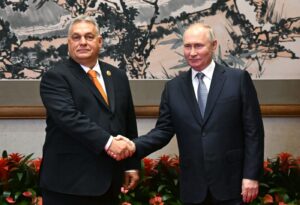
Hungarian PM Viktor Orban and Russian President Vladimir Putin in 2023. Photo source: Grigory Sysoev / Wikimedia Commons, CC BY-SA 3.0
The EU, being a champion of democracy and legality, was trapped in its own morality: if it acted against Orban’s government, the EU would have disrespected Hungary’s sovereignty, its elections, and the choice of its people. However, many experts – including Hungarians – argued the government had lost its democratic mandate by monopolizing the media, limiting courts, and changing the constitution to party advantage.
For the EU, the question of sovereignty suddenly became an obstacle that hijacked its delicate machinery. However, the EU is a supranational organization, where states share sovereignty in certain policy areas not by coercion but consent – this is a fundamental part of EU identity. It was for this reason that, despite monetary and political losses caused by Hungary, the EU only imposed sanctions years down the line after several warnings.
But this coercion was still limited to funds Hungary was only allowed to access due to its EU membership and contribution – both of which were compromised by its democratic backsliding.
The Treaty of the European Union was signed by Hungary after having complied with accession criteria to join the Union. The EU was in its legal right to demand the original criteria remains fulfilled if Hungary hoped to benefit from EU funds.
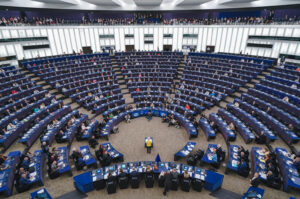
State of the Union address delivered by the President of the European Commission Ursula von der Leyen on 14 September 2022 in Strasbourg. Photo source: CC-BY-4.0: © European Union 2022– Source: EP / European Parliament / Flickr, CC BY 2.0
However, for Orban, sovereignty was a shield: he framed Hungarian sovereignty being infringed by “Brussels’ demands”, even going so far as saying the EU hoped to depose the government.
The self-defined concept of sovereignty was protecting the Orban government’s oligarchic interests, in which the EU conditionality was a major obstacle. The war in Ukraine just sharpened an already harsh collision of the EU’s political identity and Hungarian material interests. This is evident in its continuous anti-EU standing that never resonated with the Hungarian public, not even FIDESZ voters.
A Tool: Hungary’s Sovereignty Protection Office
In 2023, the Hungarian government took another step in ‘protecting sovereignty.’ The parliament considered creating a Sovereignty Protection Office, which would be allowed and expected to monitor and penalize organisations found to be a threat to national sovereignty.
Any organization that is deemed to be threatening “the sovereignty of Hungary by using foreign funding to influence public life” is to be blacklisted, penalized, and potentially banned. The bill allows the authorities access to bank accounts, documents, and electronic devices of the organizations in question.
Those banned are unable to receive donations via Hungarians’ income taxes, and are required to ask for special authorization to accept foreign donations, while it is compulsory for all donors to submit a declaration confirming that their contributions do not come from abroad. Organizations found to receive foreign donations deemed as a threat are to pay fines up to 25 times the original donation. Failure to pay and repeated offences could result in a forced shutdown.
What a ‘threat to sovereignty’ entails exactly, however, was not well-defined in the bill, extending it to undermining Hungary’s constitutional identity, Christian culture, challenging the primacy of marriage, the family, and biological sexes.
Opposition figures argued this was specifically targeting NGOs, independent media, and civil societies that relied on such forms of funding. “With this proposal, they could shut down every independent Hungarian media outlet and shut down every NGO engaged in public affairs,” Márton Tompos, the chair of the opposition Momentum party, wrote on social media. Budapest mayor Gergely Karácsony said the bill “follows the Russian playbook,” while independent lawmaker Ákos Hadházy described it as another move of “Putinisation.”
The law was passed and the Office started operations. Shortly after, the EU started infringement procedures as the bill that allowed the existence of the office broke several EU laws. In 2024, the EU took the issue to court.

EP Plenary session – Council and Commission statements – Presentation of the programme of activities of the Hungarian Presidency Photo: European Union 2024 – Alain Rolland
New Prime Minister Peter Magyar’s Tisza Party has since submitted a bill to abolish the Sovereignty Protection Office: “The Sovereignty Protection Office performs no actual public duty, and its creation served purely political intent and interest,” said the bill. “The real purpose of the Sovereignty Protection Office was to exert pressure for political purposes on citizens, certain organisations, and media outlets.”
The example stands: using the idea of sovereignty, a modern-day government can justify invading the privacy of its citizens and deconstructing its democracy.
But there are similar examples from the Americas where sovereignty was deemed to be an obstacle.
An Obstacle: US vs. Cuba
The US has had some kind of political pressure on Cuba since the 1960s. Trump has ratcheted this up when returning into office in January 2025, re-adding Cuba to the State Sponsors of Terrorism list and just recently in early May Trump issued Executive Order 14404, which explicitly identified Cuba as a threat to US National Security and Foreign Policy:
“The United States will continue to take action to counter the Cuban regime, those furthering its goals, and those abroad enabling the elites to profit while the Cuban people suffer,” the factsheet issued by the US Department of State reads.
However, the sanctions hit the people hardest. Due to the US bar on oil imports, the country has been struggling with power outages, scarce medication, and even the lack of waste collection, leading to an increase in “hygiene-related illnesses and gastrointestinal issues.”

Nicolás Maduro being escorted by the DEA. Photo source: Drug Enforcement Administration / Wikimedia Commons, Public Domain.
Since January’s US operation to abduct Venezuela’s leader to prompt regime change, Trump has stated he hopes the same will happen in Cuba. In March, he said “Cuba is next, by the way.”
Cuba’s sovereignty has little power in this situation, though in theory it is an obstacle to the US’s interests. In fact, it is blatantly ignored, as the US continues to justify its actions by invoking its own sovereign rights, demonstrating the cleavage between rhetoric and catering to US interests.
But the loss of Cuban sovereignty could mean the collapse of its statehood; so the island is most likely going to have to cooperate with the US either way. “The island’s citizens simply cannot endure deepening economic immiseration under external pressure for the remaining years of the second Trump administration. Large fiscal imbalances, a heavy debt burden, and scant access to external financing mean that the government’s room to maneuver has all but disappeared,” Michael J. Bustamante and Ricardo Herrero write in Foreign Affairs.
Though sovereignty presented an obstacle in this situation, it is unlikely to stop the US from exerting its own sovereignty to this extent. This is despite Cubans looking for change themselves, and despite many suggesting that US sanctions created a situation where the people were unable to change the regime themselves.
Is Sovereignty Losing its Relevance?
State sovereignty is constantly used in justifications of foreign policy and can be widely interpreted. As such, many ignore its continued relevance in observing foreign policy and political morality.
Yet, as demonstrated, it is an excellent tool to witness how when powers collide, it is frequently invoked for rhetoric, to bypass the more difficult explanation and escape accountability.