
 By
By The Kinahan Organized Crime Group (KOCG) is a transnational syndicate involved in cocaine importation into Europe, arms smuggling, and money laundering on a global scale. KOCG’s clients include Mexican and Colombian drug cartels, the Lebanon-based Islamic militant group Hezbollah, and Iran’s intelligence services.
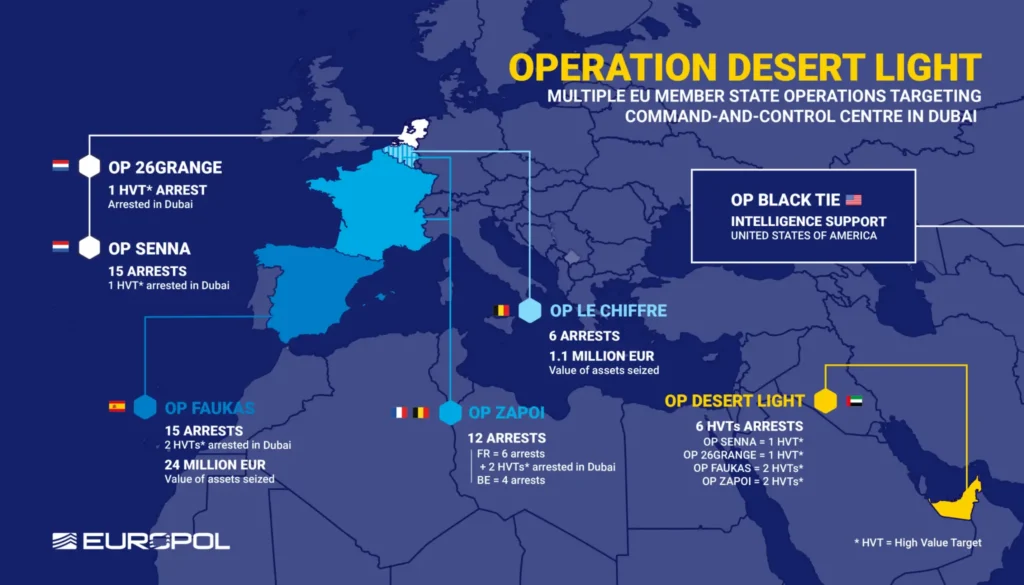
Daniel Kinahan, the alleged leader of the group, was arrested in Dubai on Friday following a covert operation involving Irish and United Arab Emirates (UAE) authorities.
The Kinahan Crime Family- The real Mobland
The scale of Kinahan’s operation is significant.
The Kinahan cartel is considered among the largest criminal organizations globally, with an estimated value of €1.5 billion.
They invested and launder money, which sets them apart from other gangs. They have also infected the international banking system like a virus, recruiting legions of professionals to wash illicit gains alongside legitimate investments in return for handsome commissions. This should not be underestimated if we look at where Christy Kinahan – the “patriarch” of the clan – came from.
As The Times recalls it, three decades ago, Kinahan was eking out a living forging cheques and driving a taxi around Dublin. He grew up in middle-class Ireland and began his criminal career with relatively minor offenses, including drug possession, weapons sales, and forgery.
However, according to journalist John Mooney, Christy was far from ordinary—he was intelligent, multilingual, and skilled at building trust and networks.
Christy Kinahan (often called “The Dapper Don”) encountered the law in the 1970s when he was arrested for trying to steal a car. Kinahan quickly became involved in serious crime and was eventually caught with heroin during a raid in September 1986. The following year, he was sentenced to six years in prison and was released in March 1992 — but it wasn’t long before he was in trouble again.
In October 1997, when he returned from the Netherlands to Ireland to attend his father’s funeral, Kinahan was again jailed, this time for four years. By then, he was an accomplished drug trafficker, supplying large shipments of cannabis, cocaine, and Ecstasy to the Irish and British markets.
During his sentence, he not only forged alliances with both Catholic and Protestant paramilitaries like the Irish National Liberation Army and Ulster Volunteer Force, but he also obtained an arts degree in jail and learned Spanish, French, and Dutch.
“He came out of prison with a business plan — he was determined to be the biggest drug dealer in Ireland,” said Craig Turner, deputy director of the UK’s National Crime Agency (NCA), to The Times.
By the early 2000s, with bases in major drug import hubs such as Rotterdam and Antwerp, cocaine trafficking became central to the organization’s activities. Kinahan had established a significant presence within organized crime networks.
By 2006, it had become one of the largest criminal enterprises in Europe, and Christy’s wealth exceeded $500 million.
His organization expanded into what is now known as the Kinahan Organized Crime Group (KOCG), a transnational syndicate that includes family members, notably his sons Daniel and Christopher Jr., as well as long-term associates.
KOCG to MTK: Sportswashing and Money Laundering
Kinahan became heavily involved in professional boxing promotion, which gave access to international travel and networks and provided a veneer of legitimacy. Involvement in professional sports has also provided opportunities to establish relationships with wealthy and influential individuals.
In 2012, Christy’s eldest son, Daniel, became involved in professional boxing when he opened a gym in Marbella, Spain, where the family had relocated their drug operations some years earlier.
By that time, Christy was in jail again (altogether he spent around 11 years behind bars). Daniel then evolved the organization further. He encouraged collaboration with the rival gangs, forming partnerships to jointly purchase and transport drug shipments.
The resulting alliance, referred to as the ‘Super Cartel,’ controlled an estimated one-third of Europe’s cocaine supply, as well as other illicit activities.
Daniel also assumed a front-of-house role in the business, later named MTK Global. In the space of a few years, he became one of the most influential figures in the sport, brokering fights for the likes of the heavyweight champion Tyson Fury, who, until recently, made no secret of their friendship. “I’m just after getting off the phone with Daniel Kinahan,” said Fury on Instagram in 2020.
MTK Global, signing over 300 boxers, trainers, and managers, became highly influential, partly because it paid fighters reliably—an uncommon practice in boxing. However, it is suggested that this financial strength was fueled by laundered drug money.
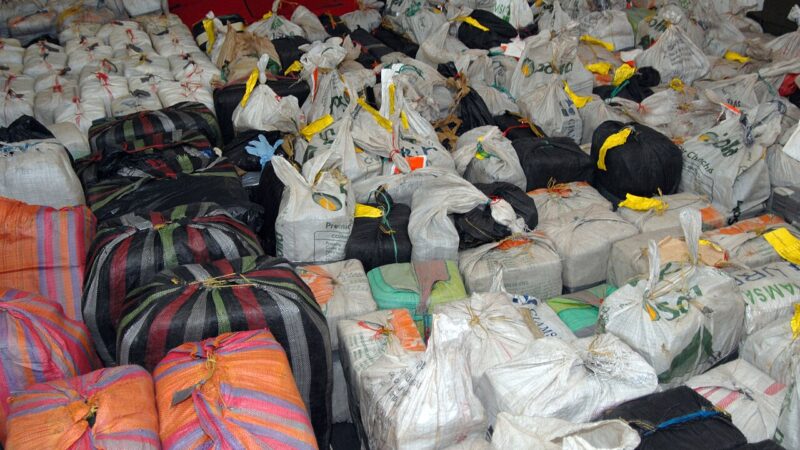
Source: Europol
Ironically, the boxing match was what exposed the Kinahans to the investigative journalists at Bellingcat and The Times, and led to their arrest in the UAE.
For some time, the U.S. government has aggressively pursued them, offering a $5 million bounty and placing them under sanctions typically reserved for oligarchs and terror groups.
In 2016, the Kinahans relocated to Dubai, where they deepened ties with Hezbollah, a Lebanese militia involved in drug and weapons trafficking. Through these connections, they reportedly gained links to Iran.
Authorities suspect the Kinahans carried out operations on behalf of Iranian interests, including an assassination and attempts to procure aircraft.
These connections positioned the organization at the intersection of organized crime, geopolitics, and terrorism.
The Hezbollah Role with Narco- and Weapon Smuggling to Europe
The relationship between Hezbollah and organized crime developed over several decades, shifting the group from a regional militant force to a complex network involved in terrorism, geopolitics, and transnational crime.
Hezbollah was founded in 1982 during the Lebanese Civil War, with direct support from Iran’s Revolutionary Guards. The end of the Cold War and the acceleration of globalization opened new opportunities for not just crime syndicates but also terror groups.
Hezbollah expanded its activities beyond the Middle East by embedding operatives within Lebanese diaspora communities in West Africa, Latin America, and Europe. These networks enabled involvement in drug trafficking, diamond smuggling, and money laundering, generating significant revenue for the group.
Over time, the group developed sophisticated money-laundering schemes and logistics chains linking Latin American cocaine production to European markets via Africa.
These systems allowed Hezbollah not only to fund its activities but also to offer services to other criminal organizations.
The Islamists expanded their ties with Latin American paramilitary-revolutionary militias (People’s Army and FARC) and criminal organizations, including Colombia’s Medellin cartel, La Oficina de Envigado, North Valley cartel, as well as Mexican and Brazilian cartels.
An in-depth investigation published by The New York Sun sheds new light on the criminal infrastructure sustaining Hezbollah.
As Tehran’s economy weakened, Syria’s drug production declined, and Lebanon began to dismantle established smuggling networks, Hezbollah has increasingly relied on global narcotics trafficking to fund its military, political, and other operations. According to the report, Hezbollah has evolved into one of the world’s most sophisticated hybrid criminal-terrorist organizations. Its revenues now flow from cocaine trafficked through Latin America, and money-laundering networks stretching across four continents.
Recently, Hezbollah and other Iran-linked proxies have reportedly used criminal groups to support covert operations targeting European Jewish communities.
The Cocaine Pipeline to Europe
Around 2001, Christy Kinahan identified an opportunity in Colombia, where cocaine production was increasing. As Mexican cartels assumed control of U.S. supply routes, Colombian producers sought alternative markets. Europe, experiencing economic growth after the Cold War, became a focus. Kinahan acted as an intermediary, purchasing cocaine from Colombian cartels and distributing it in Europe.
This period saw a significant expansion of the European cocaine market, which began to approach the size of the U.S. market.
European crime groups such as Tito and Dino, Grupa Amerika, the ’Ndrangheta, and the Galicians have grown enormously wealthy and powerful off cocaine.
But unlike the Mexican cartels in the US, none of them have the capacity to shut other European actors out of the market. Irish, British, French, Dutch, Turkish, and Belgian actors also play a key role in the supply chain, both up and downstream, according to an InSight Crime report.
Perhaps unsurprisingly, it was the Italian mafia that pioneered the move upstream, securing cheap cocaine in Colombia and establishing a permanent presence in Latin America in the 1990s. Buying at the source in Colombia and arranging transport back to Europe meant the Italians could pocket most of the massive profits themselves. Other European mafias soon began to mimic this model, and it is becoming ever more common today.
With its linguistic and cultural links and thanks to an alliance with Galician smugglers, Spain has historically been the natural entry point for Latin American traffickers.
The cocaine trade is now populated by a variety of different types of criminal syndicates, which are made up of many different and mixed nationalities. There are no longer criminal structures like the Medellín Cartel, which controlled cocaine production in Colombia and sold their drugs on the streets of Miami and New York.
Furthermore, in today’s increasingly fluid underworld, none of these groups has the capacity to run cocaine routes from production to retail single-handedly. Instead, they constantly form and dissolve networks and alliances with different actors from all across the globe.