 By
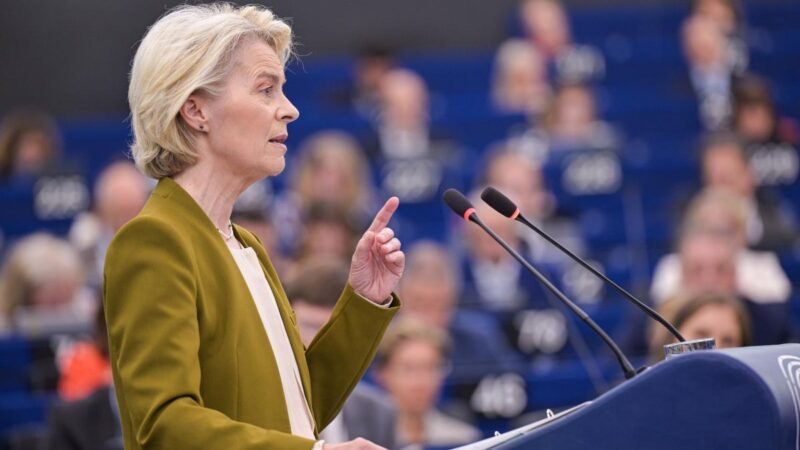
By European Commission President Ursula von der Leyen’s State of the Union speech is a traditional event in European politics when – depending on one’s adoration towards the former German defense minister – “a truly democratic moment” shines as the member of the European People’s Party takes center stage in Strasbourg and delivers a speech about many things.
Part of that is the way forward for Europe as von der Leyen sees it and a huge part of that is the establishment of new programs, initiatives, institutions. This year’s speech was no different but there were some additional thoughts worth highlighting.
They can feel the impact of the global crisis.
Maybe this is the sentence that was the most noteworthy, at least from the first section of the speech. From a communications standpoint it would be interesting to ask von der Leyen or her staff why they thought that referencing her “countrymen” as “they” instead of speaking in first person plural would be a good idea. There are a couple of countries where she is quite disliked so why deepen the trench by detaching herself even more when she is perceived as out of touch?
We will put our bilateral support to Israel on hold.
As Brussels-based news portal POLITICO wrote in their satirical overview of the speech, decoding the highlights, this sentence truly meant “We can’t do anything to stop EU members sending whatever they like to Israel.” This is the most lavish part of being president of an international organization that is not yet federal but not exactly international anymore either. These sentences bode very well with those who resonate and yet, no real commitments were made. At least not timely enough.
As the AP news agency reports, Martin Konecny, director of the Brussels-based European Middle East Project said, the announcement and the policy are “just too late, and too little, given the catastrophe on the ground.”
One thing that definitely has to be agreed with though is how von der Leyen condemned what she called weaponized “man-made famine.”
We will therefore use our tools to support independent and local media.
As always, it will be thrilling to see how independence and locality will be defined and measured. Promising financial support as a head of a political project for “independent” outlets to stay independent is a strange and possible double-edged loop but I am almost sure a new institution is incoming, maybe even alongside the proposed European Center for Democratic Resilience.
It is time to break free from the shackles of unanimity.
Also: “Ready to strengthen the pro-European democratic majority.”
Anybody who has taken a university course titled something like “European Studies” or “The History of the European Union” encountered the fact that unanimity has practically been part of the EU’s DNA. Challenging something this embedded is always a novelty but this notion of extending qualified majority voting to policy areas where it has never been is more on the reckless or overzealous side. Considering the history and the nature of the EU it is almost on par with the abolishment of the veto in the United Nations Security Council.
It is perfectly understandable that von der Leyen and her supporters want to further their agenda and the perceived need for a more agile European decision-making system is definitely there in the heads of many. Hungarian Prime Minister Viktor Orban and Slovakian Prime Minister Robert Fico have been abusing the system without any direct and meaningful-enough reprimand only shows the lack of capabilities of the Commission.
Topping that with saying that QMV extension will serve Europe’s much-needed unity is borderline cynical.
Unanimity is not shackles.It is a legacy safeguard to make sure Europe heads in a direction which is rooted in common agendas. And to prevent “independence moments” which are detrimental or catastrophic. Because we have had a few.