 By
By Geopolitical conflicts have a habit of affecting important sea chokepoints and disrupting global trade routes. Recent developments have made the consequences of this painfully real.
During Israel’s war against Hamas, the Suez Canal was a dangerous ground for trade ships for a prolonged period of time, disrupting trade flows and economic growth worldwide. This year, the war launched against Iran by the United States and Israel and Tehran’s response of closing down the Strait of Hormuz spiked oil prices over 100 dollars a barrel. Such developments not only undermine energy security in oil-importing countries, but also affect fertilizer prices which could have dangerous consequences on the world’s poorest regions, and increase food prices by up to 30 percent.
In this context, the Northern Sea Route (NSR), untouched by conflicts and relatively insulated from global political tensions, is increasingly seen as a replacement to consider.
The NSR, running along Russia’s Arctic coastline, is opening to maritime traffic, due to the acceleration of global warming and ice coverage melting at four times the global average. As a result, seasonal transit is emerging as a possibility, with some scientific projections suggesting that the passage could become a viable alternative to the Suez Canal by the 2030s.
These developments are demonstrated by the 2025 transit of Istanbul Bridge, a China-linked container ship which became the first multiple-port shipping operation conducted by a non-specialized ship through the NSR. The operation was seen as an important milestone and demonstrated the route’s potential to become integrated into global shipping networks, even if, for the time being, only seasonally.
The significance of the NSR to global maritime security is indisputable. On the one hand, its remoteness in the Arctic ensures that it does not become a victim to international instability or acts of piracy. On the other, it also significantly shortens the shipping distance between Europe and Asia.
The passage, running from the Europe-adjacent Kara Sea to the Bering Strait, separating the United States and Russia, could, in theory, be crossed in 19 days, which would shorten transit by 40 percent compared to the Suez route.
These realities raise questions about the NSR’s viability as a safer alternative to shipping routes crossing the Middle East. Various stakeholders, anticipating progress in this area, are already positioning themselves to benefit. Russia, given its geographic and historical ties to the route, naturally holds the greatest sway, but other actors are also maneuvering to establish themselves as key players in this emerging new landscape.
Who Should Control the NSR?
While many stakeholders are vying for influence, the NSR, running along Russia’s northern coastline, is dominated by the Kremlin, which seeks to preserve it as nationally and politically controlled. Moscow claims legitimacy over the passage, which it bases on geographical, but also historical ties.
Russian interest dates back to Peter the Great, while formal control was claimed in a 1965 decree, and significant infrastructural developments started already during the Cold War.
For Russians, then, the route represents a hard-won national heritage, which demanded enormous state effort and human sacrifice.
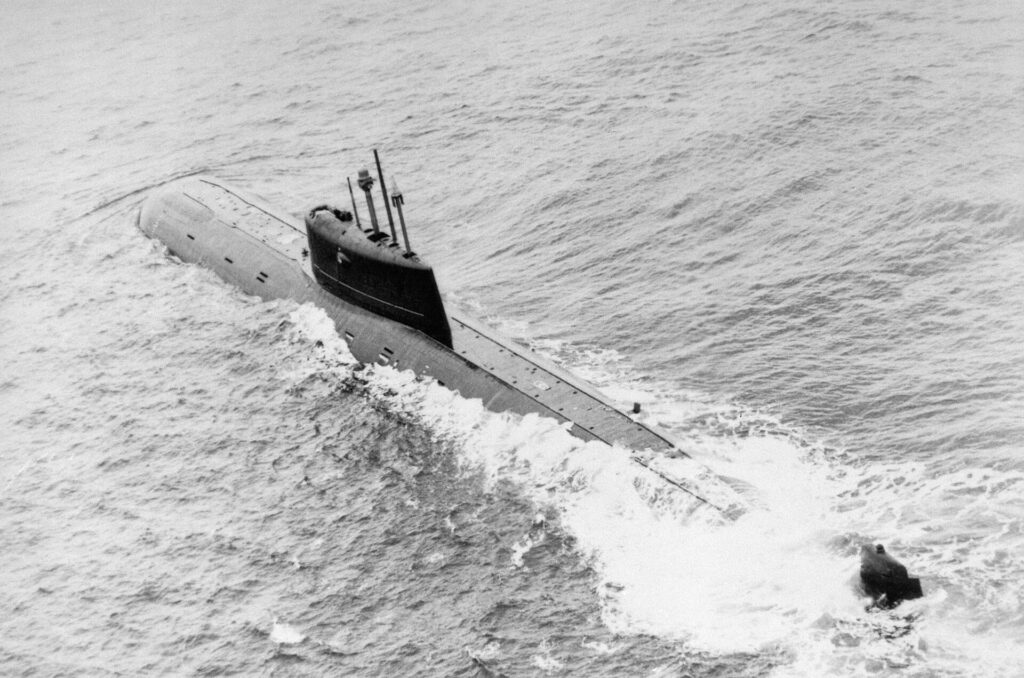
The Soviet nuclear submarine K-278 Komsomolets in 1986
After the end of the Cold War, renewed interest emerged in the 2000s, driven by rising oil prices that allowed for investment in massive energy projects, such as the Yamal LNG and the Arctic LNG 2. However, Western sanctions imposed following Russia’s 2014 annexation of Crimea left Moscow without sufficient resources to fully exploit the route’s potential. This is where China and other partners have become important: cooperation with outside actors is essential to Russia’s ambition of making the NSR the new cornerstone of a multipolar global economy.
China has emerged as a foundational partner, with its investment remaining a crucial element of completing and operating the LNG projects.
Beijing’s increasing interest is demonstrated by a 2018 White Paper, which describes the country as a “near-Arctic state,” as well as its plans for a “Polar Silk road“ that recognizes the region as an emerging international transport corridor.
In China, the NSR is perceived as strategically important, as it could provide an alternative to the Strait of Malacca, on which Chinese dependence is viewed as a critical vulnerability.
China’s involvement has expanded significantly since Russia’s 2022 invasion of Ukraine, filling the void left by Western companies that have decreased their presence. Its involvement includes recent deployment of icebreaking vessels as well as joint investment in infrastructure. The two countries’ cooperation is best exemplified by their agreement in 2025 to make the NSR a strategic Arctic corridor and the establishment of a joint committee on NSR development.
Although Russia retains formal control over the NSR, its growing dependence on Chinese capital and technology has turned the corridor into an increasingly shared Russian-Chinese project. Their cooperation is nevertheless limited by mutual mistrust, which drives Russia to diversify its partnerships. Moscow has pursued Indian investment in the NSR infrastructure, urged Japanese companies to maintain their role in the Arctic LNG 2 project, and sought broader involvement from other BRICS+ countries.
Europe, too, is reassessing its Arctic strategy to secure a foothold in the emerging competition over the route.
In 2025, European Commission President Ursula von der Leyen argued that “Europe must be more proactive and more invested in the Arctic,” as a way to respond to Russia’s dominance over the NSR. Reliance on it, however, would be strategically perilous from the perspective of European strategic autonomy.
Apart from being a global trade alternative, it is also a tool for consolidating Russian Arctic power through resource extraction, route control, and military expansion. Its growing use is closely connected to energy shipments, a central focus area of EU sanctions, where political risk is particularly high. It would be self-defeating to replace European dependence on Russian gas with dependence on a Russian-controlled shipping route. The EU should therefore treat the NSR as a seasonal and opportunistic option, rather than a central trade artery.
Between Ambition and Reality
This is precisely where the NSR’s limitations come into focus. Even as the NSR rises on the agenda of policymakers around the world, navigational, environmental and geopolitical risks continue to limit its viability as a Suez alternative. A shipping route’s commercial value depends on reliability of access and stability of conditions. In both cases, the NSR falls considerably short.
Russia has claimed the passage as its internal waters and has established an elaborate system of rules to govern it. It does not recognize the international right of innocent passage, requiring prior authorization and completely banning foreign warships, while those ships that are allowed to pass may be required to use the services of Russian icebreaker escorts. The new Russian 15-year Arctic strategy, approved by Putin in 2020, signals that Moscow is not preparing the route for full opening or for its integration into the global framework of freedom of navigation. The Kremlin may instead plan to profit from transit fees and keep access conditional on authorization.
This is different from how the Suez or other passages are governed. The legal character of the Suez Canal creates a system of national administration by Egypt based on a principle of continuous openness in peace and war, with no discrimination based on nationality. Russia is building the exact opposite: strict administration contingent on prior authorization and based on preference and strategic choice.
Environmental transformation may also open access slower than expected. While rapid sea retreat has fueled optimism about the future of Arctic shipping, shrinking ice should not be falsely associated with easier navigating conditions. As ice cover melts, floating ice formations can block narrow straits or surprise ships even in generally ice-free locations.
Safe transit through the route is, for now, conceivable only with ice-class vessels and specially trained crew. Those involve expenses that can discourage shipping companies and constrain the route’s competitiveness. Additional costs also include search-and-rescue infrastructure, insurance premiums, Russian escort fees, and icebreaker services. The lucrativeness of the NSR therefore relies on coordinated investment in port modernization, logistical integration, and risk management to remove important commercialization barriers. Even so, forecasts show that the NSR will only be commercially viable for select goods once ice has retreated to 25 percent, and will only be completely ice free around mid-century.
Although a fully melted Arctic may appeal for its economic benefits, we should not collectively await that happening. An ice-free NSR would be detrimental to global biodiversity and would bring about catastrophic consequences for humanity and wildlife.
As a result, environmental regulations have also appeared as constraining factors in the NSR’s viability. Emerging carbon-pricing bans or pollution bans can complicate finances and discourage the use of the route.
Taken together, these factors illustrate that a shorter passage does not always mean cheaper transit – 40 percent reduction in distance does not necessarily translate into equal reduction in costs. Despite years of development, transit volume in the NSR remained approximately 3 million tons in 2025 compared to the nearly 1.6 billion tons that pass through the Suez Canal annually.
Even existing traffic is not without its controversy. The revolutionary transit of the Istanbul Bridge was criticized by environmentalist for its likely use of heavy fuel oil, which, they say, underscores the dangers of increasing shipping through the Arctic, one of the world’s most fragile ecosystems. Meanwhile, rising geopolitical tensions increasingly challenge the longstanding Arctic governance paradigm built on cooperation, environmental stewardship, and diplomatic restraint.
Unlocking Arctic shipping routes and natural resources depends on coordinated governance, joint investment in infrastructure, and collaboration in monitoring and forecasting services. Cooperative governance is vital to reduce weather-related risks for vessels while minimizing the route’s climate footprint.
Yet despite being in their shared interest, disputes over the distribution of profits and political leverage threaten to undermine the benefits cooperation could provide.
Nowhere is this threat more visible than in the United States, where President Donald Trump’s recent threats to take over Greenland exemplify the strategic value Washington sees in the Arctic. The United States, alongside NATO and its Western allies, does not recognize Russia’s claim of the NSR as part of its internal waters and can be expected to challenge the Kremlin’s unilateral control of the route or its cooperation with Beijing to monopolize commercial gains.
Washington already does so in practice: American vessels regularly conflict with Russia’s ban of warships through its broader Freedom of Navigation Operations (FONOPs) program. Moscow, for its part, considers the United States and its allies as a fundamental threat to its Arctic ambitions and the outsized rewards it stands to gain from controlling the NSR. For this reason, both sides have deployed increased military presence and have adopted a more assertive posture in the region. Meaningful cooperation, under these circumstances, is unlikely to resume.
The Northern Sea Route: A Route Worth Watching, But Not Depending On
How, then, should we assess the NSR’s prospects? Its growing significance is undeniable, and yet fulfillment of its promise still lags behind, and there remains a gap between geopolitical ambition and operational reality. For now, the Arctic passage may be better understood as a seasonal complementary passage and a Russian industrial artery, rather than a geopolitically pivotal alternative to Suez.
This distinction matters for policymakers, especially in Europe. The temptation to embrace the NSR as a corridor that can replace the conflict zone of the Middle East should be resisted to avoid creating a new dependency. Overly optimistic reliance on the route, even if it were to become economically viable, risks substituting one conflict zone for another. The route may gain strategic importance, but not necessarily for its safety or reliability.