

 By
By This July Fourth marked the United States’ Semiquincentennial celebration, commemorating the 250th anniversary of the Declaration of Independence. We asked Tamas Magyarics, Hungarian historian, former ambassador, and research fellow, about what are the possibilities of another American Century, and how the country’s foreign policy changed under Donald Trump. Last but not least, we discussed the declining attractiveness of the “American Dream”.
The Relative Decline of American Power
The Twentieth Century, often called the American Century. Professor, how would you describe the current era? Is the 21st century still the American century, or has that idea already failed?
The United States has experienced a relative decline in power, especially compared with the 1990s and early 2000s. That period is often called the “unipolar moment.” The United States had an extraordinary ability to shape the international system according to its own preferences. There were limits, of course, but no other state could seriously balance American power at the time.
What were these limits? Was there a moment when America overextended itself?
Yes, this is when the idea of imperial overstretch becomes important. Paul Kennedy’s well-known work, The Rise and Fall of Great Powers, shows that empires often move in cycles. Over time, the costs of maintaining an empire can become greater than the benefits it produces. This happened to several great powers in history: the Spanish, the French, the British Empires and the Soviet Union. Eventually, these powers could maintain their influence at a cost of losses.
Afghanistan, Iraq, and the Failure of State-Building
How did this imperial overstretch appear in the American case?
It became visible in Afghanistan and Iraq. The neoconservative approach was based on the idea that the United States could transform parts of the world according to Western norms. This meant exporting a Western-style market economy, parliamentary institutions, liberal values, and human rights.

Armed US Marine Corps (USMC) Marines assigned to Lima/Company, 3rd Battalion, 23rd Marine Regiment, line up to board a transport aircraft at Blair Field in Al Kut, Iraq, during Operation IRAQI FREEDOM. Photo: USMC/National Archives
However, these efforts failed. In Afghanistan, the result was particularly bitter. As a joke goes: After twenty years of war, the country moved from Taliban rule back to Taliban rule. The United States invested enormous resources, but in 2021, the Taliban returned to power almost immediately after the American withdrawal.
Do the Iraqi and Afghan failures mean that American dominance is over?
No. Even though American relative power has declined, the United States is still the leading global power in most major categories. In hard power, especially military capability, the United States remains far ahead. It has nuclear capabilities, global force-projection capacity, and a worldwide alliance system. Its aircraft carrier fleet is still unmatched. The United States has around eleven or twelve carrier strike groups, while China has far fewer comparable capabilities.
What makes American military power so unique?
The American military is not only strong because of its equipment. The United States has formal and informal security systems across the world: NATO in Europe; alliances with Japan, Australia, the Philippines, and others; as well as cooperation through frameworks such as the QUAD. The United States also maintains hundreds of military facilities around the world. Not all of them are large bases like Ramstein in Germany, but they allow Washington to monitor and influence global developments.
What about intelligence and technology?
The United States remains highly advanced in human intelligence, electronic intelligence, and surveillance capabilities. China has caught up in some categories, like cyber capabilities, AI, and especially in manpower.
Although the war in Ukraine has shown that technology, logistics, intelligence, drones, artillery, and industrial capacity can matter as much as the number of soldiers. China is close to the United States in some technological fields, but America still has enormous advantages.
For this reason I would not bet on the American dominance collapsing in the next ten, fifteen, or twenty years.
It will change, but it is unlikely to disappear suddenly.
Does China Want to Replace the United States?
If not military, but from an economic perspective, China is rising. The question is, does Beijing want to take over the American global role?
That is one of the biggest questions. In the early 2000s, when Washington realized that China had serious potential, the United States invited China to become a more active participant in maintaining the global order. Robert Zoellick famously encouraged China to act as a “responsible stakeholder.”

Washington Crosses the Delaware projected on the Washington Monument
Source: Wikipedia
China, however, did not fully accept this role. Maintaining a global order is extremely expensive. It requires military infrastructure, alliances, bases, logistics, crisis management, and the ability to project power across the world. China has not shown the same willingness to finance and operate such a global system.
So, China is not trying to become a new hegemon?
China appears more interested in a multipolar world, where several major powers coexist.
Beijing’s main goal is regional predominance rather than to become a global sheriff or to copy the American model of worldwide leadership.
This approach is also consistent with classical Chinese military thought, where the best victory is the one achieved without fighting. The voyages of Zheng He are often mentioned in this context. In the 15th century, Chinese fleets reached as far as Africa. But after these expeditions, the imperial court did not continue large-scale maritime expansion. China returned to a more inward-looking, land-centered understanding of power.
This historical example helps explain why China does not seek global hegemony.
How does Chinese strategic thinking differ from Western thinking?
Henry Kissinger often compared Western strategic thinking to chess: the goal is to defeat the opponent directly, capture pieces, and eventually achieve checkmate.
However, Chinese strategic thinking is closer to Go. The aim is to surround the opponent, limit their options, and place them in an impossible position without necessarily destroying them directly.
How does this appear in Chinese foreign policy?
Chinese strategy often relies on economic positioning rather than direct military confrontation. China places “economic stones” on the board through investments, infrastructure projects, trade relationships, and financial influence in Africa, Asia, and Europe.
Donald Trump’s Foreign Policy: America First and Burden-Sharing
Shifting to the current issues, how does Donald Trump’s foreign policy fit into this broader shift?
Trump’s foreign policy can be understood as a reaction against the neoconservative tradition of state-building and nation-building. He rejected the idea that the United States should transform other countries according to Western political models.
At the same time, Trump was not a pure isolationist. His “America First” approach was a strategy based on interests. Where the United States has clear interests, it should act strongly. Where it does not, other countries should take responsibility for themselves.
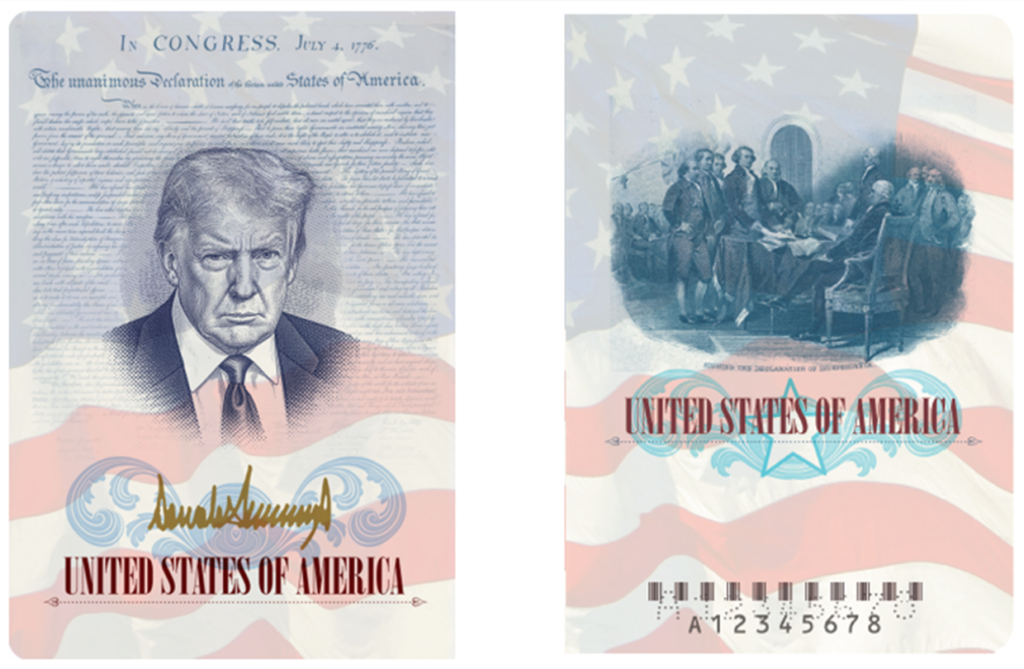
Inner covers of a new limited-edition United States passport design for the Semiquincentennial featuring the United States Declaration of Independence, and Donald Trump.
United States Department of State on Wikimedia Commons
According to the current president, the United States should behave more like a “normal country.” That means less emphasis on American exceptionalism and missionary foreign policy, and more emphasis on interests, costs, and benefits.
This approach asks a simple question: What is worth it for America?
Did only Trump recognize the limits of American power?
No. Obama and Biden also recognized the relative decline of American power. The difference was mainly in style and emphasis. All three administrations understood that the United States could no longer cover every global front alone.
How does this appear in the acts of the Trump administration?
It appears in the demand for burden-sharing. In the Middle East, for example, if reconstruction or stabilization requires hundreds of billions of dollars, Washington increasingly expects regional actors to contribute more. In Europe, the United States expects NATO allies to spend significantly more on defense. The idea of European countries spending up to 5 percent of GDP on defense reflects this pressure. Ukraine is another example. The United States has increasingly pushed European countries and the European Union to take greater responsibility for Ukraine’s long-term support.
Who influenced this strategic thinking?
One important figure is Elbridge Colby. He speaks about a “Kissinger moment,” referring to the need for the United States to return to balance-of-power politics.
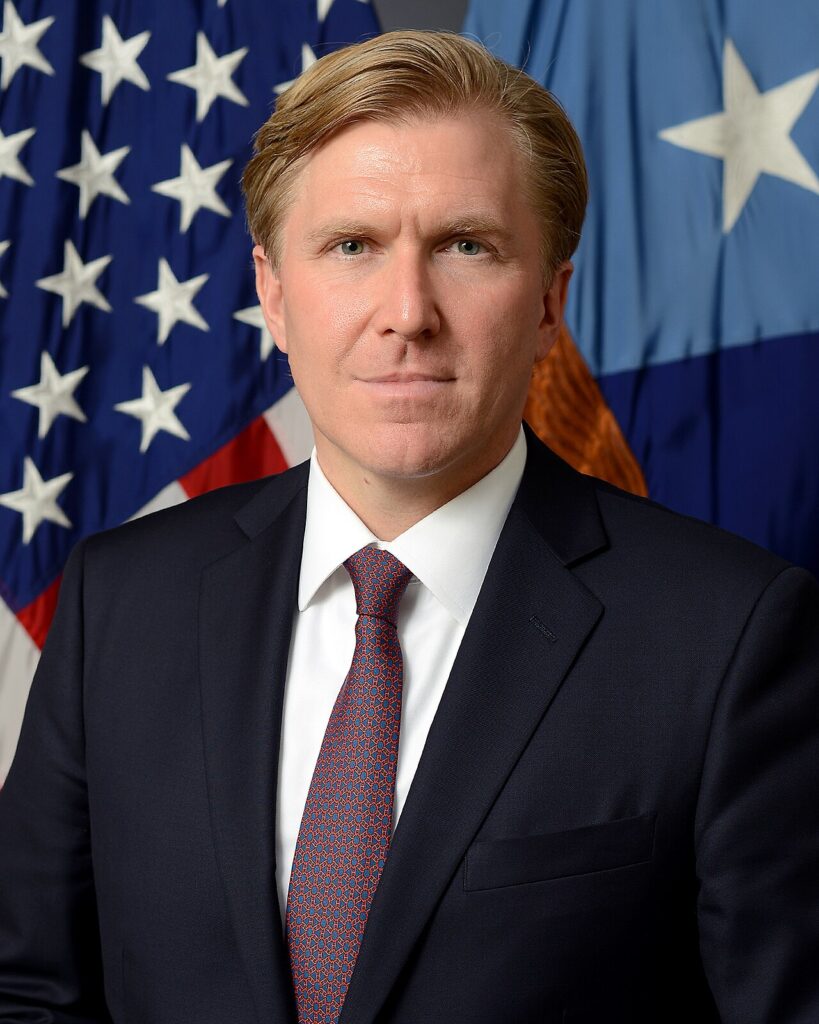
Elbridge A. Colby, Under Secretary of Defense for Policy
Nixon and Kissinger broke with some earlier American traditions. Instead of presenting foreign policy as a universal ideological mission, they focused on military balance, great-power competition, and strategic realism.
The Nixon-Kissinger approach asked where American power should be used and where local actors should take more responsibility.
Is there a historical precedent for asking allies to defend themselves?
The Nixon’s Guam Doctrine is a clear precedent. During the Vietnam War, Nixon argued that the United States would support its allies politically and diplomatically, but they should not automatically expect American soldiers to fight every war for them.
The message was that allied countries must develop their own ability to defend themselves.
How does this explain the current president’s policy?
Trump’s approach revived this logic. The United States should not be a global emergency service responding militarily everywhere. Instead, allies should take greater responsibility for their own defense.
This resembles a more traditional great-power approach: spheres of influence, balance of power, burden-sharing, and a stronger focus on national interest.
The sphere of influence means that Washington is focusing more on the Western Hemisphere.
Could this lead to a new version of the Monroe Doctrine?
That is an important question. If the United States becomes more selective globally, it may place stronger emphasis on its own hemisphere and on areas it considers vital to its national interest. The key issue is how this would affect the Western alliance system, Europe, and America’s global commitments. The main issue is whether Washington still has the will to maintain such a role and whether its allies are willing to share more of the burden.
NATO and European Strategic Autonomy
How does this affect NATO?
NATO remains one of the main pillars of American power. During the Cold War, European NATO members felt the direct pressure of the Soviet threat. There were disagreements, such as debates over the possible deployment of the neutron bomb in Germany, but the basic structure of dependence on the United States remained intact. A major turning point was the Iraq War in 2003. France, Germany, and Russia opposed the American position. Since then, some European states, especially France, have promoted the idea of strategic autonomy.
Can Europe become militarily independent from the United States?
Not quickly. It would take decades for Europe to build the necessary military capabilities. Even then, it is not clear that the United States would welcome a fully autonomous European defense structure, because American influence in Europe is closely connected to its central role in NATO.
American Soft Power and Domestic Politics
Beyond military power, could the United States remain dominant with its soft power?
The United States still dominates in soft power. American culture, lifestyle, universities, business models, technology companies, entertainment, and digital platforms continue to shape global expectations.
In the business world, the United States remains the leading country. Many of the largest banks, technology firms, and innovative companies are American.
The United States still has enormous influence over the internet and digital infrastructure.
What about research and innovation?
America still has tremendous research potential. Many of the world’s leading researchers work in the United States, and the country continues to attract talent from around the world. For this reason, it would be wrong to say that American dominance will collapse in the next ten, fifteen, or twenty years. It will change, but it is unlikely to disappear suddenly.
Is the “American dream” still a viable concept?
The American Dream is a myth fueled by Hollywood. However, America has indeed provided opportunities for tens of millions of people that they wouldn’t find elsewhere.
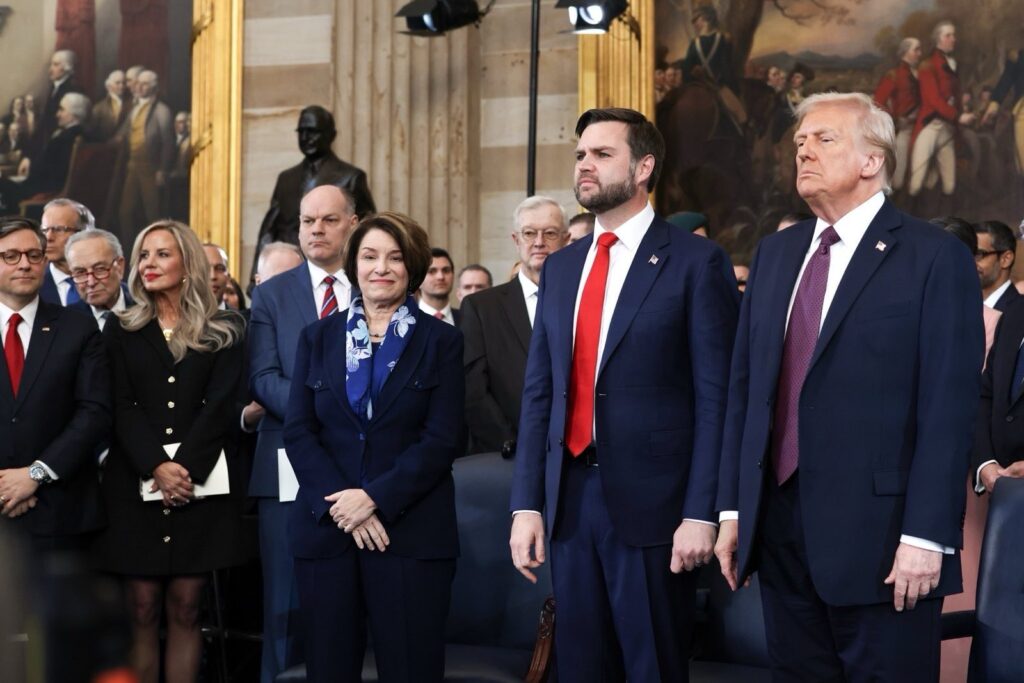
U.S. Vice President JD Vance and President Donald J. Trump on Inauguration Day, 20 January, 2025 (Photo: Office of Vice President of the United States / Wikimedia Commons)
Consider the life story of J.D. Vance, who rose from very poor beginnings to the vice presidency. The two former Democratic presidents, Bill Clinton and Barack Obama, also rose from relatively humble beginnings to become president.
Clinton’s father was an alcoholic, and as they say in the U.S., he was “born on the wrong side of the tracks.” Obama is from mixed-race family, whose father left the family when he was two.
People from India and other immigrants dominate Silicon Valley and the startup world.
At the same time, for the large middle class, the standard of living has been stagnant for decades.
The reason for this is deindustrialization, which has turned entire industrial districts into wastelands. The traditional working class no longer feels the opportunities that previous generations took for granted—namely, that their children, even if only slightly, can move up in life.
You often criticized the so-called identity politics, or the woke culture, saying that they undermine traditional American values and divert the country from its core national interests.
Identity politics tends to atomize society. It encourages people to define themselves primarily through ethnic, racial, religious, gender, or cultural categories.
This does not immediately mean national collapse or secession. But it does weaken a shared civic identity. If every group defines itself separately and interprets American history through its own grievance or experience, it becomes harder to maintain a common political language.
Do you think that the United States is already splitting apart?
Not yet. The United States is not formally splitting apart, and it still has strong institutions, enormous economic capacity, and a powerful national framework. However, the long-term trend is concerning. If different ethnic, cultural, and ideological groups increasingly define themselves against one another, this could produce deeper conflicts in the future.
The Declaration of Independence Today
The USA celebrates its 250th birthday in a few days (the interview was conducted on the 30th of June). Do the core ideals of the Declaration of Independence fit into this debate?
The Declaration of Independence remains central to American political identity. Its most famous claim is that all people are created equal and possess certain unalienable rights, including life, liberty, and the pursuit of happiness.
It also states that legitimate government derives its power from the consent of the governed. These ideas shaped the American founding and continue to influence political debates today.
Are the core ideals of the Declaration (“All people are equal and possess inalienable rights to life, liberty, and the pursuit of happiness.”) still valid in contemporary America?
Yes, but they are contested. The ideals remain powerful, but Americans disagree about how they should be applied. In the case of justice, they usually say that there is more of an administration of justice, and there is a difference between the two.
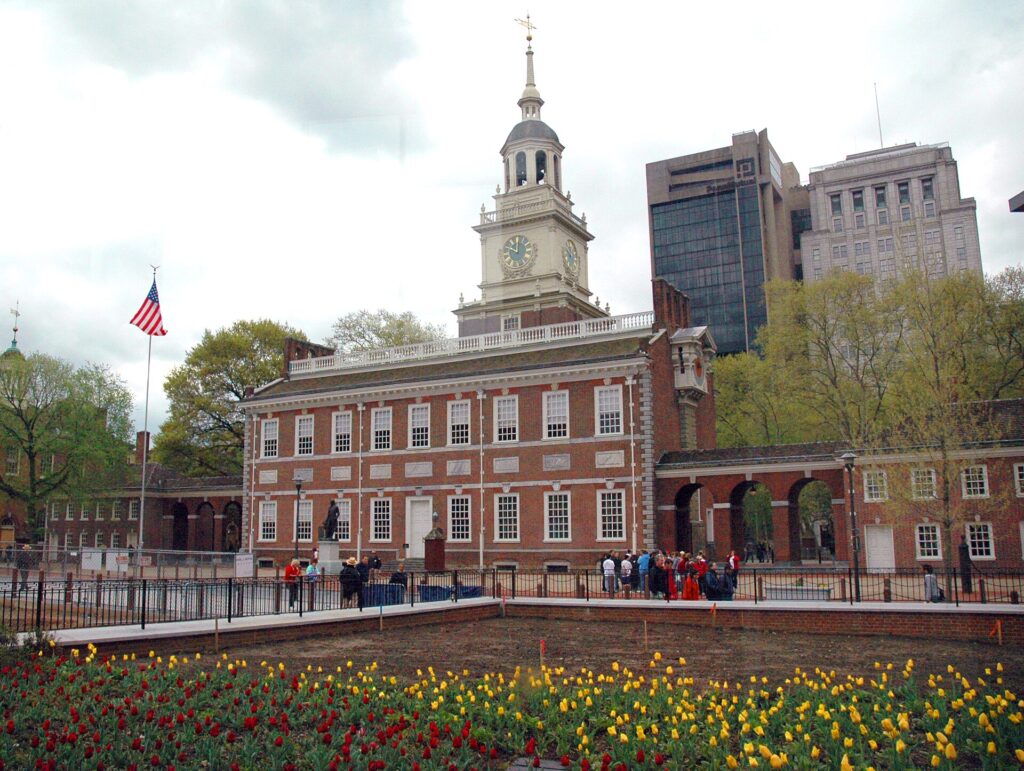
Independence Hall in Philadelphia. Source: Rdsmith4 on Wikipedia Commons.
There are debates at US universities and at work about how positive discrimination can be used. Officially, its use is prohibited. For example, the last time the court ruled in favor of a lawsuit filed by Asian American students at Harvard, it was on the basis that they could not be discriminated against in favor of black students. The deeper dilemma is the tension between freedom and equality. These two values are both central to Western political thought, but they do not always fit easily together.
How has the United States traditionally balanced freedom and equality?
If a society emphasizes freedom above all else, inequalities will naturally emerge. People have different talents, backgrounds, ambitions, families, networks, and resources. If a society emphasizes equality above all else, the state must intervene more strongly through taxation, redistribution, quotas, regulation, and social engineering. This may reduce freedom.
Historically, the United States has leaned more toward freedom. American society has placed great emphasis on individual liberty, private property, entrepreneurship, and limited government.
Today, however, parts of the American left, especially within the Democratic Party, are pushing more strongly toward equality. This creates a new political tension: how far can equality be promoted without seriously limiting freedom?