 By
By Amid White House interference and FIFA’s greed, the FIFA 2026 tournament was a much-needed distraction in an era of conflict. The slogan of “Football is for Everyone” also remains true.
‘The Greatest Event Humanity Has Ever Seen’
Despite FIFA’s prediction that three-quarters of the world’s population would participate in the World Cup, eight of the ten most populous countries were not represented.
India and China, as the 21st century’s emerging powers, did not. India, despite a total population of nearly 1.5 billion, including millions of football fans, has always struggled to get past the World Cup qualifying stages. China has had only one appearance in the World Cup despite its significant investment in the sport. Russia was barred from participating in major sporting events due to its invasion of Ukraine.
Of course, Team USA had a successful run, taking the privilege of every fair and unfair advantage as host, but their defeat to Belgium demonstrated their limitations.
Two other emerging powerhouses, Indonesia and Nigeria, are also missing. Meanwhile, minor nations without a notable football culture like Curacao, Haiti, Cape Verde, and other small nations such as Ecuador and Bosnia and Herzegovina, have all shone at the world stage.
The Guardian’s veteran columnist, Simon Tisdall, was summed up this phenomenon that the World Cup is the stage where smaller nations and individuals can receive more attention.
“In an age dominated by overbearing, illiberal economic and military powers, the men’s World Cup is upending the conventional geopolitical pecking order and power balances in refreshing and instructive ways,” Tisdall added.
FIFA 2026 WC: Corruption, Scandals, and Carnival
On and off the pitch, the World Cup has been a roller-coaster, colorful celebration of multiculturalism and racial diversity.
For instance, players from a World Cup-qualifying national team proudly state their refugee and immigrant backgrounds.
The Australian national team, for example, delivered this video published before the World Cup:
Even though the increasingly polarized political arguments surrounding immigration, around one-third of the US football squad is made up of immigrants’ descendants.
Timothy Weah’s parents immigrated from Liberia and Jamaica and met in the United States. Ricardo Pepi’s parents relocated from Mexico to Texas in quest of better opportunities. Not to mention, their best player, Folarin Balogun, who was born in New York City to Nigerian parents and raised in England.
A carnival-like welcome afforded to travelling fans by Americans from Texas to Massachusetts showed a mirror of the migrant-hating, xenophobic image of the US created by the White House.
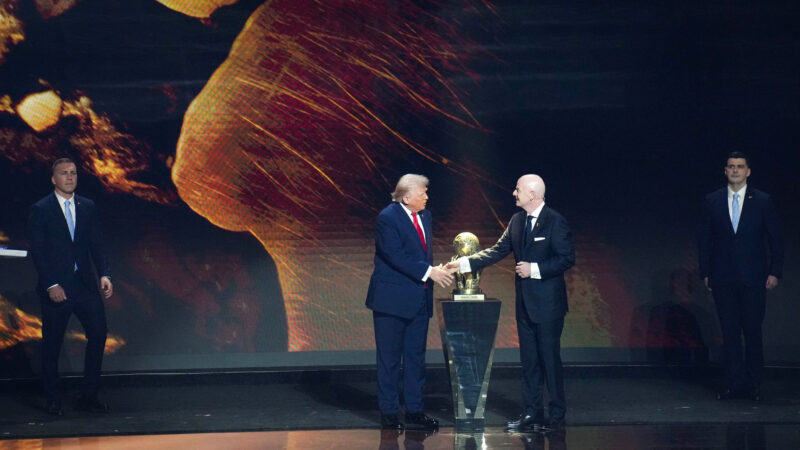
A good example of refusal among fans of Donald Trump and his buddy “Gianni” was the whistling when they entered the pitch during the medal ceremony at the MetLife Stadium.
Trump and Infantino are loudly jeered as they walk out to present the World Cup trophy. pic.twitter.com/sqxPd0o2CS
— Adam Schwarz (@AdamJSchwarz) July 19, 2026
Donald Trump’s sneaky interference sparked universal outrage and strengthened the Belgian players, who smashed Team USA by 4-1.
The tiny country was shocked by FIFA’s rule-bending decision to reinstate a red-carded USA player, Balogun, at Trump’s request. Their riposte came on the pitch, and the entire world – except the United States – rooted for the Belgians and blasted Gianni Infantino’s FIFA, which has – again – earned the title “an organization infamous for corruption.”
And there were other ugly moments, notably the unjustified US exclusion of Omar Artan, a top-ranked Somali referee, and the official harassment of Iran’s national team. Other African and Asian football teams also faced provocative check-ups from US public agents.
Not to speak about the fans from Haiti, Côte d’Ivoire, and Senegal, whom the White House had banned from entering the US.
Some racial statements also emerged targeting France and the tournament’s best striker, Kylian Mbappé, by Celeste Amarilla, a Paraguayan senator. Mariano Rajoy, likewise, targeted the French team, calling the “Les Blues” a decent team, but “had no French player”.
The widespread public condemnation against both statements suggests a gratifying shift in public attitudes.
What’s Now for the “Most Beautiful Game”?
Like preceding competitions in Russia and Qatar, this World Cup was financially successful as well as popular among the spectators.
But this happened despite, not because of, FIFA.
Although the football governing body maintained throughout the tournament that it got ticket prices right, and the full stadiums were maybe evidence of that, FIFA’s dynamic ticket pricing and overpriced merchandise reflect Infantino’s priorities: power and money.
In 2018, he shamelessly sucked up to Vladimir Putin. In 2022, Qatar’s dictatorial rulers received similar treatment. The fate of incarcerated dissidents and exploited migrant workers was overlooked.
Infantino’s unprincipled behaviour, along with FIFA’s short-sighted greed on this World Cup, may serve to upend the sports and political status quo.
The European Football Association (UEFA) is at odds with FIFA over the USA-Belgium red card controversy and Russia’s readmission. UEFA also scraps hydration breaks, guarantees inexpensive ticket costs for the 2028 European Championships, and names the rejected Somali referee to the European Super Cup final, which FIFA failed to defend.
According to Tisdall, “this split neatly mirrors the geopolitical gulf separating Trump and his fellow authoritarians from Europe’s democracies.”
The Impact of the Oil Monarchies
Despite the criticism, Infantino appears to have locked down another term in charge of FIFA when its members vote for president next spring.
In October, FIFA President Gianni Infantino urged the soccer world to reconsider tournament dates, recognizing that the game’s global reach cannot be limited to the June-July calendar.
FIFA has spent years attempting to promote Qatar, and now Saudi Arabia as evidence that the world’s governing organization is growing less regional and more global. This framing also serves a commercial function, attracting football fans and markets outside of FIFA’s traditional centers of power.
Because the Islamic calendar is lunar, Ramadan and Hajj move around ten days earlier each year, changing their collision points with world sports seasons. Hajj is a Saudi-specific phenomenon, while Ramadan is spreading across the Muslim world, with host countries including Qatar in 2022, Morocco in 2030, and Saudi Arabia in 2034. If that chronology predicts FIFA’s future, these calendar clashes indicate a reoccurring tension.
Conventional wisdom holds that World Cups do not actually change much; everyone gets enthusiastic, there is a lot of talk about a world unified by the beautiful game, the competition begins, England loses on penalties, Germany always wins, and then there are politics, as normal.
After France’s famed multiracial team won in 1998, the death of the French far right was widely predicted. It never occurred.
We do hope that despite Trump’s and FIFA’s efforts, this World Cup will result in a long-term shift towards greater global fairness and equality.
“Football is for Everyone.”