 By
By On August 8, the Israeli security cabinet approved the plan to take control of Gaza City after weeks of lockdown and starvation in Palestine. On August 10, Israel targeted the media tent near Al-Shifa Hospital that housed the few remaining journalists inside the Gaza Strip.
The attack targeted Anas al-Sharif, a renowned Palestinian journalist who had been working for Al Jazeera for two years as a locally sourced correspondent. The bombing also killed Al Jazeera correspondent Mohammed Qreiqeh, camera operators Ibrahim Zaher and Mohammed Noufal, as well as two freelancers, Moamen Aliwa and Mohammad al-Khaldi.
Israel confirmed shortly after that they were in fact responsible for the attack and that it was a deliberate, targeted offensive against al-Sharif, who they said was a leader of a Hamas terrorist cell who “posed as a journalist.”
“Anas Al-Sharif served as the head of a terrorist cell in the Hamas terrorist organization and was responsible for advancing rocket attacks against Israeli civilians and IDF [Israeli army] troops,” the Israeli military confirmed on Telegram.
This was not the first such incident in Gaza.
When the Committee to Protect Journalists (CPJ), a non-profit organization monitoring the safety of journalists worldwide since 1981, the first year they released their annual report, 2024 was the deadliest year on record, with 124 journalists killed worldwide, 85 of whom died in Gaza. Of those 85, ten were killed in targeted attacks, including 5 who died after their press van was struck in a single attack.
2025 is already a deadlier year, with 13 deliberate murders so far. The murder of 6 journalists in the August 10 strike is the deadliest single attack in the Israel-Gaza War so far.
The CPJ highlighted Israel’s “longstanding, documented pattern” of calling journalists terrorists “without providing any credible proof.”
Human Rights, Press Freedom, and Democratic Values
According to the Geneva Convention, journalists reporting on the frontlines of armed conflicts are to be considered civilians. Civilians are “any person” who cannot be categorized as a prisoner of war, member of armed groups, volunteer corps, or inhabitant who takes up arms. If in doubt about the civilian status of any person, the individual in question is to be considered a civilian.
Israel argued that al-Sharif is a terrorist based on documents it found in Gaza. Some – namely spreadsheets supposedly listing Hamas operatives, injuries, and a section of phone numbers the IDF believed to be a directory for the East Jabalia battalion – were released for publication.
But the legitimacy of these documents is questioned by many, with international media outlets, such as the BBC and Reuters, saying it cannot be independently verified, CPJ rejecting it as insufficient in credibility, and the Foreign Press Association also condemning it as unverifiable.
Al Jazeera condemned the killing of its team, calling it an assassination.
Though al-Sharif supposedly worked with a Hamas media team in Gaza before the war, there is no evidence suggesting he was further affiliated with the group or that he ever took up arms before or during the current war.
This can be addressed as doubt, in which case al-Sharif should still be considered a civilian.
Even if this reasoning falters, and al-Sharif is to be confirmed as a non-civilian, the other journalists in the tent are not included in the documents provided by Israel.
The civilian status of the rest of the Al Jazeera team was never called into question by Israel, who never explained why they were included in the targeted killing.
Article 50 of the Protocols additional to the Geneva Conventions of 12 August 1949 clearly states that “The presence within the civilian population of individuals who do not come within the definition of civilians does not deprive the population of its civilian character.”
As such, the murder of these journalists can be categorized as a war crime, committed in violation of international law.
“If Israel can kill the most prominent Gazan journalist, then it can kill anyone. The world needs to see these deadly attacks on journalists inside Gaza, as well as its censorship of journalists in Israel and the West Bank, for what they are: a deliberate and systematic attempt to cover up Israel’s actions,” said CPJ Regional Director Sara Qudah.
Rational Politics or Human Issues?
Journalists are civilians under international law whose job is to bring stories to people to aid the understanding of complex issues. Many times, they ultimately humanize political issues as they explain them. Humanizing war, however, ends in the moral collapse of the justification of violent actions.
When constructing such narratives of war, one side must be considered evil, while the other good. The demonization of the enemy is the only way the human mind can continuously justify murder and war.
What James Forsher, an assistant professor of mass communications, told ABC News in 2003 is still true: “The secret in propaganda is that when you demonize, you dehumanize.”
Emma Briant, associate professor in news and political communication at Monash University, in Melbourne, Australia, highlighted the tendency of both Hamas and Israel to say that civilians are not, in fact, civilians by utilizing dehumanizing rhetoric.
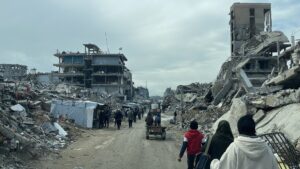
Images of war 23-25 from Gaza. Photo: Jaber Jehad Badwan on Wikimedia Commons. Licensed under: Creative Commons Attribution-Share Alike 4.0 International.
There is also the juxtaposition of rationalist politics, which sanitizes any conflict from human feeling, simplifying it down to a ‘zero-sum game’ that determines the survival of a nation, which is how Israel defines its security in a region that historically resents its existence.
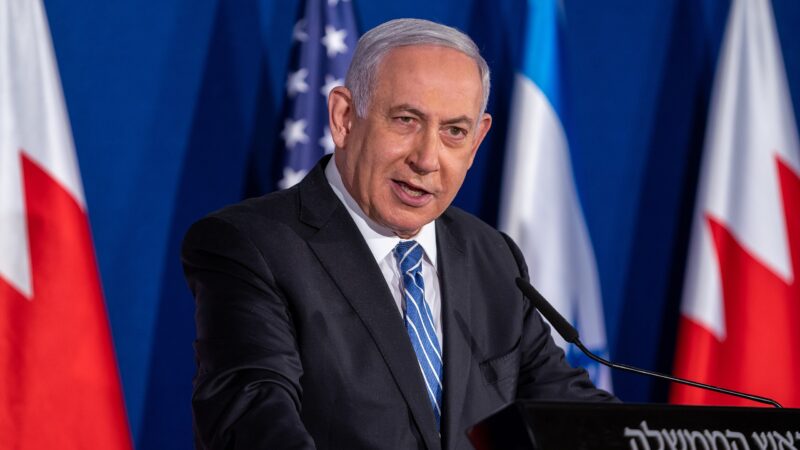
Israel’s struggle in a culturally unfamiliar setting frequently leads to its leaders calling for ‘a war to survive,’ and Netanyahu is no exception. “We are in an operation for our home, a war to ensure our existence, a war that we will win,” he said after the October 9 abductions.
This is an important point to remember for any diplomacy expert hoping to negotiate with Israel over possible de-escalation. Adding to the fear with further existential threats negates the point of negotiations and gives Netanyahu ammunition for his rhetoric; however, his tactics, as pointed out by critics, have gone beyond what is necessary for survival and turned the war into one of attrition, where his opponent is the one that must do everything in order to survive.
But this war has equal human and rigorously rational elements from each side that make deciding who should be the victor impossible. One targets reporters and starves a population, while the other commits acts of terrorism, hides among civilians using them as human shields, and abducts those civilians to keep them as hostages left to starve or die by execution.
There is no – and there should not be – any ‘good’ side in the Israel-Palestine war. Each side has committed atrocities, and all the rest of the world can do is hold each political actor to account.
Reality vs. Moral Principles
The killing of journalists cannot be justified by labeling them a security threat. The very essence of journalism is reporting on what happened or is happening, staying close to the sources of information; this can sometimes be interpreted by governments to be breaching national security, but civilians with civilian tactics should not be able to intervene with such matters without compromising their civilian status.
Why Israel has been targeting journalists is something outsiders can only guess. But one issue Israeli forces and the government keep running into is apparent: Israel’s existence is not just up to what it does and how well it protects itself. It is wound up in a carefully constructed international social network, which has been protecting Israel on the principle of its creation upon the ashes of the Holocaust.
Despite the longevity of these ties, most are not unconditional. Israel’s disregard for civilians, international law, and the freedom of speech and the press do not bode well for its relations with the Western world. Losing those alliances could bring about the isolation of Israel on the international stage and, as such, the collapse of the careful balance in the area.
According to an investigation conducted by the Israeli-Palestinian +972 Magazine Israel’s military tasked a “legitimization cell” with identifying journalists they could legitimize killing by undermining their work and falsifying information that they are militants of Hamas, thus stripping their civilian status. This would provide a diplomatic fallback with foreign allies.
Continuing such tactics, however, will most definitely continue to cost civilian lives, and without international reprimand, Israel’s tendencies will worsen. Israeli politics exist within the context of a volatile Middle East where borders were drawn by strangers unaware that ethnicity here means less than tradition and religion. While the West’s democratic principles are difficult to reconcile with regional politics, Israel’s tactics have gone beyond undemocratic and into war crimes.
With Egypt and Quatar’s aid, Hamas has now agreed to a 60-day ceasefire deal, said to be based on US Envoy Steve Witkoff’s proposed framework. This would involve Hamas releasing all remaining hostages (only 20 of whom are believed to remain alive) in two batches. Sources say Israel is hesitant to accept the deal, wanting all to be released at once.
As the international community is slowly attempting to reach a middle ground to create a Palestinian state without Hamas, it must remember each war crime committed by each side to make sure suffering does not continue.