
 By
By Last week brought about a historic development in British politics: for the first time, a Green Party candidate won a national by-election. Hannah Spencer, a local plumber, won the Gorton and Denton constituency by a large margin as well, taking 14,980 votes, with Reform UK taking second place with 10,578 votes. For Labour, coming in at third place with 9,364 votes, this represents a 25.3 percent drop in votes compared to 2024, when they won by a 13,000-vote majority.
The results can be interpreted as a small-scale metaphor for larger British politics. As Labour is bending in ideology to keep voters, it is slowly losing its grasp on leadership. However, this has been a long time coming, with Labour never quite recovering after Brexit and the loss of the Red Wall. These were several historically Labour-supporting, post-industrial constituencies throughout Northern England, the Midlands, and certain regions of Wales.
Politics without a Plan
Tony Blair, the longest-serving Labour Prime Minister, enjoyed unprecedented approval ratings: he held the highest postwar approval rating for his first tenure, then the worst for his handling of the Iraq War (2003-2011). When he resigned, Gordon Brown took over without an election, and later lost the 2010 general election.
Under Keir Starmer, many viewed the Labour government as weak and swimming with the tide. But Labour’s unwillingness to step up and confront controversial issues began long before Starmer became party leader.
Labour’s previous leader Jeremy Corbyn enjoyed major support within the party and its voter base until his ill handling of antisemitism within the party and his consequent unwillingness to apologize crushed his image.
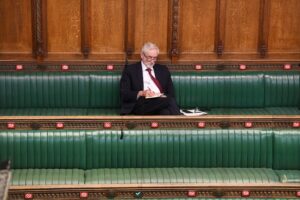
Corbyn later became a backbench Member of Parliament. Photo: Rt Hon Jeremy Corbyn’s first PMQs as a backbench MP. Source: UK Parliament / Jessica Taylor / Wikimedia Commons, CC BY 3.0
The consecutive Conservative governments’ success combined with the paralysis of Labour led to their biggest defeat. The collapse of the “Red Wall” in the 2019 General Elections meant the constituencies that voted Labour for generations “turned blue” as Labour failed to convince its traditional base.
However, when the Conservatives faced crisis after crisis, there was a new opportunity for change. Yet Labour missed it, as they failed to define their political identity – a task that is increasingly important in British politics.
By remaining on the fence on major issues for years, Labour has splintered, unable to define what it stands for – instead defining what it is trying to avoid.
Not only that but also failing to tackle working-class issues meant failure to keep their traditional voters, while their manifestos left new voters without a clear vision of what a Labour government would strive to achieve.
Labour Was the ‘Next Best Thing’ – Now Their Lacking Shows
Later, the sole purpose within Labour became survival by avoiding anything that could cause a scandal within and for the party. They chose a policy of nothingness, where the lack of a robust manifesto was switched to a series of rhetoric slogans with no clear meaning or policy behind them.
Labour was not elected, in the traditional sense of the word, in 2024. It was merely the party that had the fewest scandals and the least animosity from voters. They were chosen despite all other parties, not for their own manifesto or vision for the country.
Ordinarily that would not cause a major problem. However, Starmer’s government was the first to return to power since Tony Blair’s election – he had many expectations to meet. Without a strong base, however, Starmer merely became the alternative to Nigel Farage. That manifesto may no longer be enough for the average voter, long disillusioned with the ideas of New Labour under Brown and Blair.
Being the next best thing got them elected, and the lack of an alternative kept them in power. But now, change is on the horizon with the recent win by the Greens signalling something new, albeit not unknown in British history.
Newcomers Emerge and Win
After the First World War, the Liberal Party, one of the two major political parties in the 19th and 20th centuries, lost its relevance as Labour rose to take its place. Historians attribute this to a variety of issues: the divide of leadership within the party, the electoral system, and wartime hesitance in policies are just some. All these contributed to the growth of Labour’s support, which inevitably took over the Liberals’ position.
The first-past-the-post system has always affected smaller parties disproportionately. If a constituency was won by a narrow margin, the loser’s efforts are not translated into mandates. As such, becoming a national third party means it is difficult to climb up the ranks as the two dominant parties battle one another in each seat.
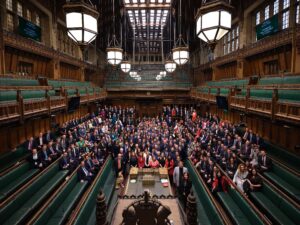
New member group photograph of the 2024 Parliament, 09/07/2024. Photo: UK Parliament Image Bank / House of Commons / Wikimedia Commons, CC BY 3.0
As the Liberal Party’s voters became hesitant, they turned to a better alternative, which then translated to the party sliding to the sidelines of national politics. Currently, as Labour’s politics of nothingness is pushing it further down the polls, smaller parties can find their way into more seats, slowly taking over parliament.
Immigration continues to be a faultline issue, gripping British debate the way Brexit did in the late 2010s. But while Brexit dealt with a range of issues, many of which had immediate consequences, immigration is a policy area where developments are usually felt in the long run. This makes it easier to take on extreme stances without direct backlash.
Reform UK has capitalized on this. Combined with their ability to attract Labour’s disillusioned voters, they have climbed to the top of the polls and won by-elections leading many analysts to believe that they are the new political force set to shake up the Conservative-Labour dominance.
But the byelection of the Greater Manchester constituency, Gorton and Denton, shows that it is not necessarily the appeal of the far-right that motivates voters but the simple idea of change – something only newcomer parties have been able to inspire.
The Green Party’s win shows the appetite for more left-wing politics, once represented by Labour, despite many workers having migrated towards the right, supporting Brexit.
While the Green Party has only just experienced its first byelection win and remains a small unit in parliament, its membership and poll performance are on the rise nationally, especially since Zack Polanski became party leader.
Gorton and Denton truly was a “referendum” on Starmer’s leadership, as local Reform UK candidate Matt Goodwin said: Starmer blocked the popular mayor of Greater Manchester, Andy Burnham, from running in the constituency, further weakening Labour’s standing for what party insiders called “petty factionalism.”
It also showed that the radical immigration policy of Reform does not resonate with everyone who is looking for an alternative to the big parties.
Since the byelection, the Greens have also overtaken Labour in a YouGov survey, asking respondents about their voting intentions.
What Can Be Expected of the Next General Election?
Politics are about representation, but often, especially around elections, more is decided based on voters’ feelings of being seen. If a politician is oblivious to the problems of everyday people, a functioning democracy will soon see them out of office.
Within the British election system, this means that Labour’s continued failures could see them not just out of office but dropping out of the race to be first- or second-best.
The Brexit effect is still felt across the Isles as traditional voting patterns are morphing into a new political landscape. Though 2029 is a way off, the post-war duopoly might just fade or collapse entirely during this election.