 By
By The English council elections and parliamentary elections in both Wales and Scotland have proven that the era of dual dominance in UK politics is over, with both Labour and Conservatives losing traditional strongholds.
It was the smaller (Greens) or local devolved parties (Plaid Cymru and the Scottish National Party) making gains; but the party with the biggest wins was Reform UK, sweeping undecided voters across councils.
The election results show how the public’s trust in the two-party tradition has been shaken to its very core; now there is a new era beginning, where Reform and the Greens are not just bywords of electoral results.
English Councils: Fragmentation Gives Reform Momentum
Nigel Farage, now leader of Reform UK, has had a strong influence on defining political faultlines in British politics. With Brexit, he got the ball rolling, only to be stalled when the Conservatives capitalized on his ideas to become the party of ‘Leave’ voters.
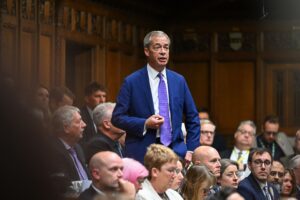
Nigel Farage as Reform UK MP for Clacton durong the 2024 Prime Minister’s Questions. Photo source: ©House of Commons / UK Parliament / Wikimedia Commons, CC BY 3.0
The field has now changed. Brexit has been replaced by immigration: according to Ipsos’s Issues Index, it was the second-most mentioned issue in April with 32 percent, which was the lowest level the agency recorded for the year.
For Labour and the Conservatives, immigration has been an issue seemingly impossible to solve. Though current Home Secretary Shabana Mahmood has introduced hard-liner immigration reforms, including reviewing refugee status every 30 months, abolishing asylum hotels, and upscaling removals, many are still worried about the lack of effective measures against small boat crossings, for example.
Reform successfully capitalized on this; the party swept in 14 councils, and even Essex County where Conservative Leader Kemi Badenoch, and shadow secretaries Priti Patel and James Cleverly are all MPs. Suffolk County council, another Tory stronghold, has also defected by a large margin.
Reform also took several Labour strongholds near Newcastle. While no party reached majority in the city, Reform came second, tied with the Greens, with 24 councilors, after the Liberal Democrats’ 25.
Despite such a sweep, Reform struggled to secure council majorities across the country. The number of ‘no majority’ councils increased by 28 this election, bringing it to a total of 65. It is now officially the most common single mode of control, with 42 percent of councils lacking a one-party majority.
Elections expert Peter Kellner also suggests that though Reform performed well, their support may have peaked, as their vote share is down compared to last year’s. According to Sky News’ calculations, they have won 27 percent of available seats across nations, compared to 32 percent last year.

Prime Minister Keir Starmer hosts antisemitism event. Photo source: Simon Dawson / No 10 Downing Street / Number 10 / Flickr, CC BY-NC-ND 4.0
Fragmentation is apparent in the results: Labour still leads in the number of councils, but they lost 40 overall. The Conservatives have collapsed as well; they lost 10 councils and only hold 9 now.
The Greens have also strengthened their hold: they gained the second-most number of seats (440) after Reform (1453). This translated into five council majorities.
Most importantly, the party won its first two mayoral elections, both in Labour boroughs. Hackney has been in Labour hands for all but 8 years since it was created in 1964, while Lewisham’s seats were under complete Labour control after the 2022 elections.
The result prompted Green leader Zack Polanski to declare the era of two-party politics to be “dead and buried,” as the Greens are on the path to replacing Labour. “It is very clear that the new politics is the Green party versus Reform,” he said.

Carla Denyer, co-leader of the Green Party, with Zack Polanski AM, Deputy Leader and London Assembly Member. Photo source: Bristol Green Party / Wikimedia Commons, Public Domain.
The Liberal Democrats, though were outshined by Reform and Green gains, maintained their hold, gaining 152 seats and three councils. Meanwhile, the Conservatives lost 563 seats and 10 councils, including Essex, Suffolk, and Hamshire where they held control since 1997. Despite this, Badenoch stated the “Conservatives are coming back.”
Welsh Parliament: Historic Labour Defeat but No Majority
The Welsh parliamentary elections completely reordered how politics plays out in the small nation. The historic vote left Labour in collapse, with long-time contender Plaid Cymru taking most votes, though finishing short of a majority.
The Senedd elections, just like Holyrood elections in Scotland, show that the two-party dissatisfaction is a national problem: pro-independence parties have won in both Scotland and Wales, with a general sense that Westminster-centered parties have forgotten to address the issues plaguing them.
Wales is where Labour’s fall is most catastrophic. Labour has governed here since devolution began in 1999; their fall completes the separatist overtaking of all three Celtic nations.
Welsh Labour succeeded for a long time in separating itself from Labour UK and showing a more progressive front than its parent party. During Conservative-governed years, they were able to define themselves in opposition to Westminster, attracting the more nationalist voters.
Prime Minister Keir Starmer’s election ended both, resulting in Welsh Labour losing a lot of trust, while cost of living and childcare, NHS waiting times, and a general distrust in politicians already put them on shaky grounds.
While Reform made progress, taking several constituencies, they remain in opposition, as many voters were unsure of trusting the party’s far-right tendency: a YouGov poll shortly before the election showed that Reform was the party that the most respondents did not want to see in the Welsh Parliament. A coalition with the party is unlikely.
The new electoral system also hindered Reform, as Wales has switched from mixed to a fully ‘closed list proportional representation’ system, meaning voters cast their ballots for parties’ lists. Reform gained 34 representatives in the Senedd, nonetheless.
Welsh nationalist party Plaid Cymru came out on top with 43 seats and are forming a minority government. Independence is still a question, so the party prioritized stability. Reform has branded itself the “pro-union majority” after the election.
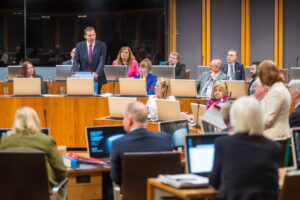
Plaid Cymru Leader Rhun ap Iorwerth speaking in the Senedd. Photo Source: Senedd Cymru / Welsh Parliament / Flickr, CC BY 2.0
Labour came third, only securing nine seats. As a result, former First Minister Eluned Morgan now has no seat in the Senedd; the title falls to Plaid Cymru Leader Rhun ap Iorwerth, the first non-Labour politician in the position.
Scotland: Scottish Nationals Waver but Hold
The Scottish National Party (SNP) has held firm dominance over the nation since before devolution; one key reason for allowing more decisions to the Scots was to quell the SNP’s rise. But after a few Labour governments, the SNP has won consistently since the 2007 Scottish elections.

First Minister John Swinney opens Scotland’s first GP walk-in clinic at Wester Hailes Healthy Living Centre, 2026. Photo source: by Scottish Government / Flickr, CC BY 4.0
This election was no different; First Minister John Swinney is set to form a minority government with 58 seats, well ahead of Reform UK, who placed second with 17 seats. The Scottish Greens were not far behind with 15 seats; a record for the party, who also got a hold of Edinburgh Central and Glasgow Southside, the constituency of former First Minister Nicola Sturgeon.
Reform gains came mostly at the expense of Scottish Conservatives, though their one constituency loss went to the SNP. They remain a small force with 12 seats, only second-worst result compared to the Liberal Democrats with 10 seats. LibDems, however, held onto their constituencies, even gaining three from the SNP, mostly in the northern isles.
Fragmentation of the vote may not have reset the map in Scotland quite as much, but it did shake the SNP’s hold in several areas and inducted Reform into Scottish politics. Aside from a small reshuffling, it was the traditional duo, Labour and Tory, losing ground here as well.
This is in part due to Scottish immigration-positivity, which has only begun to change recently. Cost of living, the NHS, and the economy were all more important issues for voters. Independence remains in thoughts, but just like in Wales, has been put on hold in favour of stability.
A New Reality
The elections have clearly demonstrated British disillusionment with traditional parties. Experts say the two-party system is indeed over. Instead, a five-party era is coming.
“We have never had five-party politics before. We’re in unprecedented territory and none of us know exactly where this will go,” John Curtice of the University of Strathclyde told The Guardian.
Reform UK’s support may have peaked but they have room to grow; otherwise they have undeniably established themselves as a major political force. The Greens are not far behind. As Labour infighting and Tory inaction continues, these parties will keep getting chances to seduce voter support.
Despite it sounding over-the-top, Reform UK as the new right and the Greens as the new left could become a reality, in England at least. Devolution means the pull between Westminster and its sister parliaments will widen, also contributing to these processes. The election has set a new, interesting, multi-party arena worth watching.