

 By
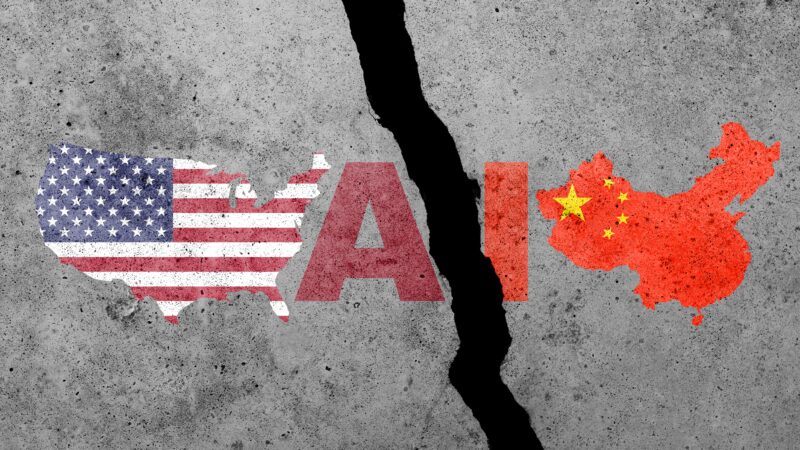
By In May 2026, while Donald Trump prepared for his visit to Beijing, many expected tense discussions about tariffs, Taiwan, military deterrence, and trade imbalances. However, another issue had quietly become just as significant: artificial intelligence.
For years, the U.S.-China technological rivalry was considered mostly as a semiconductor war. Washington imposed export controls on advanced chips, GPU clusters, and lithography equipment, hoping that restricting access to cutting-edge hardware would slow China’s rise in AI.
The US logic was that whoever controls the most powerful chips controls the future of artificial intelligence. However, by 2025, that assumption had begun to crack.
In 2026, the global AI race is no longer defined solely by hardware supremacy but rather by software efficiency, energy economics, robotics, and the ability to diffuse AI into the real economy faster than competitors. And on many of these fronts, China is rapidly catching up.
From the Chip War to the Token War
China’s strategy is not to beat the United States at the highest end of semiconductor technology. Instead, Beijing is pursuing a far more pragmatic approach: circumvent the fortress rather than storm it.
As analysts say, China is adapting the classic old strategy of “encircling the cities from the countryside.” While the United States continues focusing on frontier models and elite hardware, China is aggressively targeting the mass-market layer of artificial intelligence: cheaper, more energy-efficient, and commercially deployable AI systems.
The key concept reshaping the industry is the “token economy.”
In modern AI systems, competitiveness is increasingly measured not simply by raw computing power but by how cheaply and efficiently models can generate tokens — the basic units of language processing. The critical metrics are now tokens per watt, cost per token, and inference efficiency. This shift plays directly into China’s strengths.
DeepSeek reportedly trained its V3 model for around $6 million, compared with estimates of roughly $100 million for OpenAI’s GPT-4. This means that Chinese firms compensate their weaker chips with smarter architectures, optimization techniques, and ruthless cost engineering.
The strategy is brutally simple: deliver AI that is “good enough” at a fraction of the price.
While Anthropic’s Claude Opus charges roughly $5 per million input tokens, Chinese models such as MiniMax and Zhipu GLM-5 offer comparable enterprise capabilities for around 30 cents. This is not merely a technological competition anymore.
It is industrial warfare through pricing.
And it seems like working. By 2026, Chinese models surpassed American systems in weekly token traffic on OpenRouter, one of the world’s largest AI aggregation platforms. During a single week, Chinese models processed over 5 trillion tokens, significantly outpacing U.S. rivals. This means open gates of the global market for China.
From “AI in the Cloud” to “AI in Steel”
For much of the last decade, Western visions of AI revolved around cloud-based systems: chatbots, generative text models, search engines, and digital assistants. But China sees the future differently. Beijing is now prioritizing what researchers call “embodied intelligence” — AI embedded in physical machines operating in the real world. Humanoid robots, autonomous vehicles, logistics automation, and industrial AI are no longer futuristic experiments in China. They are becoming pillars of their national strategy.
The symbolic turning point came during China’s 2026 Lunar New Year Gala, when humanoid robots performed martial arts and danced alongside humans on national television. For foreign viewers it looked like state propaganda. But in reality, it was a geopolitical signal.
China was demonstrating that the next phase of the AI revolution will not happen only inside data centers or smartphone apps. It will unfold in factories, warehouses, supply chains, hospitals, transportation systems, and city streets. And it seems like Beijing holds several structural advantages in this race.
Manufacturing, Data-based Industry and Standards
China’s manufacturing ecosystem allows robotics companies to iterate at extraordinary speed. The country’s electric vehicle supply chains — motors, batteries, precision components, and industrial tooling — are already spilling over into robotics.
Embodied AI improves through real-world experience. China is funding massive testing zones where robots and autonomous systems continuously gather operational data in live environments.
In 2026, China also released its first national humanoid robotics standards framework.
It may sound bureaucratic, but standards shape global markets. Whoever defines interfaces, safety protocols, and industrial norms gains long-term geopolitical leverage.
Exporting a Digital Political Model
And here comes the twist: China’s AI ambitions are not only economic. The country’s 15th Five-Year Plan (2026–2030) explicitly states Beijing’s intention to expand its influence over global AI governance, cybersecurity standards, and digital infrastructure — particularly across the Global South. This has fuelled growing concerns about the international spread of what critics describe as ’digital authoritarianism,’ claiming that Chinese AI systems are not politically neutral technologies.
Research from Stanford and Princeton argues that China’s AI regulations effectively extend the country’s censorship architecture into generative AI. Models are legally required to uphold “Core Socialist Values” and avoid content that threatens national security, undermines state unity, or spreads ’false information.’
In practice, this includes politically sensitive subjects such as Taiwan, Hong Kong, Tibet, and Xinjiang. But the implications extend beyond China’s borders.
Some studies suggest Chinese models increasingly reproduce geopolitical narratives aligned with Beijing’s strategic interests — including downplaying Russian aggression in Ukraine or reinforcing state-approved international talking points. Artificial intelligence is evolving into an instrument of information power.
Why Export Controls May No Longer Be Enough
Washington’s biggest strategic problem is that the current export-control architecture was designed for physical goods. Chips can be counted, servers can be tracked. Manufacturing equipment can be blocked at ports, but software cannot.
One of the main challenges of the next phase of AI competition is “model distillation” — the ability of smaller systems to learn from the outputs of larger frontier models.
Once advanced AI systems become accessible through APIs (Application Programming Interface), capabilities can spread globally through ordinary internet traffic. Knowledge no longer moves inside shipping containers. It moves through data flows.
American AI firms increasingly accuse Chinese labs of extracting capabilities from frontier systems at an industrial scale. But the deeper issue is structural: software diffusion does not obey the logic of Cold War-era export controls.
Photo: Illustration by Shutterstock
AI as a New Cold War Dilemma
The emerging situation increasingly resembles the logic of nuclear deterrence. As The Economist recently argued,
AI is creating a fearsome Cold War-style dilemma. Both Washington and Beijing understand that artificial intelligence could become essential to economic growth, military power, cybersecurity, and geopolitical dominance.
At the same time, both fear the risks of uncontrolled escalation. The result is an uneasy mixture of competition and reluctant cooperation. Some limited agreements already exist, for example, humans should control nuclear weapons, not AI systems; AI safety dialogues; and informal coordination on evaluation protocols and catastrophic risk testing.
But deep mistrust remains. American policymakers suspect China uses the dialogue of “AI safety” to gain time and technological access. Chinese officials, meanwhile, believe that Washington’s export restrictions are designed to permanently lock China into second-tier technological status.
Social Concerns Could Hinder the Chinese AI Revolution
China’s domestic transformation also contains a major contradiction.
The country wants to become the world leader in automation while simultaneously wants to avoid mass unemployment.
Cities like Qingdao and Wuhan were flooded by autonomous delivery vehicles, robotaxis, and drone logistics systems. Companies like Baidu, Meituan, and Neolix are deploying thousands of AI-powered machines into daily urban life. However, Beijing remains deeply concerned about social stability.
China’s latest Five-Year Plan explicitly warns against “large-scale unemployment risks.” China’s political order depends heavily on stable social security, therefore regulators have even proposed limiting AI systems whose primary purpose is to replace human labor.
To bear this in mind, the government is attempting something unusual: a form of “human-first automation.”
For now, robots are primarily replacing dangerous, physically exhausting, or low-status jobs. Simultaneously, authorities are funding retraining programs and transitional employment initiatives. But the underlying tension is obvious.
The same technologies that promise enormous productivity gains may eventually destabilize labor markets on a historic scale.
The Real Shape of China’s AI Strategy
The most important realization is that China’s AI strategy is no longer simply about technological catch-up. It is about constructing an alternative digital order.
In that model, AI is cheaper and massively scalable; state influence is deeply embedded; industrial deployment matters more than frontier prestige; open-source ecosystems accelerate diffusion; and technological infrastructure becomes an instrument of geopolitical influence.
The United States still dominates many frontier layers of AI research. But China is increasingly positioning itself to dominate deployment, scaling, manufacturing integration, energy-efficient inference, and affordable automation.
The next decade of AI competition may therefore not be decided by who builds the single most advanced model, but instead by who can integrate artificial intelligence into the real economy — faster, cheaper, and at planetary scale.