
 By
By Romanian politics shows no sign of letting up, and political instability has returned once again. The rifts caused by the annulment of the presidential election, despite new elections having been held, do not appear to have been resolved, as many people remain dissatisfied.
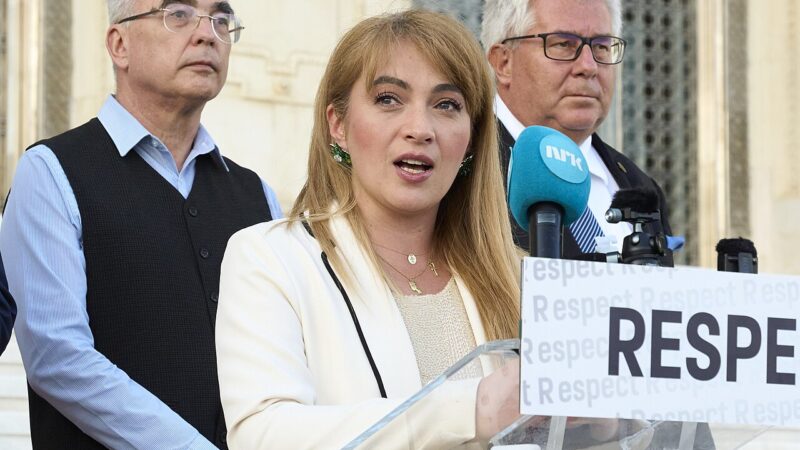
Last week, there was a vote of confidence in the Romanian Prime Minister, Ilie Bolojan of the National Liberal Party (PNL). That motion was supported mainly by two major parties: the conservative Alliance for the Union of Romanians (AUR), the second-largest party in parliament, leading in the polls, and the Social Democratic Party (PSD), a party that was part of the current government but has decided to leave and back the motion. Now many fronts are open; it is not known whether there will be elections, whether a new Prime Minister will be chosen, or who that new Prime Minister might be… For this very reason, The Long Brief has decided to bring in Silvia Uscov.
Uscov is a high-profile Romanian lawyer who coordinated the legal team for George Simion’s presidential campaign for the May 2025 elections in Romania and is now a member of AUR.
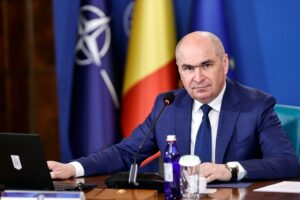
Romanian Prime Minister Ilie Bolojan at a government meeting on the 16th of April 2026. Photo source: Romanian Government / gov.ro / Wikimedia Commons.
Tell us a bit about why AUR decided to table a motion of no confidence against Ilie Bolojan’s government.
Two things, really. First, the Bolojan government pushed through so-called reforms by expedited procedures that bypassed any real parliamentary debate, even though they massively affected the incomes of ordinary Romanians and the situation of companies.
Second, the same expedited route was used to fast-track the listing of strategic state-owned companies on the stock exchange, with clear favouritism, putting the national interest at risk. A government cannot reform a country by going around its parliament.
AUR has historically had a very difficult relationship with the PSD, especially considering that it was under Marcel Ciolacu’s (former Romanian PM) leadership that the presidential elections were suspended. How did you come to cooperate with them on this motion? Was it ultimately a political or institutional decision?
Let me be clear: AUR has not forgotten 2024.
The annulment of the presidential election remains a democratic wound, and history will judge it harshly. But this motion was not a coalition; it was two parties that understood it was important to sign and vote the censure motion together because the Bolojan government was harming Romania. This is about parliamentary mathematics and national interest. That’s all.
This is not the first motion of no confidence to be tabled in Romania. Why do you think this one has managed to gain broader support, and do you believe Romania is entering a deeper institutional crisis?
281 votes, a record in Romanian parliamentary history. But the reasons go beyond dissatisfaction with austerity.
A key reference point is the SAFE programme: the Bolojan government had a very visible interest in concluding defence contracts with Germany, and in order to push them through, the cabinet adopted an emergency ordinance in breach of the Constitution, after it had already been dismissed by Parliament through the motion of no confidence. A government that is no longer a government cannot legislate by ordinance. The Constitutional Court has a case on this, and a criminal case may follow. None of this means Romania is beyond repair. Romania is ambitious.
What is the next constitutional and political step for AUR after this motion? Is the objective to negotiate with Dan to form a new government, or is the real aim to trigger early elections?
Our objective is to return power to the Romanian voter, especially because the December 2024 parliamentary vote was distorted by the manufactured fear that the first round of the presidential election had been won by a so-called pro-Russian candidate. That narrative shaped how Romanians voted, and it was never tested in a clean political environment.
So yes, early elections are the legitimate horizon.
At the same time, AUR is first in the polls and second in Parliament; we are constitutionally entitled to propose a Prime Minister, and we will. But let me be honest: we are not afraid of the ballot box. The establishment is.
If early elections are indeed the objective, could you explain what would actually be required under the Romanian Constitution for that to happen? What parliamentary majorities, procedures, or institutional steps would be necessary?
Article 89 of the Constitution is deliberately restrictive. The President may dissolve Parliament, and I stress ‘may’; it is not mandatory, but only after Parliament has rejected two investiture proposals within 60 days of the first request. So in practice, early elections require either a sustained parliamentary blockade or honest political will to acknowledge that the current Parliament no longer reflects the country. The constitutional path exists. What is missing is the political honesty to use it.
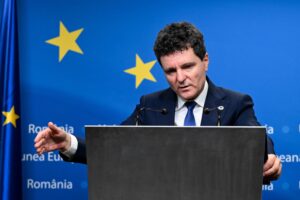
Nicușor Dan, President of Romania in 2025. Photo source: © European Union, 1998 – 2026 / Wikimedia Commons
Under the Romanian Constitution, there is also the possibility of suspending or removing the president from office. From a legal point of view, under what circumstances could such a mechanism be activated against President Nicușor Dan?
The Constitution provides two distinct mechanisms.
Article 95 allows suspension for “grave acts infringing upon constitutional provisions”: the procedure is initiated by one-third of MPs, the Constitutional Court delivers an advisory opinion, an absolute majority in joint session must then vote in favour, and a national referendum follows within 30 days.
Article 96 covers impeachment for high treason, a two-thirds vote in joint session, followed by trial before the High Court of Cassation and Justice. These are exceptional legal remedies, not political weapons.
Do you believe there is currently any constitutional basis for initiating such a procedure, and what role would Parliament and the Constitutional Court play in that process?
If the President crosses constitutional lines, we will not hesitate to use the instruments the Constitution provides, and that is a matter of legal duty, not political preference.
But at this moment, I do not consider that there is a legal basis for suspending President Nicușor Dan.

Călin Georgescu with George Simion at a polling station, May 18, 2025. Photo source: AUR Alianța pentru Unirea Românilor / Wikimedia Commons, Public Domain.
George Simion, AUR leader, has previously said that Călin Georgescu should become Romania’s PM. Does AUR still support that idea, and constitutionally speaking, how realistic would such a scenario actually be?
Călin Georgescu won the first round of the 2024 presidential election and was then stripped of the right to compete in what followed. The president of AUR, George Simion, has been clear that, in our view, Mr. Georgescu represents the legitimate expression of a confiscated vote, the rightful president. As of today, however, Călin Georgescu as Prime Minister is neither in President Dan’s scenario, nor in any scenario where a parliamentary majority would actually vote for him. Constitutionally, any eligible Romanian can be proposed for the office. Politically, the 233 votes are simply not there, and pretending otherwise would not serve anyone.