

 By
By For this very reason, following Fidesz’s defeat and the controversial clash between Trump and Netanyahu, The Long Brief has decided to interview Juan Ángel Soto.
Soto is a Spanish political scientist and commentator specialising in political theory and the evolution of conservatism. With academic training in law, business, and politics in both Spain and the UK, he combines research with experience in think tanks, having served as international director of the Disenso Foundation and founded Fortius Consulting. He also teaches at the University of Navarra, contributes regularly to the media, and is a Visiting Fellow at the Danube Institute, linking academic ideas with contemporary political debates.
In 2020, the established conservative movement of the new right in Europe was mainly represented by PiS and Fidesz. What has happened since then?
Since 2020, the movement has broadened beyond its original Central European nucleus. PiS and Fidesz were the clearest examples of a governing conservative right, but the wider European context changed: migration, energy insecurity, inflation, war in Ukraine, distrust of Brussels, and cultural polarisation made many of their themes more mainstream. The 2024 European elections confirmed that right-wing and national-conservative parties had grown significantly, even if the traditional pro-EU centre still retained an overall majority.
But growth has also brought fragmentation. There is no single “European new right.” There are Atlanticist conservatives, sovereigntists, national populists, post-liberal intellectuals, Christian democrats, and anti-immigration parties.
What issues or slogans have driven this growth?
Three issues above all: borders, sovereignty, and identity. Since 2015, migration has been the most powerful mobilising theme, especially where citizens feel that governments have lost control. And migration has also put identity and sovereignty at the centre of the debate. Sovereignty has become the language through which many voters express frustration with EU overreach, judicial activism, globalisation, or technocratic politics. Identity includes religion, family, national memory, education, and resistance to what many see as aggressive cultural progressivism.
But the most successful conservative movements have not relied only on slogans.
They have linked cultural concerns to material ones: cost of living, housing, security, demographic decline, energy prices, and the dignity of working and middle-class families. That’s why sometimes conservative policymaking is often rebranded as common-sense policymaking.
Has this new right become established?
Partly, yes. It is no longer marginal. It has parties in government, major parliamentary groups, think tanks, media ecosystems, youth organisations, and international conferences. It has shaped the agenda even where it has not governed.
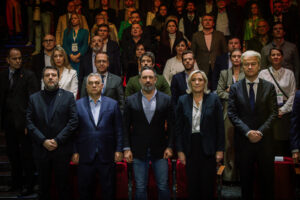
Summit of the Patriots for Europe in Madrid, 8th February 2025. Photo source: Vox España / Flickr, Public Domain.
But establishment is not the same as maturity. The movement has become electorally established, but not always institutionally or intellectually established. In many places, it still depends too much on charismatic leaders, reactive rhetoric, and protest energy. As Bannon urged Trump in 2017, national populism will need new elements as fuel if it wants to survive in the long term. Anger and fear are powerful but fast-burning fuels.
Could it follow the path of the EPP and become institutionalised and moderate?
That is both a risk and a necessity. It is a risk because institutionalisation can become domestication: parties enter the system, adopt its language, and forget why voters supported them. Another risk of institutionalisation is the rapid emergence of fringe movements to the right of the new or national conservative right, potentially competing for the same electorate in the short term. Yet it is also necessary because movements that refuse institutional maturity cannot govern well.
The challenge is to become serious without becoming harmless.
European conservatism should not abandon popular concerns, but it must translate them into policy, administration, law, and institutional reform.
The alternative is permanent protest, which is emotionally satisfying but politically sterile.
What have been the main failures of European conservatism?
First, insufficient competence in government. Too often, conservatives have been better at diagnosing problems than solving them.
Second, corruption or clientelism has damaged credibility in some cases. The right cannot speak about national renewal while tolerating oligarchic behaviour.
Third, the movement has sometimes confused sovereignty with isolation, or patriotism with ideological tribalism.
Fourth, it has often failed to build a positive social programme. It knows what it opposes, but not always what kind of country it wants to build.
Fifth, there has been a tendency to import foreign culture wars instead of grounding conservatism in each nation’s own history, institutions, and social needs.
Finally, and more importantly, the internationalisation of the conservative movement has created growing tension between ideological affinity and national interest. If patriotism is to remain a foundational principle of conservatism, it cannot coexist with the reflexive defence of foreign actors simply because they are perceived as ideological allies, even when their actions harm one’s own country’s strategic or economic interests. Too many self-described patriots now risk subordinating national interest to transnational ideological loyalties.
Fidesz and PiS have faced setbacks. What explains this?
In Poland, PiS lost power after the 2023 election because the opposition was able to mobilise a broad coalition around democratic renewal, fatigue with long-term rule, and social polarisation, among other things, because of massive influx of Ukranian refugees. PiS remained the largest single party, but it could not form a majority.

April 6, 2018, Budapest – Prime Minister Mateusz Morawiecki took part in the ceremonial unveiling of a monument commemorating the Smolensk disaster. Photo source: W. Kompała / Chancellery of the Prime Minister (KPRM) / Wikimedia Commons, Public Domain.
In Hungary, the 2026 election has marked an even deeper turning point, with Péter Magyar’s Tisza party defeating Fidesz after sixteen years of Orbán’s rule. The reasons were a major anti-incumbent shift centred on corruption, institutional fatigue, and demand for democratic restoration.
The lesson is not that conservatism is finished.
The lesson is that no movement can live forever from historical legitimacy, cultural rhetoric, or leader charisma. Delivery matters. Renewal matters. Institutions matter.
You’ve mentioned this a few times. Why should European conservatism distance itself from figures like Netanyahu and Trump?
As mentioned above, because of the tension between ideological preferences and national interest. European conservatism must be rooted in European interests, European traditions, and European prudence. It should maintain good relations with Israel and the United States, but it should not subordinate its moral or strategic judgement to foreign leaders.
Trump represents a more transactional, personalised, and often disruptive model of politics. Netanyahu represents a wartime leadership style tied to a very specific national and regional context. European conservatives should learn from others, but not become satellites of anyone.
A mature conservatism must defend national interest, constitutional order, the moral limits on the use of power, and strategic independence.
Is European conservatism influencing Latin America?
Yes, but the relationship is mutual. Latin America has long had its own conservative, Catholic, liberal-conservative, and anti-socialist traditions. What has changed is the creation of a transatlantic language: sovereignty, anti-woke politics, religious liberty, anti-communism, border control, and criticism of global governance.

President Trump Meets with President Bolsonaro. Photo source: Trump White House Archived / Shealah Craighead / Flickr, Public Domain Mark
European conservatives have helped provide institutional models, conferences, networks, and intellectual legitimacy. But Latin American movements are not mere copies. They are shaped by crime, corruption, socialism, evangelical and Catholic mobilisation, weak institutions, and the legacy of populism.
What alliances and positions should European conservatives pursue?
They should build alliances around three pillars: sovereignty with responsibility, security with legality, and identity with social cohesion.
That means defending borders but also seriously reforming asylum systems. It means defending family and demographic renewal but also offering housing, childcare, and labour policies that make family formation possible. It means criticising Brussels when necessary, but also understanding that Europe needs geopolitical weight in a dangerous world.
The future of European conservatism depends on whether it can become a governing philosophy, not just a protest movement.
It must be patriotic without being provincial, Atlanticist without being submissive, European without being federalist, and popular without being demagogic.