
 By
By The V-Dem Institute downgraded the U.S. from “liberal democracy” to “electoral democracy”, which happened due to the unlikely erosion of democratic institutions among the well-established democracies.
According to the Swedish-based institution’s democracy report, “the democracy in the USA is deteriorating at an unprecedented scale and speed.” The United States’ score on the liberal democracy index declined by 24 percent in a single year, dropping from 20th to 51st out of 179 countries. That place ranks Washington lower than any other G7 nation.
The United States received a mere 81 out of 100 on the Freedom House Freedom in the World index, ranking between South Africa and Jamaica.
This year’s study arrives at a key juncture in American electoral democracy—as we prepare for the 2026 midterm elections.
Weakening of Democratic Institutions
Another feature of the V-Dem research is that Donald Trump’s return to power in January 2025 has resulted in rapid centralization of presidential power, politicization of monitoring bodies, and restrictions on civil freedoms and dissenting voices.
The Trump 2.0 era saw the federal government reshaped to align with the president’s political vision, heavily influenced by the Heritage Foundation’s Project 2025, a conservative policy blueprint and transition plan designed to restructure the US federal government and consolidate executive power.
The Trump administration deployed the National Guard to cities across the country to quell protests against his immigration policies, increased the budget of the Department of Homeland Security and its agencies (specifically Immigration and Customs Enforcement [ICE]), and bombed numerous foreign countries without seeking congressional approval. Extrajudicial attacks on boats in the Caribbean, the implementation of restrictive press rules for the Pentagon, the deportation of international students for speaking out against the administration’s views, and the longest government shutdown in American history all occurred in less than a year and a half.
These measures are the results of a largely unchecked administration, with both chambers of Congress following the party line, resulting in a dramatic breakdown of checks and balances.
Identity Politics and Democratic Backsliding
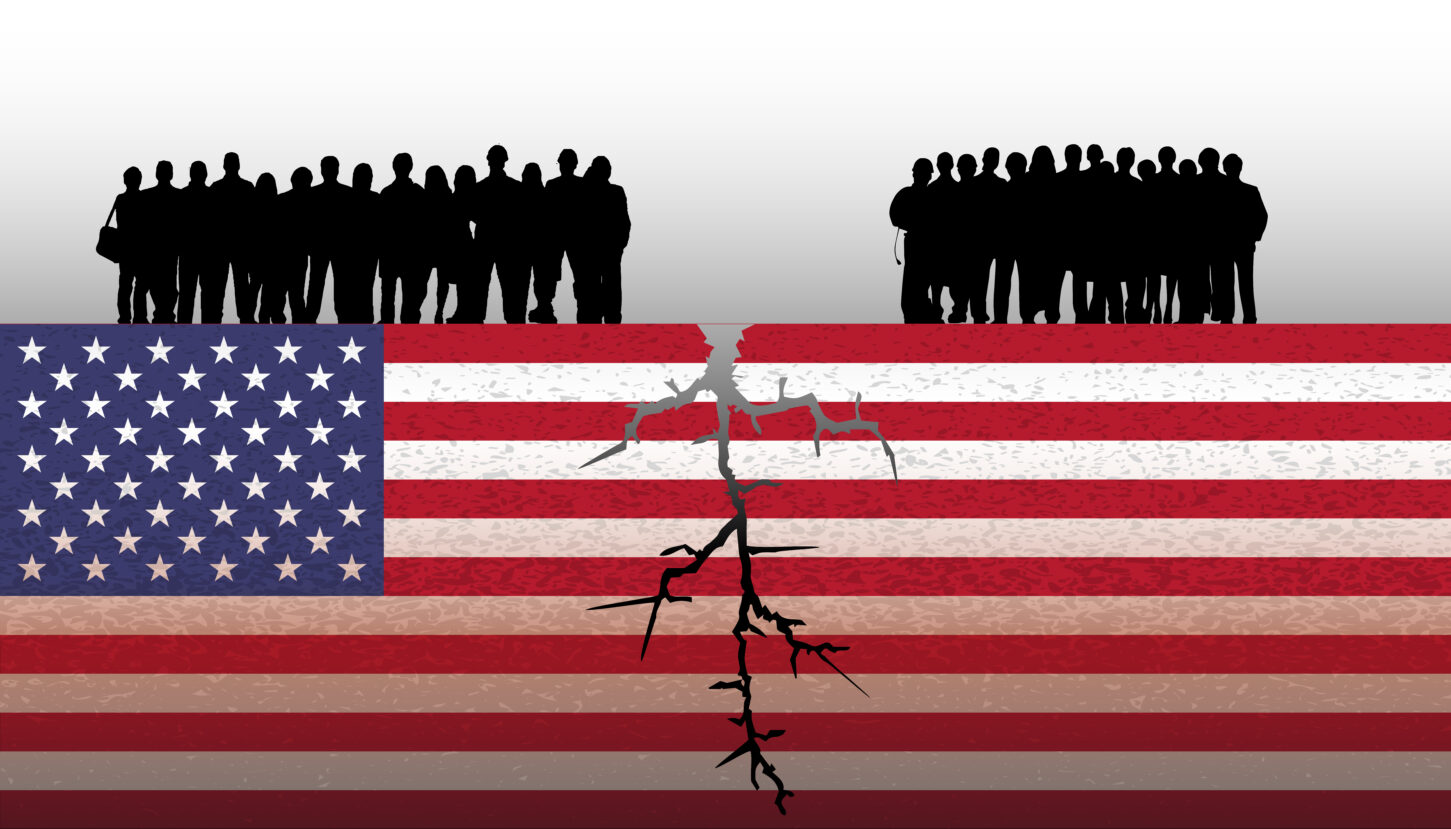
According to researchers, incumbent tactics to undermine democracy increase affective polarization by raising voters’ hostility toward nonpartisans.
It is not surprising that voters who support a party opposing the incumbent government will have a negative attitude about the incumbent’s party if that government engages in actions that undermine democracy.
In the United States, for example, this would imply that Republican voters would become more hostile to the Democratic Party if a Democratic incumbent leader sought a power grab.
The objective is to eliminate the political opponent.
The people on the opposite side of the aisle are no longer debating partners but existential threats. There is no place for compromise.
The Democratic Party, which spent decades celebrating “firsts” — the first Black president, the first Latina Supreme Court justice, the first woman elected as the Democratic presidential nominee — is now witnessing those firsts evaluated by the same ruthless, unglamorous metrics as everyone else: competence, outcomes, and accountability.
According to the liberal Washington Post, “(identity politics) at its best was a genuine attempt to correct for centuries of exclusion, to call out discrimination, to open doors, and to signal to voters that their communities had a seat at the table.”
Voters, even minority voters who Democrats believed were motivated by identification appeals, began to favor actual outcomes over symbolic ones.
A recent example is the Democratic Party’s primary for the California gubernatorial campaign. The winner, Xavier Becerra, is the son of immigrants who grew up in a California farmworker household. Becerra is a former state attorney general, Cabinet secretary, and one of the most experienced public officials in his sector. Despite his pedigree, he initially struggled to elicit equivalent enthusiasm from party insiders.
Karen Bass, Los Angeles’ first black woman mayor, is the first sitting incumbent since 2006 to face a runoff election. The cause is not her identity, but her record in dealing with homelessness, the Palisades fire, and the failure to eliminate a massive budget imbalance.
Meanwhile, the triumph of a group of young left-wing activists in various Democratic Party primaries has thrown the Democrats into another identity dilemma. Centrists claim they are radicals who will jeopardize the party’s chances of regaining control of Congress at the midterms.
These young politicians are members of the Democratic Socialists of America (DSA); they won primaries in New York, Pennsylvania, Colorado, and Michigan, often beating Democratic stalwarts. Their most recent shock success occurred in Florida, where state legislator Angie Nixon defeated a widely favored opponent in the Democratic Senate primary.
Culture War Feeds Autocratization
This tribal mentality directly accelerates the process of autocratization. Political science research consistently demonstrates a terrifying trend: in highly polarized societies, voters are willing to turn a blind eye to the violation of democratic rules, provided that the infractions are committed by “their side” to defeat the “other side.
V-Dem also warns that nearly a quarter of the world’s nations (44) are now autocratizers, echoing a precipitous rise in autocratization. As recently as ten years ago, this number was only 28, and 25 years ago, less than a dozen. According to the Swedish Institute, “if a democracy begins to autocratize, it is more likely to break down than to survive.”
Conclusion
According to Verfassungsblog’s examination of the V-Dem statistics, the United States continues to successfully maintain the key mechanics of democracy: citizens can vote, and elections are fundamentally clean. However, it lacks the institutional safeguards that protect people against the “tyranny of the majority” and executive excess. According to the research, the country’s democratic health has effectively returned to 1965 levels.
Democratic institutions can function only as long as there is a minimum level of mutual trust and a shared sense of reality amongst members of society.
In the year of the 250th anniversary of the U.S. Declaration of Independence, the question is whether America stays an electoral democracy or can one day restore its identity as a liberal democracy, allowing it to continue the fight for freedom and equality.